#Associations
“Innovation, resilience and international experience remain the great strengths of the Swiss textile machinery industry”
Interview
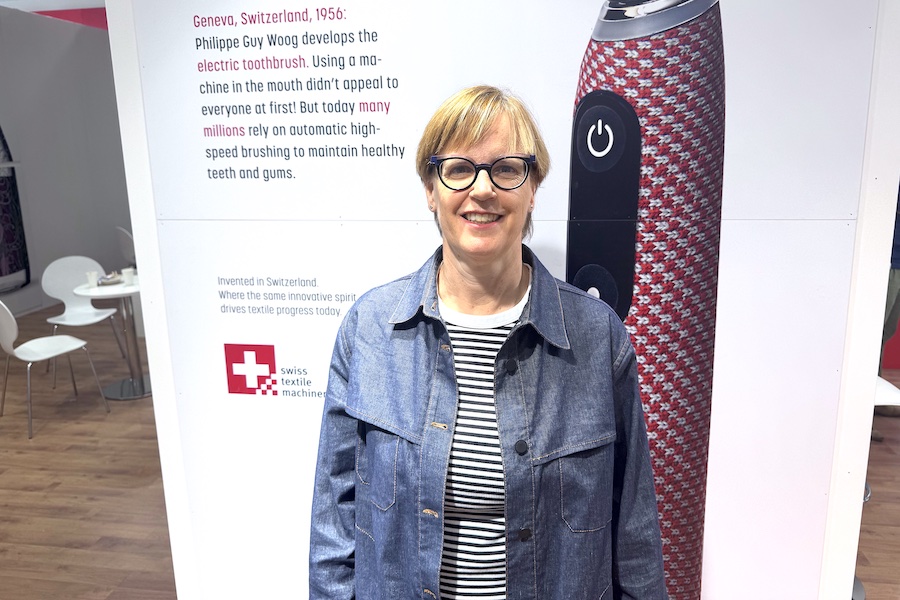
Cornelia Buchwalder
Secretary General
Swiss Textile Machinery Association / Swissmem
by Oliver Schmidt
1. Ms. Buchwalder, after several months of sabbatical, you recently returned to your role as Secretary General of Swiss Textile Machinery. Looking at the Swiss textile machinery industry with a bit of distance, how would you describe the current mood in the sector – and what developments have stood out to you most?
Naturally, my return was initially overshadowed by current geopolitical developments. I came back at the beginning of March – exactly at a time when new uncertainties were emerging and the global environment had once again changed noticeably. For an internationally oriented industry such as Swiss textile machinery, developments like these have an immediate impact on supply chains, investment decisions and overall market sentiment.
What stood out to me most among our member companies was a remarkable level of resilience and a continued positive spirit. The economic situation remains challenging, without question. Many markets are still characterised by caution, and uncertainty makes long-term planning difficult. Nevertheless, companies are continuing to move forward consistently. Projects are there, initial signs of recovery are becoming visible, and topics such as automation, digitalisation and more sustainable production processes continue to be actively advanced.
What also impresses me is the attitude of many companies. Despite all the challenges, the focus remains clearly on solutions, innovation and customer needs. Especially in times like these, that is anything but self-evident – and in my view, it is also one of the particular strengths of the Swiss textile machinery industry.
2. The global textile industry continues to operate in a challenging environment shaped by geopolitical tensions, changing trade relations and a high degree of uncertainty. How is this situation currently affecting Swiss textile machinery manufacturers?
Uncertainty is probably the greatest challenge at the moment. Many companies tell me that even a difficult situation would be easier to manage if it were at least stable and predictable over a longer period of time. That is exactly what is often missing today. Trade relations can change within a matter of weeks, new tariffs are introduced or withdrawn again, political tensions influence investment decisions – and all of this makes strategic planning extremely difficult.
Naturally, this situation directly affects customers’ willingness to invest. In many markets we still see a cautious approach, while overcapacities and weaker demand continue to weigh on parts of the industry. In Switzerland, there is the additional challenge of the strong Swiss franc, which repeatedly creates further pressure for export-oriented companies.
Despite these challenges, I currently sense a slightly more positive mood among many of our member companies. Developments are certainly coming from a low level and definitely not with any sense of euphoria, but initial signs of recovery are visible. There are more project discussions again, more concrete enquiries and, in some cases, the first positive signals in incoming orders.
3. Swiss companies have played an outstanding role in the international textile machinery industry for decades. How can this strong industrial cluster be explained – and what still distinguishes Swiss textile machinery today?
Interestingly, the origins of the Swiss textile machinery industry go back a very long way and are also linked to the international trade policies of that period.
During Napoleon’s Continental Blockade, many machines could no longer be imported from England, which at the time was regarded as the leading textile nation. Swiss textile companies therefore began developing their own machines or repairing and improving existing equipment. Over time, this led to the development of an independent mechanical engineering expertise that became firmly established in Switzerland.
Of course, this industry could also have disappeared again over time. Instead, an exceptionally strong industrial ecosystem developed over many decades. This includes not only the machinery manufacturers themselves, but also specialised suppliers, a strong academic and research landscape, and the typical Swiss engineering expertise that is also well known from other industries.
Another key factor is the strong international orientation. Switzerland never had a sufficiently large domestic market to focus only on local demand. Swiss companies therefore had to think internationally and establish global trade relationships at a very early stage. This export-oriented mindset has shaped the Swiss textile machinery industry for generations and has certainly contributed to the exceptional international experience many companies possess today.
Added to this are factors such as quality, precision, reliability and long-term thinking. At the same time, companies have repeatedly had to adapt to changing market cycles, technological shifts and global transformations over the decades. In my view, this combination of innovative strength, specialisation and international experience explains very well why Swiss textile machinery continues to hold such a strong global position today.
The full article can be read in the latest issue of textile.4U, available for free download here: