#Knitting & Hosiery
“We need to move away from the price trap and return to a value-driven mindset.”
Interview
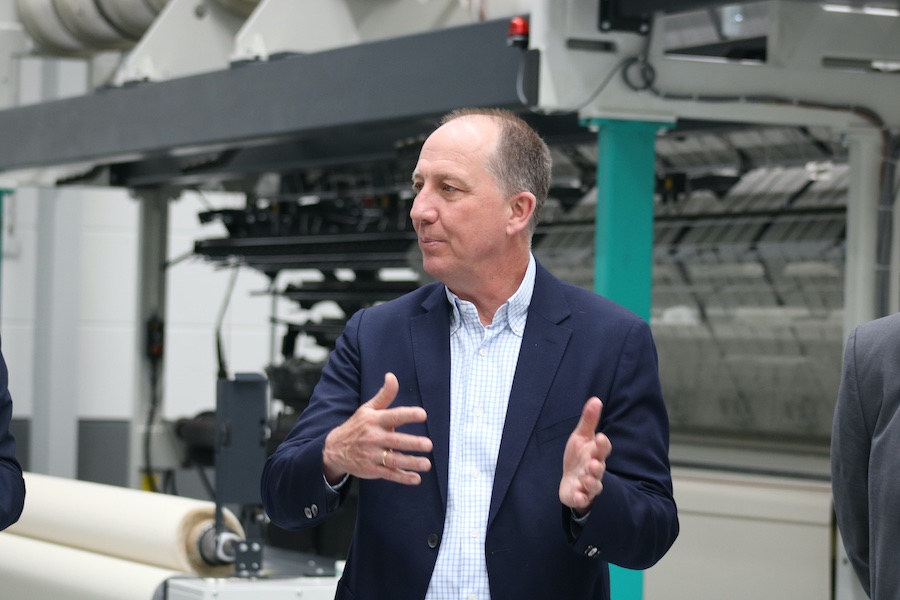
Karl Josef Mayer
Representative of the Mayer family and Member of the Supervisory Board
KARL MAYER TEXTILMASCHINEN
1. The Textile Innovation Center as a strategic platform
Mr. Mayer, the Textile Innovation Center was created on your initiative and is intended to foster creativity and new textile applications. How satisfied are you after the opening – and where do you already see concrete potential?
Overall, I am extremely satisfied. The Textile Innovation Center has essentially become exactly what I had envisioned. One particularly important moment for me was the employee day at the beginning. We first introduced all employees to the building and the opportunities it offers because it was important to demonstrate that we are investing in this location and creating long-term prospects here. The feedback was overwhelmingly positive, especially from colleagues who had already been involved in textile development before.
We have also received very positive responses from customers and visitors. Everyone who enters the building immediately recognises the potential and opportunities. The Inspiration Hub, the showroom and the machinery area have all turned out exactly as we planned. For me, however, the real work only begins now – after the grand opening. The next step is to integrate additional technologies and machine types, such as double needle bar machines or the weft insertion technology for fashion and other applications. Together with our customers, we want to develop concrete projects and create new products and markets.
I strongly believe in collaborative innovation. My motto has always been: “R&D is 1-2-3.” Ideally, you bring three partners to the table – for example the fibre producer, KARL MAYER and the customer, or alternatively the machine manufacturer, the customer and the brand. If such a team works together on strategically important textile developments, real business potential can emerge. That is why I am convinced that the Textile Innovation Center will become far more than just a new building. For me, it is the starting point of a long-term innovation initiative designed to generate sustainable ideas, applications and business opportunities.
2. New applications, staple fibres and textile innovation
At the Textile Innovation Center, you are focusing strongly on new textile applications – from staple fibres to fashion and footwear. Where do you currently see the most exciting development areas for warp knitting technology?
One key topic for us is clearly the processing of staple fibres. We see this as one of the most important strategic development areas for the future. Today, only a limited number of warp knitters process cotton on warp knitting machines because the process is still technologically very demanding. In many cases, specially prepared, high-quality cotton fibres are required, which makes the process expensive.
Our goal is therefore to make this processing significantly easier and more economical. We need to reduce the technological barriers and further develop the machines so that staple fibres can also be processed efficiently in medium-price market segments. If we succeed, KARL MAYER will create an entirely new technological platform.
Particularly with regard to sustainability and recycling, we see considerable potential here. The ability to process a wide range of fibre types – including recycled materials– will become increasingly important for the textile industry.
Another exciting field is our weft insertion technology. Today, it is used primarily in technical textiles. At the same time, we see significant opportunities to transfer this technology into new application areas such as fashion & apparel, footwear and other functional textile products.
This is exactly where we see a major opportunity: transferring technologies originally developed for technical textiles into entirely new markets and enabling completely new textile solutions. Many of these opportunities have hardly been explored so far.
3. Transformation of the textile industry
The textile industry is currently under enormous pressure to transform – from sustainability and recycling to global competitive pressure. Where do you see the greatest challenges for the industry today?
One of the biggest challenges, in my view, is the enormous global volume of textiles and the question of how we can deal with it more responsibly in the future. Today, textiles are produced, consumed and discarded in huge quantities. As an industry, we urgently need to find ways to return textiles into circular systems – in other words, to take materials back, recycle them and reuse them.
At the same time, we must restore a stronger appreciation for the value of textiles. The vision of KARL MAYER is not “We believe in the value of textiles” by accident. When textiles increasingly become disposable products, quality, innovation and ultimately the entire value chain lose importance. I therefore believe that politics, industry and associations must work together to reduce this fast-fashion and throwaway mentality. Higher-quality textiles that are used longer not only reduce waste, but also create greater value throughout the industry.
The greatest opportunity, in my opinion, lies above all in technology. The key questions are how fibres can be recycled, how recycled materials can be processed efficiently on machinery, and how functioning textile circular systems can be organised logistically. This, for me, is the real transformation process for the textile industry: combining high-quality textile products with new technologies, recycling solutions and a stronger focus on value creation.
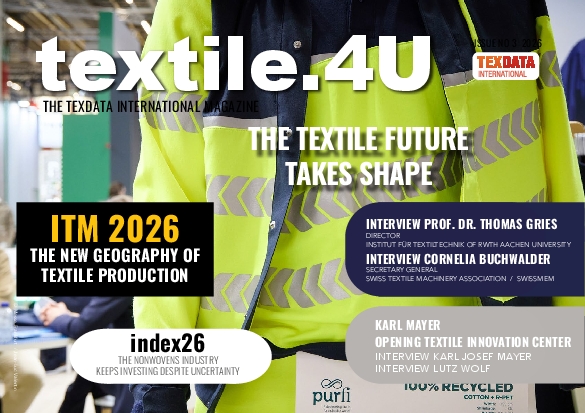
The full article can be read in the latest issue of textile.4U, available for free download here: