[pageLogInLogOut]

#Technical Textiles

“ We have multiple companies and divisions operating in textiles, and we decided to integrate them into one platform. ”
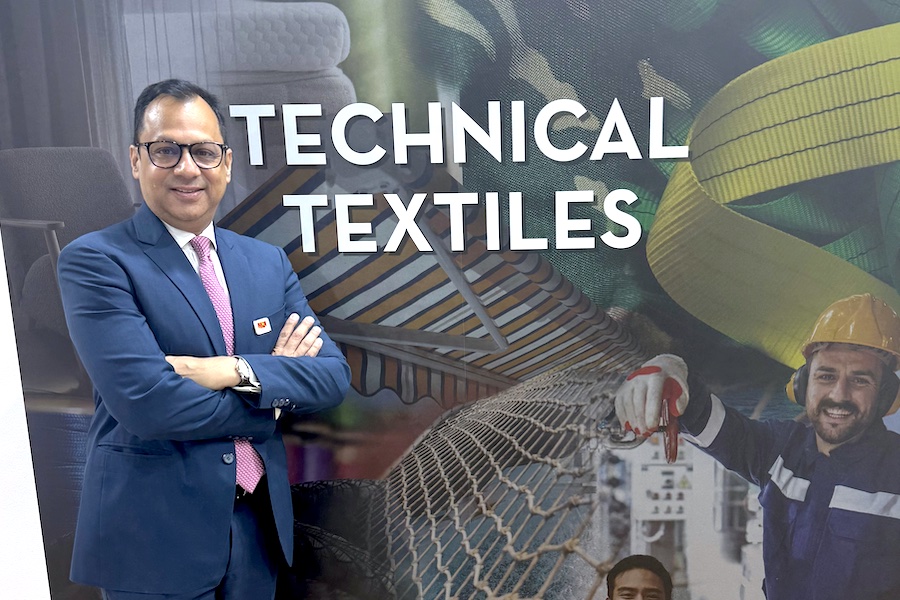
Kapil Agrawal © 2026 TexData International
At Techtextil 2026, the Aditya Birla Group presented its textile activities as a unified platform for the first time. In this interview, Kapil Agrawal, Business Head Textiles, Acrylic Fibres & Overseas Spinning, explains how the group is expanding from traditional textile products towards integrated technical textile solutions, circularity and higher-value applications – and outlines the role India could play in scaling fibre-to-fibre recycling in the years ahead.

Interview

Kapil Agrawal

Business Head Textiles, Acrylic Fibres & Overseas Spinning

ADITYA BIRLA GROUP

by Oliver Schmidt


Mr Agrawal, the Aditya Birla Group is presenting its full technical textiles portfolio at Techtextil for the first time. This reflects your transformation from a traditional textile player into a solutions-driven, sustainability-led partner for high-performance and safety-critical applications. How do you define this transformation in concrete terms – and what is your expected timeline?

First of all, let me briefly introduce the Aditya Birla Group. We operate in 41 countries, with a turnover of about USD 67 billion and a market capitalisation of around USD 112 billion. We are active in more than 20 sectors, from cement and paints to fashion, telecom and aluminum, with around 227,500 employees across locations.Textiles have been a foundation of our group since around 1947. Today, our textile business represents around USD 5 billion. The idea of bringing our textile activities together emerged about two years ago. 

We have multiple companies and divisions operating in textiles, and we decided to integrate them into one platform. What you see today is the result of that process.In addition to our strength in commodities, our focus is also moving towards growing in specialty and technical textiles. Beyond the product itself, customers look for confidence and trust in a partner, and this is something the Aditya Birla Group stands for. We work closely with our value chain partners to develop solutions together.

A second key element is research and development. We have three world-class facilities in India and invest significantly in new products. For example, we are active in circularity, with fibres developed in Thailand on an acrylic basis, known as ReGen, and further developments in India. The third element is our financial strength, which allows us to invest and scale our business.


Are there already products on the booth that clearly reflect this shift from a textile company to an integrated group?

We have always been active in textiles through different entities. What we are presenting now is a one-stop platform for our customers. It covers applications in protective apparel, automotive applications, tyre cord, home textiles and other segments. When you walk through the booth, you see solutions across several technical textile areas where we are already present.


Within technical textiles, where do you currently see the biggest shifts towards higher value creation – at the material level, in applications, or in integrated solutions?

In my view, the main shift is in integrated solutions. It is about understanding the challenges of the industry and the end users, and then working backwards to provide solutions. That is where the major value addition happens.


Can you share a concrete example where you have already moved into a higher value segment?

We have recently developed FR products, which represent a move up in the value chain. We are also a major spinning company in Germany, Europe along with working with leading fibre suppliers globally.


The full interview can be read in the latest issue of textile.4U, available for free download here:
More News from TEXDATA International

#ITM 2026

ITM 2026: The new geography of textile production

New production hubs are emerging across North Africa and Central Asia, while Türkiye is accelerating its transformation toward higher-value, technology-driven and more sustainable textile manufacturing.

#Research & Development

“Production is a product”

From technical textiles and AI-driven robotics to the limitations of textile circularity: Professor Dr Thomas Gries looks back on more than two decades of development at ITA Aachen. In the interview, he explains why production technology remains a decisive success factor, discusses international collaborations and innovation ecosystems, and shares his views on the transformation of production landscapes and the challenges facing an increasingly regulated industry.

#Knitting & Hosiery

“We need to move away from the price trap and return to a value-driven mindset.”

With its new Textile Innovation Center, KARL MAYER is sending a strong signal for innovation, collaboration, and the future of textile applications. In this interview, Karl Josef Mayer discusses new opportunities in warp knitting, the processing of staple fibres, recycling, the changing role of machinery manufacturers, and why the textile industry must once again focus more strongly on the value of textiles. by Oliver Schmidt

#Associations

“Innovation, resilience and international experience remain the great strengths of the Swiss textile machinery industry”

Geopolitical uncertainty, growing competitive pressure from China, new free trade agreements and the shift towards a circular economy are currently reshaping the global textile industry. In this interview, Cornelia Buchwalder discusses the current mood within the Swiss textile machinery sector, the industry’s distinctive innovative strength, new market opportunities in India and Asia, and the technological trends that could shape the upcoming trade fair cycle leading up to ITMA 2027.

More News on Technical Textiles

#Knitting & Hosiery

KARL MAYER launches extra-wide HKS 3-M EL for increased productivity

KARL MAYER has launched a new extra-wide version of its HKS 3-M EL tricot machine, designed to increase productivity particularly in the manufacture of textiles for sports, activewear and athleisure applications.

#Research & Development

Reducing development times for technical textiles by accelerated thermo-oxidative aging in a high-pressure autoclave

Synthetic polymers used in technical textiles can be effectively protected against degradation caused by heat, oxygen, and water through the use of stabilizer systems. This enables service lives of several decades, extending to more than 50 years. As the use of durable technical textiles continues to grow, so does the demand for reliable methods to predict their service life within economically feasible testing periods. For the first time the German Institutes of Textile and Fiber Research Denkendorf (DITF) developed methods for robust service life prediction for textiles in an IGF research project.

#ITMA Asia + CITME 2026

Three stages, multiple customer benefits: KARL MAYER during ITMA ASIA 2026

At ITMA ASIA in Shanghai, KARL MAYER will once again demonstrate that it understands the challenges facing the Asian textile industry – and will present tailor-made solutions.

#Technical Textiles

RDJ 6/2 in E 32: Finesse in Motion

The appearance of sports and casual shoes is as diverse as their applications, ranging from sporty to stylish and from functional to fashionably practical. In particular, spacer fabrics produced on highly flexible KARL MAYER double needle bar raschel machines with Jacquard technology are in high demand for manufacturing these trendy shoes. These efficient production machines enable attractive designs with integrated multifunctional zones on one or both fabric surfaces, such as breathable mesh structures. Flexible in size and positioning, these features enhance both aesthetics and wearing comfort.

Latest News

TOP