[pageLogInLogOut]

#Recycling / Circular Economy

Solving the Feedstock Gap: Unlocking Post-consumer Feedstocks for Textile-to-Textile Recycling in Europe
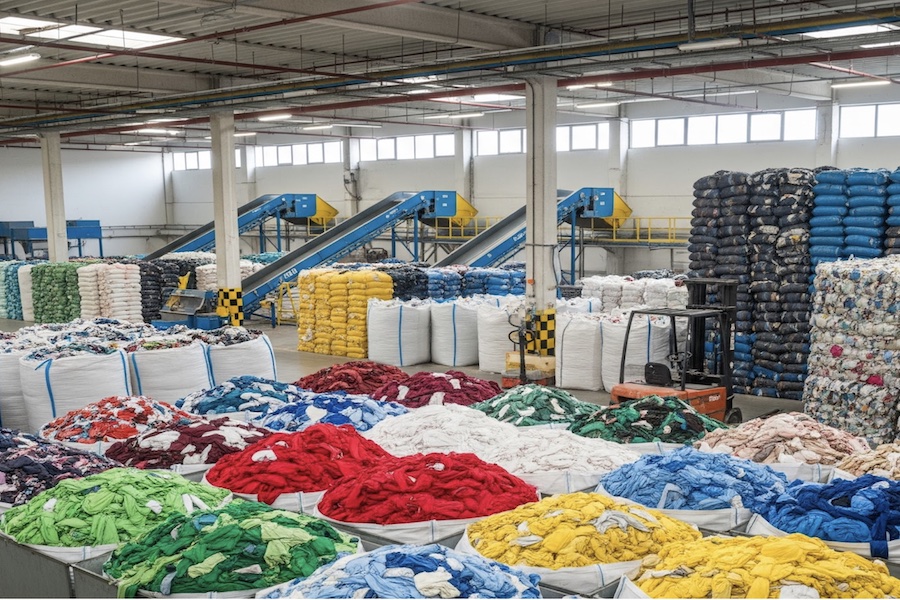
Fashion for Good launches Project FAE (Feedstock Activation Europe) to develop the sorting and pre-processing infrastructure needed to channel non-rewearable post-consumer textiles into textile-to-textile (T2T) recycling at scale. The project is a practical response to one of the most pressing problems in textile circularity: making post-consumer waste a viable, commercially competitive raw material for recyclers.

THE CHALLENGE: A TECHNICAL AND ECONOMIC GAP

When post-consumer textiles are collected, they are first sorted for rewearability and directed to resale markets. What remains (the “non-rewearables”) has few viable

destinations today: only a small fraction enters T2T recycling(1). The majority is downcycled, landfilled, or incinerated. Secondhand export markets, which have historically absorbed significant volumes, are contracting: declining material quality is limiting resellability, while trade restrictions are tightening further. Besides, weak demand in destination countries is leading to excess stock accumulation and, without sufficient recycling or reuse infrastructure to handle it, most of it often ends up landfilled.

New recycling capacities coming online across Europe could change this, offering a route to valorise a much larger share of non-rewearable textiles. However, that opportunity will only be realised if the upstream feedstock infrastructure is in place to supply them at acceptable cost and quality, which today, is not the case.

The core challenge is feedstock infrastructure (the sorting, pre-processing, and supply systems that sit upstream of recycling) has not yet proven sufficient to meet recycling needs. Post-consumer textiles are heterogeneous and costly to process, and recyclers have stringent specifications of what they can take in, often having different material specifications between different technologies. Sorters see large sections of waste unsellable to recyclers, along with high collection and processing costs for recyclable fractions, while recyclers require competitively priced feedstock. Neither side can close the gap alone: for many sorters preparing material at the price, quantity and quality recyclers need remains challenging, while some recyclers can’t absorb the cost of doing it themselves. That’s why most continue to rely on post-industrial waste, which is often cleaner, more consistent, and easier to process.

The integration of post-consumer feedstock into T2T recycling, however, is a matter of when, not if: demand for recycled fibres is growing, and regulatory pressure is increasing. EU Extended Producer Responsibility legislation will require brands to take financial responsibility for their products at end of life, making functional recycling pathways a commercial necessity.

"We have been talking about textile circularity for years, and the honest truth is that the technology is no longer the bottleneck. What is holding us back is much more unglamorous: the sorting lines, the pre-processing steps, the supply systems that need to exist before a single fibre can be recycled. Project FAE is our attempt to tackle that unglamorous, necessary work head-on - together with the brands, sorters and recyclers who know this problem better than anyone. If we get this right, we unlock something the industry has been trying to reach for a long time." Katrin Ley Managing Director at Fashion for Good

Addressing these challenges requires coordinated action across the full value chain: from the brands that put garments into the world, to the sorters that handle them at end of use, to the recyclers that need consistent, quality input material. The Feedstock Activation Europe (FAE) project, an initiative from Fashion for Good, includes brand partners adidas (the lead sponsor), BESTSELLER, and INDITEX. Strategic partner Rehubs is involved, with Rematters offering on-ground assistance.

THE APPROACH: FROM TECHNICAL ASSESSMENT TO COMMERCIAL FRAMEWORK

The project draws on advisory expertise from across the value chain: including sorters such as Boer Group, Circle-8 Textile Ecosystems, Erdotex, Formació i Treball, Humana People to People, Kringwinkel Antwerpen, New Retex, Nouvelles Fibres Textiles, Plaxtil-Essaimons, Sympany, Texaid, and Texlimca; as well as recyclers spread across mechanical, thermomechanical and chemical technologies such as Circ, Circulose, CuRe Technology, eeden, Infinited Fiber Company, Kipas (fibR-e), Matterr, Meltem Kimya, Recover, Reju, OnceMore from Södra, and WornAgain. The project is also supported by ecosystem partners including InvestNL, Landbell Group, Refashion, Reverse Resources, TEXroad, Wargon Innovation, WRAP,ZDHC and Global Fashion Agenda.

“Circularity will not be achieved through product innovation alone. The bigger and more urgent work is building the infrastructure that does not yet exist at the scale we need: sorting, pre-processing, and supply systems that enable post-consumer textile waste to move toward closed-loop recycling. This is not a challenge any single organisation can solve. Project FAE brings together the brands, sorters, and recyclers willing to work together to realize this pathway in the EU, and we are proud to be part of that work” Gudrun Messias; Director, Sustainability Direction at adidas AG

The project works across two parallel tracks:

The first aims to solve feedstock preparation for recycling to unlock the valorisation potential of post-consumer waste, via advanced pre-processes, including fibre blend separation, elastane removal, and contaminant extraction. Project FAE will assess the technological and commercial feasibility of these advanced pre-processing technologies, identifying what is ready to deploy and what still needs development.

The second focuses on infrastructure. Project FAE will develop a framework for regional hubs for large-scale sorting and pre-processing hubs across Europe - facilities that aggregate post-consumer textile volumes, apply automated sorting and mechanical pre-processing, and produce feedstock streams tailored to the specifications of different recyclers. By building at scale and leveraging centralised and automated sorting and pre-processing technologies, the hub model addresses one of the core business model challenges facing sorters today: the cost and complexity of preparing feedstock at the quality and volume recyclers require. At scale, and leveraging automation, it aims to reduce per-unit processing costs, improve feedstock quality, and create a more viable business case for both sorters and recyclers.

Together, the two are intended to produce not just technical findings, but a practical and commercial framework the wider industry can act on, with the ambition to support real implementation in the coming years, as part of broader efforts to build a viable post-consumer waste value chain in Europe.

Read more about the project here.

https://www.fashionforgood.com/case-study/feedstock-activation-europe/

(1) European Environment Agency. (2023). Europe’s used textiles are an increasing waste and export problem. Available at this link:

https://www.eea.europa.eu/en/newsroom/news/europes-used-textiles-are-an


More News from Fashion for Good

#Raw Materials

Fashion for Good mobilises industry to adopt mass balance attribution and accelerate decarbonisation

Fashion for Good launches today the Mass Balance Demonstrator project, a collaborative industry initiative to implement and scale the mass balance attribution (MBA) chain-of-custody model for biomass-attributed PET in textile applications. The project represents a concrete step toward accelerating brand-driven decarbonisation across the apparel value chain.

#Recycled Fibers

Advancing the future of stretch: Fashion for Good launches new project to validate bio-based and recycled elastane

Launched today, Stretching Circularity is a collaborative project initiated by Fashion for Good dedicated to accelerating the adoption of lower-impact elastane alternatives that are compatible with circular textile systems. By validating bio-based and recycled elastane solutions through pilot-scale testing and demonstrator garments, the initiative aims to remove one of the most significant technical barriers to a circular textile economy.

#Recycling / Circular Economy

Fashion for Good releases open-source blueprint for near-net-zero textile manufacturing

Fashion for Good launches the first open-source blueprint for near-net-zero textile manufacturing, tackling one of fashion’s biggest emissions hotspots. Developed under the Future Forward Factory project, the blueprint offers Tier 2 manufacturers in India five practical, financially viable pathways to reduce carbon emissions by up to 93%.

#New Materials

From premiums to parity: How Fashion for Good is rewriting the economics of new materials

Fashion for Good launches Price Parity Toolkit: developed with support from Laudes Foundation, Canopy and Finance Earth, the framework introduces an innovative financing approach (premium decoupling) to remove price premiums from the supply chain and unlock faster adoption of lower-impact materials across the industry.

More News on Recycling / Circular Economy

#Techtextil 2026

BASF at Techtextil 2026: Helping to shape the future of the textile industry with tangible solutions

At the leading international trade fair for technical textiles and nonwovens from April 21 to 24, 2026 at the Messe Frankfurt, BASF will present numerous solutions and new projects in the textile sector to customers and partners at booth B 68 in hall 11.0. The focus is on product innovations and future-oriented technologies.

#Recycled Fibers

RE&UP partners with Madewell and ISKO on textile-to-textile denim capsule

RE&UP Recycling Technologies is accelerating the shift toward a closed-loop textile economy through a collaboration with American denim brand Madewell and global fabric manufacturer ISKO. By transforming approximately 20,000 pairs of post-consumer jeans into recycled feedstock for a textile-to-textile denim capsule, RE&UP demonstrates the commercial viability of circular systems in the denim sector.

#Recycled Fibers

Syre and JEPLAN Announce Strategic Partnership to Accelerate Textile-to-Textile Recycling

JEPLAN, INC. the Japanese pioneer developing and operating chemical recycling technologies for circularity in packaging and textiles, and Syre, the textile impact company on a mission to hyperscale textile-to-textile recycling, announced today a strategic partnership. Together, the companies aim to extensively accelerate the timeline towards commercialization of next generation textile-to-textile polyester recycling technology.

#Recycling / Circular Economy

Reju secures €135 Million in Dutch NIKI Funding for industrial-scale textile-to-textile regeneration hub at Chemelot Industrial Park, the Netherlands

Reju™, the progressive textile-to-textile regeneration company, has been awarded €135 million in funding under the Netherlands’ Nationale Investeringsregeling Klimaatprojecten Industrie (NIKI) program. The funding will support Reju’s planned industrial-scale Regeneration Hub at Chemelot Industrial Park in Sittard-Geleen, covering both the investment phase and ongoing operations, and represents a critical milestone on the path toward final investment decision.

Latest News

#Techtextil 2026

SAHM Winding Solutions and Vandewiele Automation present integrated automation solution for winding processes

For the first time at the Techtextil trade fair in Frankfurt am Main, Germany (21 - 26 April), SAHM Winding Solutions (Hallo 12.0. / Booth 95) and Vandewiele Automation will be showcasing their combined automation expertise for industrial winding processes. Under the motto “Combining Automation. Maximizing Flow”, the two companies will demonstrate how automated package handling and robot-assisted yarn knotting can be integrated into a continuous production flow.

#Recycled Fibers

UNIFI celebrates recycled and circular Innovation with ninth annual REPREVE® Champions of Sustainability Awards

Unifi, Inc. (NYSE: UFI), the makers of REPREVE® and one of the world’s leading innovators in recycled and synthetic yarns, today announced the winners of its ninth annual REPREVE Champions of Sustainability Awards, recognizing brands and mills that are advancing circularity and responsible manufacturing across the global textile industry.

#Man-Made Fibers

Lenzing commissions 14 MW power‑to‑heat facility, strengthening grid stability and heat management

The Lenzing Group has successfully commissioned a new power‑to‑heat (P2H) facility with an electrical capacity of 14 megawatts. The installation converts renewable electricity directly into process heat, is fully integrated into the existing heat network at the industrial site, and represents a key building block for a fossil‑free heat supply. As project partner, VERBUND was responsible for the energy‑market integration and will operate the facility for balancing energy marketing, enabling it to respond flexibly to short‑term fluctuations in the power grid.

#Raw Materials

Kraig Biocraft reaches next step in production growth

Kraig Biocraft Laboratories, Inc. (OTCQB: KBLB) (“the Company”, “Kraig Labs”, or “Kraig’s”), a world leader in spider silk technology*, today announced that it has produced more than 1.3 metric tons of recombinant spider silk cocoons in a single month. This is a new world record and shatters the Company’s previous production record by a factor of five. Today marks a pivotal step forward in the transition of spider silk from laboratory innovation to an industrial-scale material platform.

TOP