[pageLogInLogOut]

#Natural Fibers

2026 ICAC report projects World cotton trade to reach 10.3 million tonnes by 2028/29

The International Cotton Advisory Committee has released the 2026 World Cotton Trade Report, which provides analysis of global cotton trade patterns, key trading relationships, import and export trends, and the geopolitical and policy developments shaping cotton trade flows.


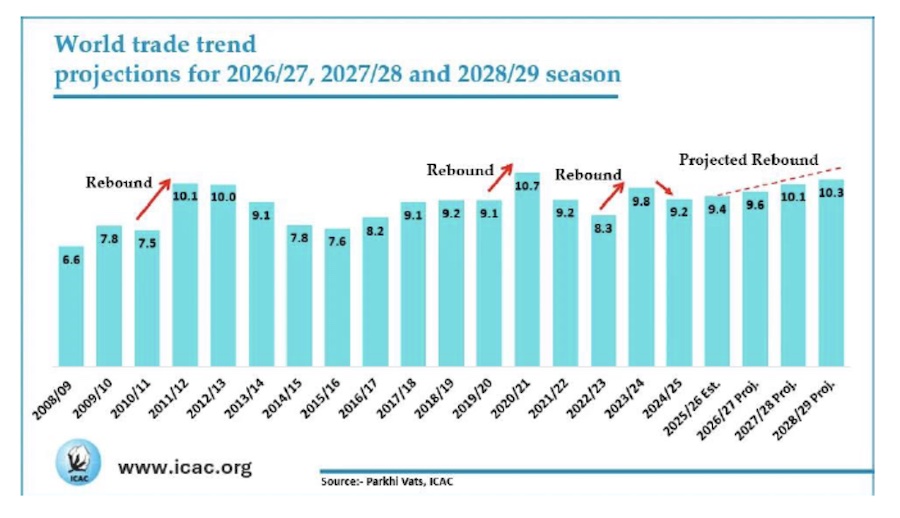
According to the publication — which is available free through the end of 2026 — global cotton trade is expected to remain on a positive trajectory over the medium term despite increasing supply-side pressures. Trade in the 2025/26 season is estimated at 9.4 million tonnes, representing a 2% increase over the previous season. It is projected to rise further to 9.6 million tonnes before reaching approximately 10.3 million tonnes by the end of the 2028/29 season.

The report identifies the increasingly tight balance between global production and consumption as a primary driver of future trade growth. In the 2026/27 season, global cotton production is projected to decline by 2% to 25.8 million tonnes, while consumption is expected to remain relatively robust at 25.5 million tonnes.

As the gap between production and consumption narrows, global markets are expected to become increasingly dependent on inventories held by major exporting countries. Any additional increase in demand would require exporters to draw down ending stocks, increasing the volume of cotton moving through international trade channels.

Demand developments in China, the world’s largest cotton-consuming country, will be particularly important in determining future trade patterns. Sustained growth in China’s textile manufacturing and consumer demand could push global consumption beyond current projections, increasing imports and providing additional support for international cotton trade.
© 2026 ICAC
© 2026 ICAC


Among the major trends addressed in the report:

  • Global cotton trade is estimated at 9.4 million tonnes in 2025/26 and projected to reach 10.3 million tonnes by 2028/29.
  • Brazil remained the world’s largest cotton lint exporter in 2025/26, supported by record production, competitive pricing, expanded market access, and reduced availability of U.S. cotton in international markets.
  • U.S. exports declined in 2025/26 but are projected to increase by 3% in 2026/27, supported by higher ending stocks.
  • China’s imports are expected to recover strongly in 2025/26 after falling sharply in the previous season.
  • Bangladesh remains one of the world’s leading cotton importers, although consumption and imports have been affected by economic disruption, energy constraints, and logistical challenges.
  • Vietnam continues to expand its role as a major cotton importer, supported by its growing textile and apparel sector and strengthening trade relationships.
  • India’s cotton import and consumption patterns are being shaped by policy changes, tariff measures, and expanding domestic textile demand.

“Global cotton trade is entering a period in which supply constraints, inventory levels, policy decisions, and consumption trends will play an increasingly important role,” said Parkhi Vats, ICAC Principal Statistician and Data Architect and author of the World Cotton Trade Report. “While production challenges and geopolitical uncertainty remain significant, the medium-term outlook points to continued growth in trade as markets respond to stable consumption and shifting sourcing relationships.”

The report also highlights how tariffs, trade agreements, logistical bottlenecks, energy costs, and changing supplier relationships are adding uncertainty to cotton value chains and purchasing decisions. Disruptions affecting shipments through the Strait of Hormuz are identified as one particularly important logistical concern.

The 2026 World Cotton Trade Report is available free of charge until January 2027 on the ICAC website here:
World Cotton Trade Report 


More News from International Cotton Advisory Committee (ICAC)

#Natural Fibers

"Review" examines the outlooks for seven major cotton producers

The newest issue of Cotton: Review of the World Situation provides an in-depth look at how seven important cotton-producing countries are responding to changing markets, rising production costs, climate pressures, evolving technologies, and growing demands for quality and sustainability.

#Natural Fibers

Global cotton trade poised for recovery as India and China drive import demand

The July 2026 issue of Cotton This Month highlights a changing global cotton market, with consumption and trade expected to strengthen despite a modest decline in production during the 2026/27 season. The next issue of Cotton This Month will be released on August 1, 2026.

#Natural Fibers

Organic cotton at the crossroads: Ideology, evidence, and the road ahead

Organic cotton occupies one of the most contentious spaces in global agriculture. While praised by brands and consumers for its environmental ideals, it also faces persistent questions about yield stability, certification integrity, and scalability. The current edition of The ICAC Recorder cuts through the ideology to deliver a rigorous, evidence-based assessment of both sides of the debate.

#Raw Materials

CSITC adds ABRAPA as a round trial sample provider

Beginning with the Q2 2026 Round Trials, the ICAC's Committee on the Commercial Standardization of Instrument Testing of Cotton has expanded its sample provision framework by adding the Brazilian Cotton Growers Association (ABRAPA) as an official sample provider.

More News on Natural Fibers

#Natural Fibers

The Woolmark Company showcases Australia's commitment to India's textile industry at Bharat Tex 2026

Reinforcing more than five decades of commitment to India's wool textile and apparel industry, The Woolmark Company, alongside Austrade and the Australian High Commission, marked a strong presence at Bharat Tex 2026, one of the world's largest textile and apparel trade platforms. Through industry engagement, strategic collaborations, technical innovation and knowledge exchange, the participation underscored Australia's continued commitment to supporting the growth and transformation of India's textile ecosystem while highlighting the versatility and value of Australian Merino wool.

#Spinning

Rieter sees Barmag integration on track as orders and sales rise

The first half of 2026 was shaped by the successful completion of the largest acquisition in Rieter’s history. The Man-Made Fiber Division enables entry into the growth segment of man-made fibers and sustainably strengthens Rieter’s market position in the Asia region. The expanded Group is now the world’s leading system supplier for the processing of natural and man-made fibers. In the first half of the year, initial cost savings in material costs and operating expenses have already been realized. The targeted synergies are expected to amount to at least CHF 20 million by the end of the 2028 financial year. Due to the completion of the acquisition on February 2, 2026, the first half of the year for the Man-Made Fiber Division only amounts to five months.

#Natural Fibers

Better Cotton Initiative multistakeholder event in US unpacks regenerative agriculture potential

The Better Cotton Initiative (BCI), in collaboration with Texas-based partner, Quarterway Cotton Growers, will expand upon its annual US field event to relay the vast potential of regenerative agriculture through an immersive experience of tours and demonstrations.

#Sustainability

The first widely accessible Life Cycle Assessment study for cashmere production published by Textile Exchange.

Crucial new data to better understand, measure, and address the impacts of cashmere production has been made available to the fashion, textile, and apparel industry through a new Life Cycle Assessment (LCA) published by Textile Exchange.

Latest News

#Associations

IVGT membership: expertise that pays off

For energy-intensive textile companies, government compensation mechanisms are an important economic factor. The IVGT successfully supports its member companies in applying for state aid and thereby regularly contributes to significant financial relief.

#Research & Development

Networking Day 2026: Industry stakeholders unite around textile recycling

In 2026, the Industry Research Group (IRG) Polymer Recycling once again brought together some of the key stakeholders in textile recycling for its annual Networking Day. This year, the event took place at EREMA’s premises in Ansfelden, Austria. It brought together key players from across the textile recycling value chain for a day of structured exchange and in-depth discussions.

#Knitting & Hosiery

The new RDJ 7/3 defines the design footprint of modern athletic shoes

Stylish, functional, and efficient to produce – spacer fabrics are the all-arounders among textile materials. These versatile fabrics are particularly in demand in the sports and casual footwear sector, as they combine comfort, breathability, and design freedom. At the same time, this industry is trend-driven, dynamic, and price-sensitive like few others. Innovations are therefore a decisive factor for success. With the RDJ 7/3, KARL MAYER offers a solution specifically tailored to these requirements. The particular strength of the new double raschel machine: its exceptional flexibility, thanks to its three jacquard bars.

#Research & Development

Smart textiles reversibly change shape in an energy-efficient manner in response to ambient temperature

Self-actuating textile structures are used in a wide range of applications, such as medical technology, automation, architecture, agriculture, and the apparel industry. An example is the use of shading nets in greenhouses, which can be deployed and retracted depending on the sunlight intensity. The German Institutes of Textile and Fiber Research Denkendorf (DITF) are developing textiles based on shape-memory polymers with reversibly controllable geometry.

TOP