[pageLogInLogOut]

#Dyeing, Drying, Finishing

Expanding options at JPF with Monforts dual heating
Energy efficiency has become critical to the continued competitiveness of Portugal’s textile manufacturing industry and all avenues for resource savings are being explored by the country’s leading textile manufacturers.
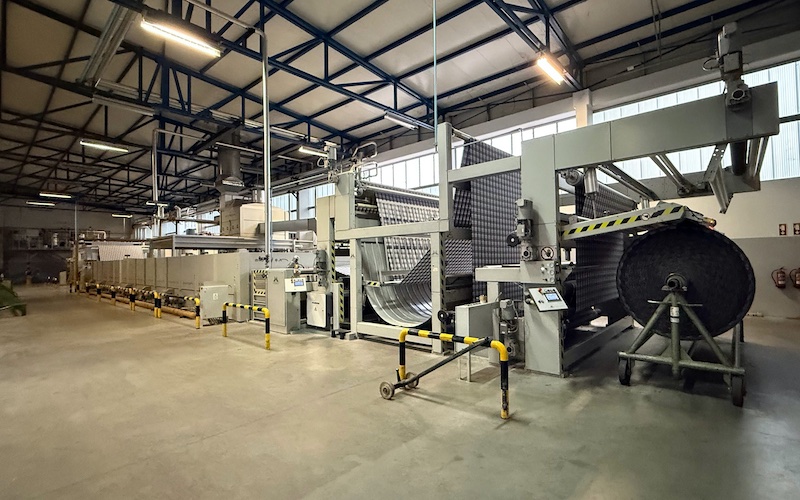
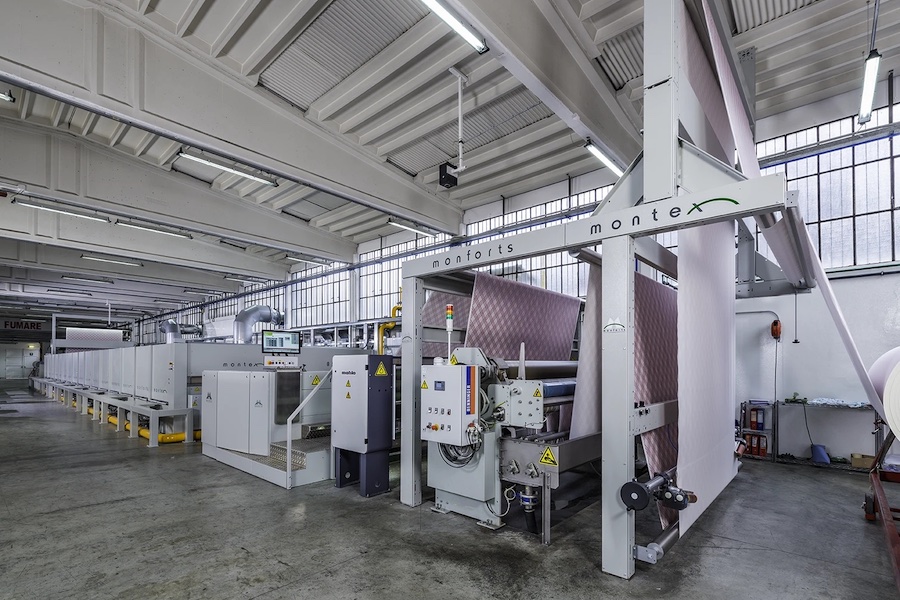
Monforts has retrofitted a dual heating unit to the most recent Montex stenter at JPF, to fully benefit from the option of operating with either steam or gas © 2025 Monforts


At the forefront of such advances is J Pereira Fernandes (JPF), which has recently expanded its fabric finishing plant with a purpose-built biomass-fuelled boiler room, enabling it to carry out CO2 neutral production via steam heating.

UNESCO World Heritage Site

JPF is located in Guimarães in northern Portugal, which has been listed as a UNESCO World Heritage Site since 2001, ensuring the company must operate to the most stringent environmental standards in terms of all emissions.

Vertically-integrated operations at the Guimarães site span spinning, yarn dyeing, weaving, fabric dyeing and finishing and cutting and sewing, with an annual finished fabric capacity of 5.5 million metres, primarily of 100% cotton goods for the home textiles market.

As a long-standing Monforts customer, a first Montex stenter with a working width of 3.2 metres was installed at the Guimarães site in 1987, followed by a second seven-chamber model with a working width of 3.4 metres in 2020. The company also operates a Monforts sanforizing line.

Steam or gas

With the new biomass boiler in place, Monforts has now retrofitted a dual heating unit to the most recent stenter to fully benefit from the option of operating with either steam or gas.

“We have been retrofitting dual heating units to operational Montex stenters for over a decade now and this is the third unit we have installed in Portugal recently,” says Monforts Area Sales Manager Thomas Päffgen. “It enables biomass-powered steam heating to be employed when processing at up to 160°C, with gas heating required for higher temperatures. In addition to the existing direct gas heating, the stenter frame chambers were each extended by a steam heat exchanger and vents for vapour pressure control.

Competitive advantages

“Energy costs have been seriously compromising our competitiveness with manufacturers in Asian countries and we have taken a wide range of measures to minimise consumption,” adds JPF managing director Sandra Fernandes. “We have made further adjustments to reduce energy on our yarn dyeing machines and other equipment, as well as switching to the most highly efficient motors and pumps across our machine ranges.

“In addition we have inverters everywhere and use economizers and heat exchangers wherever possible, as well as strongly controlling compressed air and steam leakage.”

All facilities at the Guimarães plant are now LED illuminated when natural light is not available and the company’s own solar energy generation provides around 50% of its electricity consumption during the daytime shift.

Know-how

Beyond all of this, however, the company’s long experience and accumulated know-how – JPF was founded initially as a weaver in 1933 and has been fully vertically integrated since 1970 – also contributes to competitive advantages.

“We dye at low temperatures and low liquor ratios and invest and focus on ‘right first time’ to avoid any returns which inevitably entail repeat production runs,” Fernandes says. “We also use suppliers in close proximity to our plant to avoid excessive transportation costs.

“It’s too early yet to calculate the savings we will make directly with the new Monforts dual heating unit and the boiler, because this depends very much on the price fluctuations between biomass and gas, but we are now in a position to choose the most beneficial option on a day-to-day basis. We will continue to invest in energy saving options and I would like to thank Monforts and its local representative Maquicontrolo for their invaluable assistance with this project.”
More News from A. Monforts Textilmaschinen GmbH & Co. KG

#Dyeing, Drying, Finishing

Monforts customers make strong showing at Heimtextil 2026

Monforts dyeing and finishing technology customers from Pakistan had a formidable presence at the Heimtextil 2026 home and contract textiles exhibition which attracted over 48,000 visitors to Frankfurt in Germany this month (January 13-16).

#Dyeing, Drying, Finishing

Monforts announces leadership transition in 2026

Effective from January 1, 2026, Volker Gingter, has been appointed the new Managing Director of A. Monforts Textilmaschinen GmbH & Co. KG, headquartered in Mönchengladbach, Germany, and will steer the fortunes of the leading dyeing and finishing technology company going forward.

#Dyeing, Drying, Finishing

Third Monforts Thermex for Turkey’s Altoteks

As a leader in the dyeing, finishing and printing of fabrics for workwear and uniforms, Altoteks, based in Çorlu, Turkey, has been a highly valued Monforts partner since 1996, and has just installed a new Thermex continuous dyeing range.

#ITMA Asia + CITME Singapore 2025

VDMA companies outline major benefits in finishing – and now dyeing too

Monforts and its partners Archroma and BW Converting are setting new standards in the resource efficient and cost-effective finishing of fabrics. During a recent webinar organised by Germany’s VDMA textile machinery association, specialists from the three companies provided details of the range of new energy-saving options that is now available to mills.

More News on Dyeing, Drying, Finishing

#Dyeing, Drying, Finishing

Orthopac RVMC-20 plus: German Engineering for Smarter Weft Straightening

In times of rising cost pressure and growing quality demands, textile producers worldwide are searching for solutions that combine precision, efficiency, and sustainability. With its latest innovation, the Orthopac RVMC-20 plus, Mahlo once again demonstrates the strength of German engineering: improving proven technology to meet today’s challenges.

#Dyeing, Drying, Finishing

Precision jet dyeing moves towards industrial scale as Alchemie partners with Acatel

BTMA member Alchemie Technology, the pioneer of precision jet dyeing solutions based in Cambridge, UK, is partnering with Acatel, the Portuguese leader in sustainable textile manufacturing. The two companies will work together to validate and optimise Alchemie’s Endeavour system for knitted cellulosic fabrics.

#Associations

AATCC announces 2025 Herman & Myrtle Goldstein Graduate Student Paper Competition winners

The American Association of Textile Chemists and Colorists (AATCC) recognized the winners of the 2025 Herman & Myrtle Goldstein Graduate Student Paper Competition. Founded in 1982 to give student members the chance to conduct and present original research, the competition was renamed in 1994 in honor of Herman and Myrtle Goldstein, following their US$60,000 endowment. Their gift is a lasting remembrance of their dedication to young people in the textile industry.

#Dyeing, Drying, Finishing

Stefan Moll becomes new CEO of the machinery manufacturer

Starting January 1, 2026, Stefan Moll will take over the management of Mahlo GmbH + Co. KG, the world’s leading provider of measurement and control technology for web-shaped materials. With this move, Mahlo is focusing on the long-term safeguarding of its market position and technological leadership. The current CEO, Rainer Mestermann, will leave the company after 14 years as part of a planned succession arrangement.

Latest News

#Recycling / Circular Economy

Circulose restarts commercial-scale production at Ortviken plant in Sundsvall

Circulose today announced the restart of its commercial-scale production plant at Ortviken in Sundsvall, Sweden, marking a significant step in scaling next-generation materials for the global fashion industry. The company plans to resume production of CIRCULOSE®, a recycled pulp made entirely from discarded cotton textiles, in the fourth quarter of 2026.

#Textiles & Apparel / Garment

VIATT 2026 to debut German Pavilion, strengthening European participation alongside key Asian textile hubs

Vietnam’s textile and garment sector continues to be a major contributor to the country’s economic growth, with export revenues expected to reach USD 46 billion in 2025, a 5.6% increase from 2024 . From 26 – 28 February, the Vietnam International Trade Fair for Apparel, Textiles and Textile Technologies (VIATT) is set to contribute to economic growth opportunities by accelerating digital transformation and green transition across the entire textile value chain. The upcoming edition will respond to the rising demand for advanced technologies and sustainable materials with the introduction of the German Pavilion, alongside strong exhibitor participation from key Asian sectors, as well as several high-profile fringe events.

#Sustainability

Ying McGuire becomes new CEO of Cascale

Cascale today announced the appointment of Ying McGuire as Chief Executive Officer, effective June 1, 2026.

#Technical Textiles

Sustainable, lightweight, and sound absorbing: Polyester-based front trunk solution for BEVs

As car manufacturers look to further reduce their carbon footprint, Autoneum has developed an innovative front trunk solution for battery electric vehicles (BEVs), made entirely from polyester-based textile. The Ultra-Silent Frunk offers significant weight reduction, improved acoustic and thermal insulation, and uses up to 70 percent recycled material, supporting sustainable and efficient vehicle design. Autoneum, global technology leader in acoustic and thermal management for vehicles, has already received orders for the new frunk from three major OEMs in Asia and Europe to be built in three BEV models. Series production for two BEVs has been underway in China and Germany since last year.

TOP