[pageLogInLogOut]

#Technical Textiles

Sustainable, lightweight, and sound absorbing: Polyester-based front trunk solution for BEVs
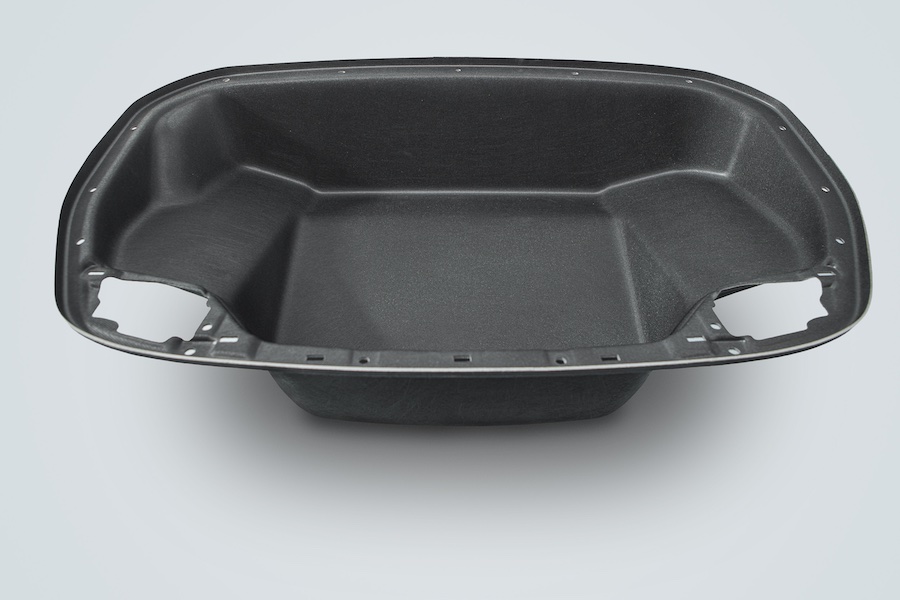
Autoneum Ultra Silent Frunk © 2026 Autoneum
As car manufacturers look to further reduce their carbon footprint, Autoneum has developed an innovative front trunk solution for battery electric vehicles (BEVs), made entirely from polyester-based textile. The Ultra-Silent Frunk offers significant weight reduction, improved acoustic and thermal insulation, and uses up to 70 percent recycled material, supporting sustainable and efficient vehicle design. Autoneum, global technology leader in acoustic and thermal management for vehicles, has already received orders for the new frunk from three major OEMs in Asia and Europe to be built in three BEV models. Series production for two BEVs has been underway in China and Germany since last year.


The global market for BEVs is growing dynamically. With rising demand, the technical development of BEVs is also advancing rapidly. In the front of a BEV, for example, the absence of a combustion engine creates additional storage space under the hood. For this front trunk space, also known as the frunk, Autoneum has developed a fiber-based 100 percent polyester product. This component is designed for high sustainability and combines lightweight, high mechanical robustness, and excellent acoustic and thermal properties in a functionally integrated design.

Strong customer interest and successful series production underway

“With the innovative frunk made from our environmentally friendly Ultra-Silent polyester textile technology, we are supporting automotive manufacturers in their goal of minimizing the CO₂ footprint of their products by integrating sustainable and lightweight components. To date, we have already received four awards for our Ultra-Silent Frunk from three major OEMs in Europe and Asia to be built in three BEV models. Successful series production for two BEV models in China and Germany has been underway since 2025, and production for two other vehicles built in China will start within the next few months,” explains Cyro Rovath, Global Product Manager Exterior at Autoneum.

In comparison to conventional frunk systems made of multiple solid plastic parts requiring complex assembly, Autoneum’s Ultra-Silent Frunk is engineered as a single, lightweight, monomaterial component that can be adapted to the technical and aesthetic requirements of automotive manufacturers. The elimination of individual components streamlines both manufacturing and assembly processes while delivering weight reductions exceeding 50 percent relative to conventional solutions – translating to savings of up to 5 kilograms depending on geometry, number of components and part size.

Waste-free production and full recyclability

Moreover, the Ultra-Silent Frunk uses up to 70 percent recycled material, cutting greenhouse gas emissions by as much as 50 percent compared to injection molded frunks. Its waste-free production and full recyclability at the end-of-life support the industry’s shift toward a circular economy.

The textile frunk also significantly enhances both acoustic and thermal performance. Its highly sound-absorbing Ultra-Silent material helps reduce noise both inside and outside the vehicle. Additionally, outstanding thermal insulation protects temperature-sensitive items stored in the frunk. Tests conducted under controlled conditions show that ice placed in the Ultra-Silent Frunk stayed frozen for up to 28 hours at an ambient temperature of 30°C, significantly outperforming conventional plastic alternatives. Based on simulations, the Ultra-Silent Frunk offers the potential to improve pedestrian protection and passive safety compared to injection molded plastic solutions due to its higher plasticity.

Autoneum’s innovative frunk design combines functional, lightweight construction with acoustic and thermal efficiency while also using sustainable materials. Through these efforts, Autoneum is helping create environmentally friendly, future-oriented solutions for the automotive industry.


More News from Autoneum

#Technical Textiles

Autoneum reports solid revenue, achieves strong EBIT margin of well above 5 percent in fiscal year 2025

Despite a challenging market environment, Autoneum reached key strategic milestones in fiscal year 2025. With two acquisitions in China, the Group significantly strengthened its position in the strategic growth market of Asia. Revenue consolidated in Swiss francs totaled CHF 2’290.6 million (2024: CHF 2’338.7 million). In local currencies, revenue increased to CHF 2’393.3 million.

#Technical Textiles

Autoneum and Polestar set new benchmarks for passenger experience and sustainability

As the global market leader in sustainable acoustic and thermal management, Autoneum is a key supplier of interior and exterior components for the highly anticipated Polestar 5 model. The successful collaboration between Autoneum and Polestar marks a significant milestone in sustainable automotive engineering: the electric grand tourer sports car features several innovations in lightweight, fully recyclable polyester-based components that ensure a superior driving experience. Polestar 5 was revealed at the IAA Mobility 2025 in Munich and is available in 24 markets.

#Nonwovens / Technical Textiles

N-Join1: an innovative, adhesive-free carpet that supports the circular economy

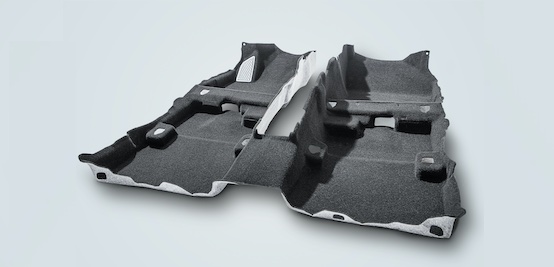
Vehicle manufacturers are increasingly looking for recycling solutions for end-of-life vehicles to meet sustainability targets and comply with new regulations that are accelerating the automotive industry’s transition toward a circular economy. In response, Autoneum has developed the N-Join1 carpet. This innovative, monomaterial carpet system, made from recycled materials, eliminates the need for latex and adhesives, thereby offering an eco-friendly solution for vehicle interiors.

#Nonwovens / Technical Textiles

Autoneum appoints new Head Corporate Communications

Ulrike Reich has been appointed Head Corporate Communications at Autoneum, effective immediately. She succeeds Claudia Güntert, who left the company last year.

More News on Technical Textiles

#Techtextil 2026

Techtextil 2026: KARL MAYER impresses as an innovative sector partner

KARL MAYER looks back with satisfaction on its participation in Techtextil 2026. From April 21 to 24, the international industry leader used the trade show in Frankfurt to meet with numerous key customers at its booth and, at the same time, establish many new contacts. Most visitors came from Germany, followed by major markets such as Poland, the United Kingdom, Turkey, France, and Portugal.

#Knitting & Hosiery

“We Believe in the Value of Textiles”: Successful Opening of the KARL MAYER TEXTILE INNOVATION CENTER

KARL MAYER inaugurated its new, state-of-the-art TEXTILE INNOVATION CENTER (TIC) with a four-day opening week from April 21 to 24. The highlight of the week was the grand opening on Thursday, which drew a strong turnout from the international textile industry: around 220 customers, brands, and partners from across the textile value chain came to the company’s headquarters in Obertshausen for a first-hand look at the new high-tech development environment and lively exchange with industry peers.

#Techtextil 2026

Speed and connectivity: Techtextil and Texprocess provided market-ready solutions for industries under pressure

With more than 36,000 visitors and 1,700 exhibitors from a total of 112 countries, Techtextil and Texprocess 2026 demonstrated how innovation comes into industrial use. The convergence of research, industry and application proved to be a breeding ground for new material solutions, manufacturing and processing technologies. Natural fibres, performance apparel, connected systems and AI-driven processing technologies emerged as key growth and future markets.

Latest News

#INDEX 2026

“We clearly see that reliability, flexibility, service and total cost of ownership are becoming increasingly important again.”

The nonwovens industry continues to face a challenging market environment. Nevertheless, AUTEFA Solutions reports successful projects, new line sales and growing demand for energy-efficient and flexible solutions. In this interview, André Imhof of AUTEFA Solutions talks about competitiveness against Chinese suppliers, new service and recycling concepts, the growing importance of application development and the opportunities created by countercyclical investments.

#INDEX 2026

“Needle punching technology is more universal and sustainable than ever!”

Needle punching technology was long regarded as a rather traditional and comparatively slow technology within the nonwovens industry. In this interview, Johann Philipp Dilo explains why needle punching is more relevant than ever today – ranging from energy efficiency and resource conservation to hygiene applications, new machine concepts and design-oriented nonwoven solutions.

#Research & Development

Textile climate control system in workwear – exhibition at the 2026 SME Innovation Day!

Conventional protective workwear often reaches its limits during strenuous physical activity. In particular, the transport of sweat and excess body heat poses a problem. The German Institutes of Textile and Fiber Research (DITF) conducted research on flow-optimized, air-conducting textile structures that enable targeted climate control directly on the body. These structures can be integrated straight into protective work garments. The textile climate control system supports the body’s natural thermoregulation. This contributes to improved workplace safety and comfort.

#Nonwovens

PET spunbond from China – EDANA welcomes imposition of provisional anti-dumping measures

On 13 May 2026, after eight months of investigation, the European Commission imposed provisional anti-dumping duties of 45.6-50.0% on imports of PET spunbond from China. EDANA welcomes this expression of the Commission’s clear determination to protect EU industries from the unfair trade practices of Chinese producers.

TOP