#Weaving
“A complex design is only useful if the machine can reproduce it consistently”
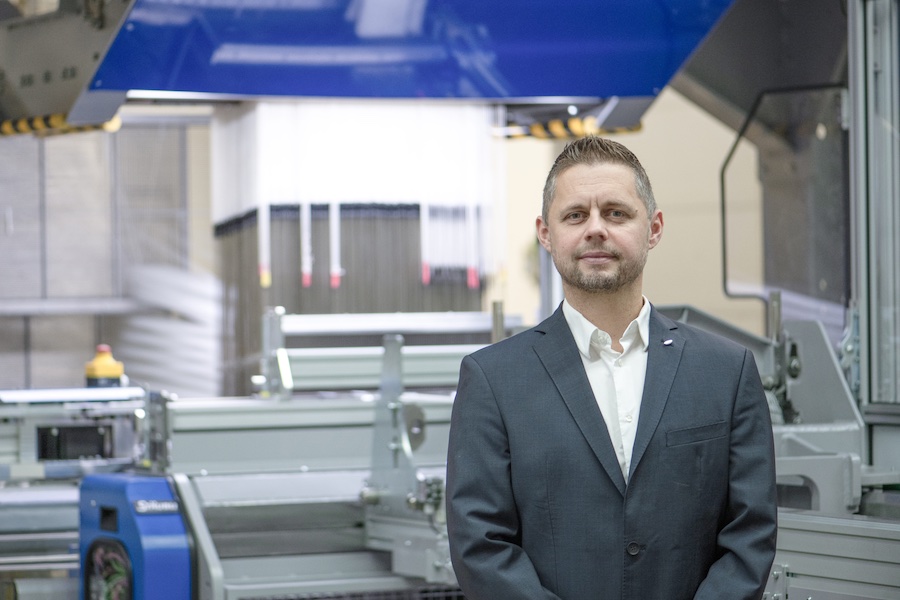
Interview
Andreas Schnabel
Head of R&D Technical Weaving Systems (TWS)
Stäubli International AG
by Oliver Schmidt, Editor in Chief, TexData International
1. Where Stäubli technology makes a difference
Stäubli weaving technologies are used in a wide range of applications, from airbags and filtration fabrics to advanced composite materials. Looking specifically at 3D weaving, could you give our readers some concrete examples of products or components manufactured using Stäubli TF systems? Where might we encounter this technology without even realising it?
Stäubli serves a wide range of markets through its broad technology portfolio, which includes dobbies for tire cord, Jacquard machines for airbags, and WPS solutions for glass-fibre fabrics used in printed circuit boards (PCBs), among other applications. Focusing specifically on 3D weaving, our TF systems are designed to produce textile structures that are used as reinforcements, mostly within a composite component. Applications range from aerospace structural parts and ballistic protection to high-temperature structural applications. Depending on the end use, these reinforcements can take the form of multilayer woven structures or near-net-shape preforms.
Stäubli has been active in 3D weaving for around 15 years. Many customer projects involve commercially sensitive technologies and applications, so we respect their confidentiality and focus here on publicly documented industry examples rather than individual Stäubli installations.
A well-known public example is the LEAP - Leading Edge Aviation Propulsion - aircraft engine, which uses 3D-woven composite technology for its fan blades and fan case. These textile reinforcements are hidden inside the finished components, so passengers may encounter the technology without ever seeing the woven structure itself.
2. Improving existing products and creating new possibilities
3D weaving opens up possibilities that go far beyond conventional textile structures. Which existing materials, components or manufacturing processes could be improved or even replaced by 3D-woven textiles? Could this technology also enable entirely new products or functionalities that have not been feasible until now? Which industries do you believe should be exploring these opportunities more closely?
3D-woven reinforcements offer an alternative to conventional preforms assembled from stacked layers of flat reinforcement fabrics, particularly when tailoring crash behavior and energy absorption. Appropriately designed composites can also replace selected titanium or other metal components where weight, performance and operating-temperature requirements favor this approach. Suitability must be assessed for each application, taking account of the reinforcement architecture, fiber and matrix materials, loading conditions, damage tolerance, manufacturing economics and qualification requirements. Beyond material substitution, 3D weaving provides freedom to tailor reinforcement distribution and load paths within a component.