[pageLogInLogOut]

#Textile chemistry

A flagship for chemical production: BASF inaugurates world-scale Verbund site in China
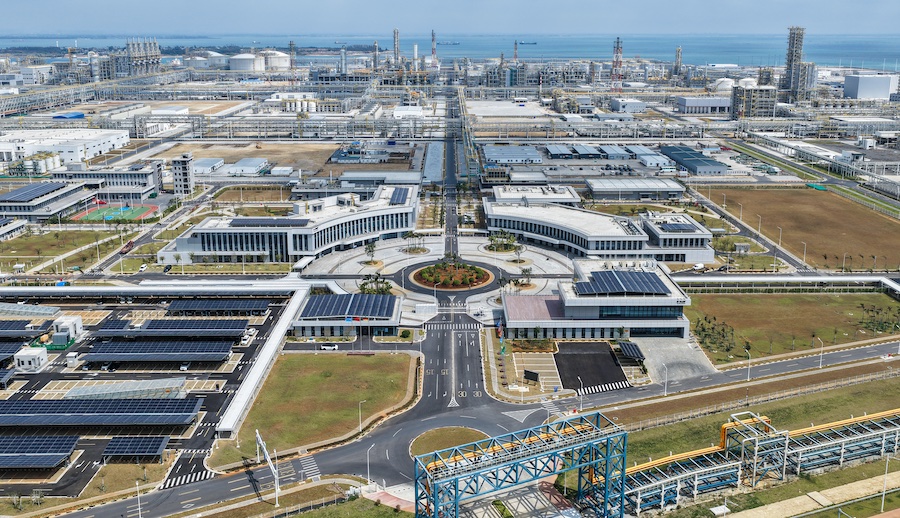
Aerial view of the BASF production site in Zhanjiang © 2026 Photo: BASF
BASF today (March 26, 2026) celebrated the official inauguration of its newly built, world-scale Verbund site in Zhanjiang, Guangdong Province in southern China. Covering an area of around four square kilometers, it is more than a major BASF project in the chemical growth market of China. “Zhanjiang shows what the future of chemistry looks like: efficient, digital and sustainable by design. The site showcases a smart integrated Verbund structure on an industrial scale,” said Dr. Markus Kamieth, CEO of BASF, at the ceremony attended by representatives from government, customers, business partners and employees.

At the Zhanjiang site, BASF employs over 2,000 people and will produce a diversified portfolio that includes basic chemicals, intermediates and specialty chemicals for the transportation, consumer goods, electronics, home care and personal care industries.

“Bringing this site to life took real ownership, speed and an exceptional level of commitment from our BASF team. Completing a project of this magnitude and complexity on time and under budget is remarkable. I want to thank everyone involved both at the site and worldwide who made this possible,” Kamieth said. “This investment shows confidence in the world’s largest chemical market in the long run and will be an important element of our ‘Winning Ways’ strategy,” he added. The majority of the products manufactured in Zhanjiang will directly serve customers in China, fully aligning with BASF’s global “local‑for‑local” approach. The project was completed on schedule and well below the original budget, with an investment of around €8.7 billion.

“I am proud of BASF’s innovative strength as the basis for the start-up of the most sustainable integrated chemical site in China, and the successful ramp-up of the steam-cracker in record time,” emphasized Dr. Stephan Kothrade, member of the Board and Chief Technology Officer of BASF SE, who is responsible for the Asia Pacific region. “It sets new benchmarks for sustainable chemical production in China and worldwide,” Kothrade added.

By using Verbund integration, process innovations and renewable energy, CO₂ emissions at the site can be reduced by up to 50 percent compared with a conventional petrochemical site. Long-term green power purchase agreements and investments in an offshore wind farm enable the site’s electricity supply to be 100 percent renewable. “Innovative technologies are also being used for the steam cracker – the starting point of various value chains at the Verbund site,” Kothrade said. It has a capacity of 1 million tons of ethylene per year and is the world’s first cracker equipped with main compressors (e-drives) powered by 100 percent renewable energy, supporting the production of high-quality, low-CO2 products. The world-scale flex-feed steam cracker is designed to process multiple types of feedstocks, such as naphtha and butane.

BASF has successfully started up 18 plants, 32 production lines, and is producing more than 70 products. With the proven Verbund concept with long value chains, BASF offers a broad, highly diversified product portfolio from the segments Chemicals, Materials and Nutrition & Care. This integration and scale enable competitive cost positions, significantly lower CO₂ emissions and reliable supply to serve multiple end‑markets. “This makes us an attractive partner for our customers in China,” said Haryono Lim, President, Mega Projects Asia, BASF. “Together with customers and partners, we will drive innovation and transformation forward in one of China’s most economically dynamic regions,” he added. Thus, the site provides an important platform for BASF’s future growth in China.

BASF announced the Zhanjiang project in 2018 and laid the foundation stone the following year. The first production plant to begin operation at the Zhanjiang site was for engineering plastics in 2022; it was followed by a thermoplastic polyurethane plant in 2024. At the turn of 2025/2026, BASF began production in the first value chains in the Verbund and successfully ramped up the steam cracker in record time.

The Zhanjiang integrated site is BASF’s seventh Verbund site worldwide and the third largest after Ludwigshafen, Germany, and Antwerp, Belgium. It will be operated solely under BASF’s responsibility.

BASF has been active in Greater China for over 140 years. Today, BASF serves almost all key industries in the region. In China, BASF has a strong production, sales and innovation footprint with large sites in Shanghai, Nanjing, Chongqing and Zhanjiang as well as numerous smaller sites across the country. In 2025, BASF achieved sales of around €8.2 billion with customers in Greater China and employed almost 13,000 people.
More News from BASF Aktiengesellschaft
Performance Chemicals for Textiles Europe

#Recycling / Circular Economy

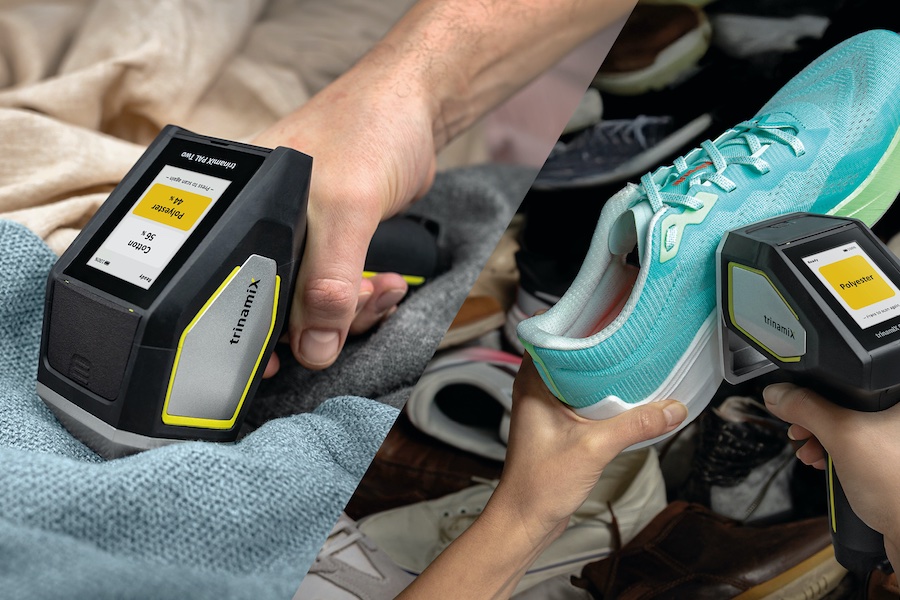
trinamiX with new management

BASF is examining strategic options for its subsidiary trinamiX GmbH. trinamiX specializes in biometric imaging and mobile material analysis. These activities are not part of BASF’s core business, on which the company is focusing as part of the implementation of its new strategy.

#Research & Development

How innovations drive BASF’s success

“Innovation has always been part of BASF’s DNA. Especially in these volatile times, it is crucial to leverage our innovative strength to develop competitive solutions that differentiate us as a company in our markets and give us a competitive edge,” said Dr. Stephan Kothrade, Member of the Board of Executive Directors of BASF and Chief Technology Officer, at the company’s Research Press Briefing held today. To achieve this, BASF implemented its “Winning Ways” strategy about a year ago with the clear goal of becoming the preferred chemical company to enable its customers’ green transformation.

#Nonwovens

Turning diaper waste into new value: BASF, Essity and TU Wien pioneer circular solutions

BASF, one of the world’s leading chemical companies and manufacturer of superabsorbent polymers (SAP), and Essity, a global leading hygiene and health company, joined forces together with the Technical University of Wien to revolutionize recycling of absorbent hygiene products (AHP).

#Textiles & Apparel / Garment

BASF at SIMAC 2025: Recycling meets Performance – PU solutions for the future of footwear

BASF is presenting new materials, concepts and recycling methods for polyurethanes in footwear at SIMAC Tanning Tech. The leading international trade fair will take place from September 23-25 in Milan, Italy. We will showcase our unique and integrated toolbox of Elastopan® (PU) and thermoplastic polyurethanes Elastollan® and Infinergy®. Together with our partners and customers we bring innovative products to the market offering utmost lightness paired with mechanical performance and automated processing.

More News on Textile chemistry

#Research & Development

Hof University develops sustainable textile coating for the fashion of tomorrow from mushrooms

Clothing is often treated as disposable: T-shirts for events, general merchandise, or short-term campaigns frequently end up in the trash after only a few uses. This is particularly problematic given that their production still largely relies on fossil-based materials. This is precisely where a new research project at Hof University of Applied Sciences comes in.

#Textile chemistry

DyStar Group announces Board transition to drive innovation

DyStar, a leading specialty chemical company with a heritage of more than a century in product development and innovation, announced today the appointment of Ruan Cunfan to its Board of Directors, effective 20 February 2026.

#Textile chemistry

Jeanologia urges industry to accelerate PP Spray phase-out following ZDHC Watchlist update

Potassium permanganate has officially entered the Chemical Watchlist of the ZDHC Foundation, signaling increased scrutiny and potential phase-out of one of the most hazardous chemicals still used in denim finishing. The inclusion confirms an industry shift that Jeanologia anticipated more than a decade ago.

#Textile chemistry

RUDOLF gets the exclusive global distribution rights for Sanitized® textile technologies

With effect from today, RUDOLF officially assumes exclusive global distribution rights for Sanitized® textile technologies from SANITIZED AG. This is the next milestone in the strategic collaboration announced in 2025, with the partnership between the two companies now fully implemented and expanded worldwide.

Latest News

#Nonwovens

VEOCEL™ Lyocell production expands to Asia – Launching a new chapter for nonwovens in the region

VEOCEL™, Lenzing's flagship specialty nonwovens brand, expands production at its Thai plant in Prachinburi. This is the first-ever production of its nonwoven-grade lyocell fibers in Asia. Built in 2022 with a 100,000-ton annual production capacity, the facility - previously focused on fibers for textile applications - now can directly meet the demand for VEOCEL™’s biodegradable¹, wood-based lyocell fibers for nonwovens products. These fibers are an essential ingredient for high-quality nonwovens products, ranging from baby wipes to facial sheet masks and everyday personal hygiene items.

#Raw Materials

Fashion for Good mobilises industry to adopt mass balance attribution and accelerate decarbonisation

Fashion for Good launches today the Mass Balance Demonstrator project, a collaborative industry initiative to implement and scale the mass balance attribution (MBA) chain-of-custody model for biomass-attributed PET in textile applications. The project represents a concrete step toward accelerating brand-driven decarbonisation across the apparel value chain.

#Techtextil 2026

Italian textile machinery innovation takes center stage in Frankfurt for Techtextil 2026

The Italian textile machinery industry is gearing up for a key event on the international trade fair calendar: Techtextil 2026, taking place from April 21–24 in Frankfurt, Germany. A prestigious representation of Italian companies will participate in the German exhibition—a global benchmark for technical and innovative textiles—to present cutting-edge technologies dedicated to an ever-expanding market.

#Techtextil 2026

Between innovation pressure and production readiness: Techtextil 2026 showcases market-ready defence textiles

EU defence spending reached a record level of around €381 billion in 2025. The importance of textile innovation in this context is underscored by the European Defence Fund’s 2026 Work Programme, which identifies “smart and multifunctional textiles” as a dedicated priority area. Techtextil translates this demand into industrial practice. From 21 to 24 April 2026, more than 10 per cent of over 1,500 exhibitors in Frankfurt am Main will present material innovations for protective textiles.

TOP