[pageLogInLogOut]

#Retail & Brands

PUMA’s materials strategy receives top marks in the Material Change Index by Textile Exchange

Sports company PUMA has received the highest recognition for its materials strategy in the Material Change Index compiled by global non-profit organization Textile Exchange.
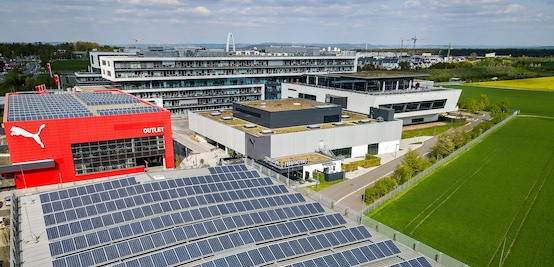
PUMA Headquarters Germany Herzogenaurach (Photo: Business Wire)


“We know how important our choice of product materials is, when we want to reduce our carbon footprint and lessen our environmental impact”

Out of hundreds of companies examined, PUMA was amongst 11 in 2024 to be ranked in the fourth and highest “Leading” tier. Companies with this distinction showed an integrated materials strategy aligned with global goals, disclosed climate goals and targets and made progress towards a circular use of materials, Textile Exchange said. This year’s result is one step up from PUMA’s inclusion in the second-highest “Scaling” tier in 2023.

“We know how important our choice of product materials is, when we want to reduce our carbon footprint and lessen our environmental impact,” said Anne Laure Descours, PUMA’s Chief Sourcing Officer. “We are very happy to be ranked as ‘Leading’ in this years’ index and we will take it as an opportunity to further strengthen our materials strategy.”

PUMA has a 2025 target of making 9 out of 10 products with materials that are classified as preferred fibres by Textile Exchange or which originate from certified sources. In 2023, this was already the case for 8 out of 10 products. In 2023, 99.7% of all leather was sourced from Leather Working Group-certified tanneries and 99.2% of all cotton was certified or recycled as was 99.4% of all paper and cardboard packaging.

Almost 65% of the polyester used for PUMA’s apparel and accessories in 2023 came from recycled materials and the company also started to scale up the use of recycled cotton. In 2024 PUMA announced that millions of football jerseys had been made with textile waste through its RE:FIBRE recycling initiative.

The Material Change Index is the largest peer-to-peer comparison initiative in the industry and aims to help track the sector’s progress in fibre and materials sourcing, strategy and the circular transition. The aim of the organization is to help the fashion industry achieve a 45% reduction in greenhouse gases from raw material production by 2030.


More News from PUMA

More News on Retail & Brands

#Recycling / Circular Economy

Recover™ secures multi-year recycled cotton agreement with H&M

Recover™ has signed a multi-year agreement with H&M to support the integration of its recycled cotton fiber, RCotton, for use in H&M’s products. Since early 2024, H&M and Recover™ have collaborated on product development, which now enables scaled commercial introduction of Recover™ mechanically recycled cotton into H&M’s collections.

#Sustainability

GORE-TEX® KIDSWEAR launches innovative membership scheme for kids’ jackets

With its revolutionary new membership model, GORE-TEX® Kidswear now offers families a simple, flexible and sustainable way of kitting out their children in top-quality jackets. It is aimed at the parents of children aged between five and ten and kicks off with a choice of functional winter jackets.

#Sustainability

H&M Foundation funds pioneering initiative to build the factories of the future

The H&M Foundation is committing SEK 53 million (approx. EUR 5 million) towards Future Forward Factories, a five-year initiative led by Fashion for Good, to address fashion’s most polluting stage: tier 2 textile processing.

#Natural Fibers

Better Cotton Initiative marks World Cotton Day with launch of innovative product label

The Better Cotton Initiative (BCI) has launched an innovative product label for the fashion and textile sectors which allows retailer and brand members to provide consumers with greater clarity about the origin and percentage of BCI Cotton in their products.

Latest News

#INDEX 2026

“We clearly see that reliability, flexibility, service and total cost of ownership are becoming increasingly important again.”

The nonwovens industry continues to face a challenging market environment. Nevertheless, AUTEFA Solutions reports successful projects, new line sales and growing demand for energy-efficient and flexible solutions. In this interview, André Imhof of AUTEFA Solutions talks about competitiveness against Chinese suppliers, new service and recycling concepts, the growing importance of application development and the opportunities created by countercyclical investments.

#INDEX 2026

“Needle punching technology is more universal and sustainable than ever!”

Needle punching technology was long regarded as a rather traditional and comparatively slow technology within the nonwovens industry. In this interview, Johann Philipp Dilo explains why needle punching is more relevant than ever today – ranging from energy efficiency and resource conservation to hygiene applications, new machine concepts and design-oriented nonwoven solutions.

#Research & Development

Textile climate control system in workwear – exhibition at the 2026 SME Innovation Day!

Conventional protective workwear often reaches its limits during strenuous physical activity. In particular, the transport of sweat and excess body heat poses a problem. The German Institutes of Textile and Fiber Research (DITF) conducted research on flow-optimized, air-conducting textile structures that enable targeted climate control directly on the body. These structures can be integrated straight into protective work garments. The textile climate control system supports the body’s natural thermoregulation. This contributes to improved workplace safety and comfort.

#Nonwovens

PET spunbond from China – EDANA welcomes imposition of provisional anti-dumping measures

On 13 May 2026, after eight months of investigation, the European Commission imposed provisional anti-dumping duties of 45.6-50.0% on imports of PET spunbond from China. EDANA welcomes this expression of the Commission’s clear determination to protect EU industries from the unfair trade practices of Chinese producers.

TOP