[pageLogInLogOut]

#Research & Development

Fabolose: Fabricating vegan and circular leather alternatives from bio-tech-derived cellulose
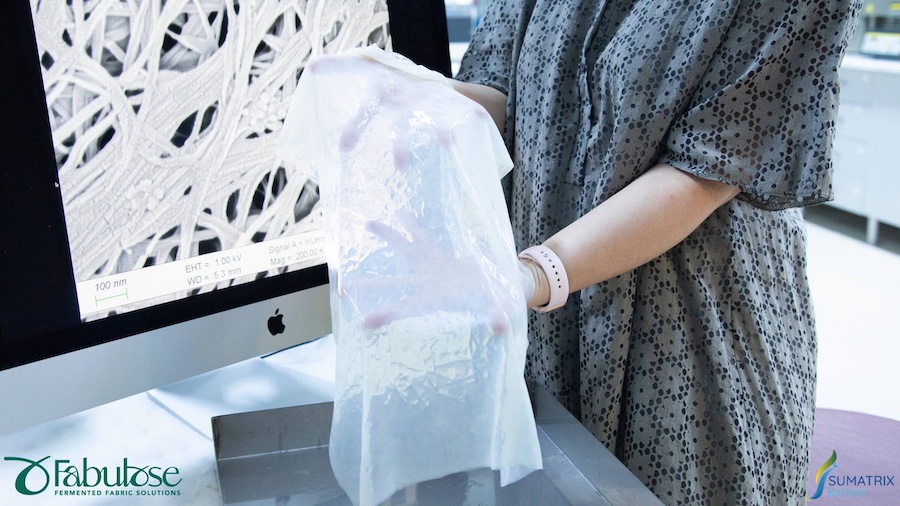
Bacterial cellulose film produced by Sumatrix. © 2026 Photo: Source: Sumatrix Biotech (CC BY-NC 4.0)
Fabulose is an EU funded project coordinated by the German Institutes of Textile and Fiber Research (DITF). Its consortium consists of leading research institutes, biotech innovators, and industry stakeholders who aim to create high-performance, biobased and recyclable leather-like fabrics, using efficient biotech production routes for bacterial cellulose, cyanophycin and bacterial pigments

Current leather alternatives are either made from petrol-based plastics and non-recyclable, or they are (partly) biobased, but difficult to scale up and recycle. The project, supported by the Circular Bio-based Europe Joint Undertaking (CBE JU), is investigating how animal-based materials can be replaced by environmentally friendly alternatives in industries such as automotive, fashion, and upholstered furniture.

Fabulose uses advanced fermentation techniques, utilizes waste streams as feedstocks, and optimizes processes with the assistace of AI. This enables the environmentally-friendly and efficient production of bacterial cellulose, cyanophycin and pigments. These bio-based materials are combined in a coating formulation that replicates the durability and aesthetics of traditional leather. DITF’s HighPerCell® technology allows for re-spinning of bacterial cellulose to filaments to create recycled textile backings that offer high tensile strength without toxic agents. Instead of processing individual batches, the technology also allows to implement a roll-to-roll production process, thereby simplifying future scale-up to cost-effective mass production.

In addition, market requirements have been collected to select optimal material characteristics, while eco-design and Safe-by-design principles help to assess potential risks and ensure alignment with the safety and sustainability objectives. A digital twin framework will include key process parameters for optimisation and monitoring of material performances.
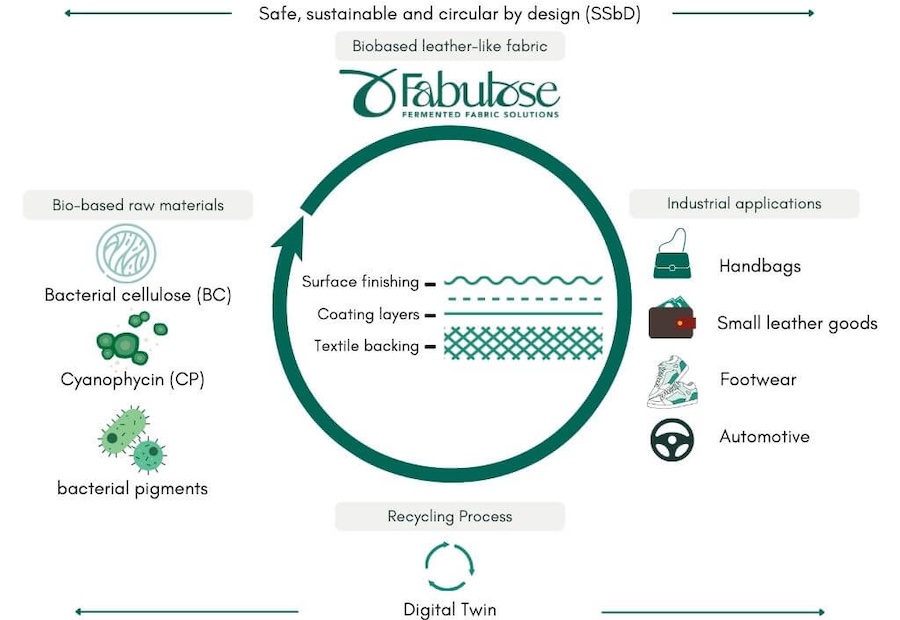
Infographic of Fabulose © 2026 Source: Fabulose project


Summary of the key project innovations:

  • Using fermentation products to enable fast and cost-effective production of raw materials
  • Grow micro-organisms on waste feedstocks and CO2 to reduce production costs and environmental impact
  • Re-spinning bacterial cellulose to filaments to create recyclable, consistent and high-quality fabrics
  • Enabling production of cyanophycin to create durable coatings and finishing
  • Implementing roll-to-roll production process to simplify future scale-up


Project partners

The Fabulose project has a duration of 3,5 years and a budget of ca. 3,5 M euro.

The consortium includes 10 partners from 6 European countries, spanning the entire value chain, from research to real-world applications:

German Institutes of Textile and Fiber Research Denkendorf (DITF) (Germany), Next Technology Tecnotessile Societa Nazionale (Italy), University of Maribor (Slovenia), Sumatrix Biotech (Turkey), VTL GmbH (Austria), Novis GmbH (Germany), Melina Bucher (Germany), Benecke-Kaliko GmbH (Germany), Konrad Hornschuch GmbH (Germany), University of Aveiro (Portugal), Sumatrix Biotech, and Steinbeis 2i GmbH (Germany).
More News from Deutsche Institute für Textil- und Faserforschung Denkendorf

#Research & Development

More safety and comfort for protective clothing thanks to auxetic fabrics

When everyday materials are pulled, they stretch or elongate in the direction of the pull and become narrower in cross-section. We can also observe this property in two-dimensional textiles. Auxetic structures behave differently here. They have the striking property of not changing under tensile stress or even increasing their width or thickness. These properties are advantageous, for example, in protective textiles or textile filter media. The DITF are researching auxetic fabrics for various applications.

#Research & Development

Panty liners prevent bacterial vaginosis

Worldwide, almost one third of women of childbearing age suffer from bacterial vaginosis. This is when the sensitive microbiome of the vagina becomes unbalanced. Such a disorder of the vaginal flora can cause urogenital infections, abscesses on the ovaries or fallopian tubes or premature births. This significantly increases the risk of infertility in women and of contracting a sexually transmitted disease or HIV.

#Research & Development

DITF send a signal for climate protection

The German Institutes of Textile and Fiber Research Denkendorf (DITF) have successfully implemented extensive investments in photovoltaic systems at their site in Denkendorf. The systems installed on the roofs of the buildings and covered parking lots have a total installed capacity of 840 kilowatt peak (kWp). The DITF invested 1.6 million euros in this with the support of the state of Baden-Württemberg. The system was ceremonially put into operation on September 17, 2025.

#Research & Development

4.2 million Euros for research into textile recycling

Around the world, used textiles are still rarely recycled and pile up into huge mountains of waste. A recent study by the Boston Consulting Group (BCG) drew attention to this problem. However, the low recycling rate is also due to the fact that only a small percentage of used textiles are actually suitable for recycling into high-quality materials and for demanding applications. The German Institutes of Textile and Fiber Research Denkendorf (DITF) are addressing this problem with their research.

More News on Research & Development

#Research & Development

New DIN SPEC assesses environmental impact of textile fragments in soil

Textile products made from synthetic fibres, finished fabrics or dyed materials release fibre fragments into the environment at every stage of their life cycle. With the new DIN SPEC 19296, Hohenstein has developed a standardised testing method to analyse how these fragments behave in soil under natural conditions. Until now, little was known about their environmental behaviour or potential ecological effects once released.

#Research & Development

Solid Air Dynamics wins second place at RWTH Innovation Award

On 30 January, RWTH spin-off Solid Air Dynamics was awarded second place in the RWTH Innovation Awards for its research in the field of aerogel fibres. Manufactured from renewable raw materials, aerogel fibres offer outstanding thermal insulation, are extremely lightweight and completely biodegradable, and can consist of over 90 per cent air.

#Research & Development

Testing and research laboratory ensures safe and more sustainable products worldwide

For 80 years, Hohenstein has stood for independent testing, scientific expertise and practical solutions. Today, the testing and research service provider supports manufacturers and brands worldwide in making textiles, hardlines and medical devices safe, more sustainable and market-ready – thereby building trust among consumers. With an international presence and interdisciplinary expertise, Hohenstein supports its customers from production through to market launch, helping them navigate an environment of growing regulatory and societal demands.

#Research & Development

Award-winning research for sustainable carbon fibre cycles

Sustainable recycling of carbon fibres is possible through targeted electrochemical surface modification, which makes the sizing of carbon fibres resistant to solvolysis. ITA PhD student Sabina Dann was awarded the MSW Award from RWTH Aachen University for her master's thesis on this development. The award ceremony took place on 12 November 2025 in Aachen.

Latest News

#Textiles & Apparel / Garment

Connecting the ASEAN textile sector: sustainability, trends, and technology take centre stage at this week’s VIATT 2026

Opening this week Thursday, the Vietnam International Trade Fair for Apparel, Textiles, and Textile Technologies (VIATT) is set to welcome visitors from ASEAN’s dynamic textile market and beyond. From 26 to 28 February, VIATT 2026 – the fair’s third editions – will reinforce its strategic proposition with an integrated showcase of the three core sectors of the entire textile value chain. Beyond new sourcing opportunities in Apparel Fabrics & Fashion, Home & Contract Textiles, and Technical Textiles & Technologies, the fair will present an expanded fringe programme.

#Spinning

Measure and control the fiber – optimize yarn quality

Producing consistent yarn quality is an everyday challenge – and a very difficult one. Detailed knowledge and understanding of the fiber raw material is absolutely critical to achieving the best possible quality in the yarn. To help spinners, Uster experts have put together guidelines for avoiding yarn irregularity claims, in a special edition of the Uster News Bulletin.

#Software

Coats Digital appoints Himanshu Mehrotra as Managing Director to lead next phase of cloud and AI-driven innovation

Coats Digital is delighted to announce the appointment of Himanshu Mehrotra as Managing Director to lead the company’s strategic direction, innovation agenda, and global growth as it accelerates the development of its cloud-native, AI-powered software solutions for the global apparel and footwear supply chain.

#Techtextil 2026

Over 1,500 exhibitors: Techtextil 2026 grows in key future sectors

Techtextil 2026 continues to grow: more than 1,500 exhibitors from 49 countries present their products and innovations in Frankfurt am Main from 21 to 24 April 2026. Over 120 of them are first-time exhibitors. Texprocess is taking place at the same time, remaining stable with around 200 exhibitors – despite challenging market conditions. Together, the two events bring more than 1,700 exhibitors to the Frankfurt exhibition grounds.

TOP