[pageLogInLogOut]

#Recycling / Circular Economy

Challenges of making yarn from recycled fibers
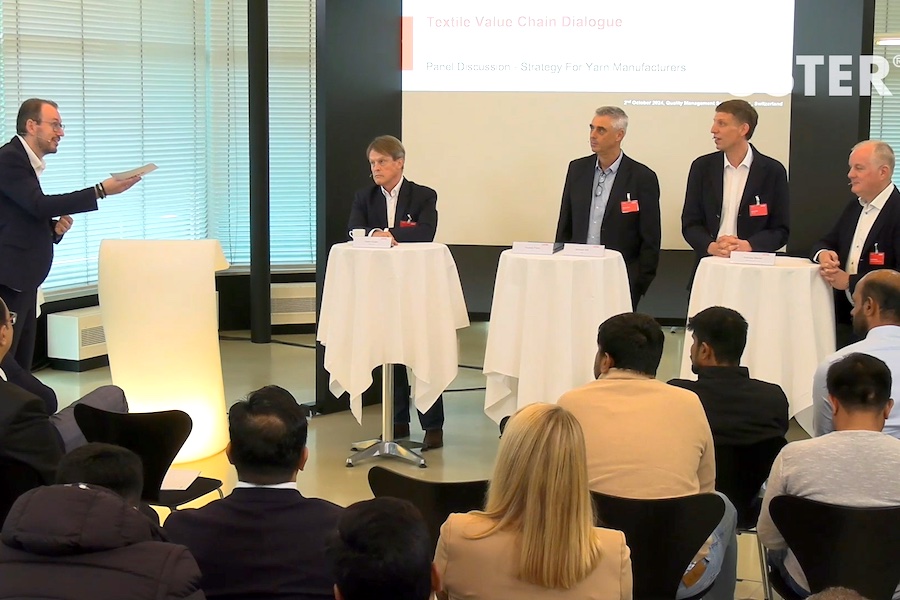
What does it take to spin quality yarn from recycled fibers? Uster Technologies brought textile industry leaders together to discuss the role of technology, data and automation – as well as the current challenges in using recycled raw material. Experts from Rieter, Säntis Textiles, Otto Yarns, and TVU commented on the current situation and looked into the future of spinning in a panel discussion organized at Uster headquarters.
Uster hosted a dynamic panel discussion featuring representatives from across the value chain to address the challenges of recycled yarns at each production stage. © 2025 USTER


The role of latest technologies in sustainable spinning

It’s more than just machinery – it’s about rethinking processes, embracing AI, data and machine automation as well as building industry-wide collaboration. As spinners navigate the multiple demands of circularity, customer satisfaction, and profitable business, one thing is clear: the future of recycled textiles must be individually engineered, comprehensively tested, and connected like never before.

Standards and individuality: engineering for reliability and diversity

Advanced machinery is a critical component in enabling engineering teams to optimize processes and drive innovation. Machines from leading manufacturers offer reliability but don’t make an inimitable product. “With the goal of being different and unique, we create our own path by developing our own final machines,” says Andreas Merkel, CEO at Otto Yarns. Otto engineers customize the machines for specialized applications. A notable example is the Spin-Knit system, which integrates spinning and knitting into one continuous operation. Originally configured for cotton, the machine was re-engineered to process technical fibers, by removing the standard top section and implementing a proprietary drafting system.

The production of recycled yarns brings technical requirements that are significantly different from those with virgin fibers. According to Stefan Hutter, owner of Säntis Textiles, there is a clear need for the development of new industry standards tailored specifically for recycled materials, and he advocates for Uster Technologies to take a leading role in this effort. Ultimately, the successful integration of advanced production machinery, newly-defined quality standards, and precise quality control systems will require close industry collaboration. This is the only way that confidence in recycled yarns can be established – ensuring that customers not only trust the product's performance and consistency but are also willing to invest in its value.

Adapting spinning processes for recycled yarns

Recycled yarn production can be achieved with existing spinning technologies, either by adapting current systems or by integrating additional processing steps. “Spinners must go back to the basic task and again learn how to spin, starting from scratch and going through the whole line of spinning,” says Michael Will, Head Textile Technology & Process Analytics at Rieter. This re-learning process is essential due to the variable nature of recycled fibers, and it demands extensive testing and data collection – measuring key parameters, validating process changes, and ensuring consistency through iterative quality control.

Growing customer demand for more automation presents a dual challenge: matching the need for maximum flexibility with the rigid configurations typical with interconnected automated systems. In conventional spinning mills, linking multiple machines can limit process adaptability. However, machine-level automation offers potential for enhanced flexibility, particularly when processing smaller lot sizes. For instance, features such as automated adjustment of comber nip distances can streamline setups.

The role of data and AI

In the recycling process, sorting, separating, and cleaning are advanced operations in which artificial intelligence plays a critical role in pattern recognition and optimization. In this way, AI enables optimization of material recovery at the right quality, to improve process efficiency. Another key area is traceability, which ensures product reliability and builds trust throughout the supply chain. “For downstream processes such as dyeing, it must be possible to trust certificates,” says Thomas Franz, Sales and Purchasing Manager at TVU.

Data analysis is fundamental to these efforts, but it becomes truly effective only when integrating comprehensive data streams. This means connecting spinning machinery and testing instruments – ideally across different brands – to enable holistic process monitoring and control. For spinners, seamless working between equipment and systems is crucial to unlocking maximum operational benefits and ensuring consistent quality in recycled yarn production.

Enabling the future would start with technology partners meeting, discussing and working together. This is a common belief of the experts participating at the panel discussion – and the Uster event has been one step in this direction.


More News from Uster Technologies AG

#Spinning

Measure and control the fiber – optimize yarn quality

Producing consistent yarn quality is an everyday challenge – and a very difficult one. Detailed knowledge and understanding of the fiber raw material is absolutely critical to achieving the best possible quality in the yarn. To help spinners, Uster experts have put together guidelines for avoiding yarn irregularity claims, in a special edition of the Uster News Bulletin.

#ITMA Asia + CITME Singapore 2025

Uster presents novelties at ITMA Asia + CITME 2025

There’s news from Uster Technologies to be announced for the industry’s upcoming event in Singapore. The Uster 360Q universe is growing with new products, solutions and services. Innovation developments can also be recorded in the fields of man-made fiber testing and fabric inspection. Uster innovations address the industry’s trending topics as mill management and process control, optimization of delivered fabric quality and yield.

#Spinning

Uster Technologies marks 150 years of empowering quality excellence

Uster Technologies marks 150 years of excellence – a milestone that reflects continuous adaptation to customer needs and industry change. Over the decades, Uster has evolved from manufacturing quality testing instruments into a trusted partner shaping the future of textile production.

#Spinning

Uster Technologies wins another infringement lawsuit

In a ‘victory for innovation in China’ Uster Technologies has secured a decisive judgment in a patent infringement lawsuit against a competitor. The final ruling by the Supreme People’s Court of PR China confirms that the competitor’s actions in copying the patented yarn feeder of the Uster Tester 6 constitute unlawful infringement.

More News on Recycling / Circular Economy

#Research & Development

Fabolose: Fabricating vegan and circular leather alternatives from bio-tech-derived cellulose

Fabulose is an EU funded project coordinated by the German Institutes of Textile and Fiber Research (DITF). Its consortium consists of leading research institutes, biotech innovators, and industry stakeholders who aim to create high-performance, biobased and recyclable leather-like fabrics, using efficient biotech production routes for bacterial cellulose, cyanophycin and bacterial pigments

#Recycled_Fibers

Reju announces site selection for French Regeneration Hub in Lacq advancing Europe’s circular textile infrastructure

Reju, the textile-to-textile regeneration company based in France, announces the site selection for an industrial sized Regeneration Hub, in Lacq, in the Pyrénées-Atlantiques, on the Induslacq platform. Reju, a Technip Energies owned company, is deepening its roots in France through the development of this new Regeneration Hub.

#Technical Textiles

Covestro showcases monomaterial concept in autonomous SUE People Mover

UE | STUDIOS has unveiled the fully autonomous electric minibus “Self-driving Urban E-Shuttle” (SUE), placing strong emphasis on sustainable material design. Developed within a project funded by the Federal Ministry for Economic Affairs and Energy (BMWE) and the European Union, the vehicle will begin public road testing this year. At the core of the concept is the consistent use of recyclable monomaterials to improve circularity at end of life.

#Recycled_Fibers

Circ announces New Fiber Club partners to accelerate commercial adoption of recycled textiles

Circ®, a global leader in textile‑to‑textile recycling, announced the scaling of its Fiber Club initiative. Building on the success of the inaugural program, Circ is bringing together a new group of brand partners: the lifestyle brand Madewell (under J.Crew Group), sustainable fashion brand Reformation, and European retailer C&A, alongside supply chain partners Lenzing and Linz Textil.

Latest News

#Textiles & Apparel / Garment

Connecting the ASEAN textile sector: sustainability, trends, and technology take centre stage at this week’s VIATT 2026

Opening this week Thursday, the Vietnam International Trade Fair for Apparel, Textiles, and Textile Technologies (VIATT) is set to welcome visitors from ASEAN’s dynamic textile market and beyond. From 26 to 28 February, VIATT 2026 – the fair’s third editions – will reinforce its strategic proposition with an integrated showcase of the three core sectors of the entire textile value chain. Beyond new sourcing opportunities in Apparel Fabrics & Fashion, Home & Contract Textiles, and Technical Textiles & Technologies, the fair will present an expanded fringe programme.

#Software

Coats Digital appoints Himanshu Mehrotra as Managing Director to lead next phase of cloud and AI-driven innovation

Coats Digital is delighted to announce the appointment of Himanshu Mehrotra as Managing Director to lead the company’s strategic direction, innovation agenda, and global growth as it accelerates the development of its cloud-native, AI-powered software solutions for the global apparel and footwear supply chain.

#Techtextil 2026

Over 1,500 exhibitors: Techtextil 2026 grows in key future sectors

Techtextil 2026 continues to grow: more than 1,500 exhibitors from 49 countries present their products and innovations in Frankfurt am Main from 21 to 24 April 2026. Over 120 of them are first-time exhibitors. Texprocess is taking place at the same time, remaining stable with around 200 exhibitors – despite challenging market conditions. Together, the two events bring more than 1,700 exhibitors to the Frankfurt exhibition grounds.

#Raw Materials

Esquel Group adds two new extra-long staple cotton varieties approved

Esquel Group’s Xinjiang Research & Development Center has successfully developed two new Sea Island cotton (Extra-Long-Staple cotton, ELS cotton) varieties named “Yuan Loong 37” and “Yuan Loong 42,” which have been officially approved and granted registration numbers. Both varieties have also obtained Plant Variety Rights certificates, marking another significant breakthrough for the Group in cotton breeding and commercial application.

TOP