[pageLogInLogOut]

#Man-Made Fibers

Global fiber production reaches record levels in 2024

Textile Exchange has released its latest Materials Market Report, alongside the Materials Benchmark Insights and Trends and an updated Climate+ Dashboard. The findings highlight both record growth in global fiber production and the challenges of aligning the industry with Paris Agreement climate goals.

Global fiber production reached a new record in 2024, underscoring both the industry’s dynamism and the scale of the challenges ahead. According to the latest data, global fiber output climbed to 132 million tonnes, up from around 125 million tonnes in 2023. This is equivalent to producing roughly four tonnes of fiber every second. While the volumes reflect continued demand for textiles worldwide, the figures also highlight a widening gap between industry progress and the climate targets set by the Paris Agreement.

Polyester remains dominant

The surge in production was driven primarily by fossil-based synthetics. Polyester remained the single most widely used fiber, accounting for 59 percent of total global output. Of this, an estimated 88 percent is fossil-based, confirming the sector’s strong dependency on virgin petrochemical feedstocks. Recycled polyester volumes rose slightly, from 8.9 million tonnes in 2023 to 9.3 million tonnes in 2024. However, because virgin polyester grew faster, the overall share of recycled polyester declined from 12.5 percent to 12 percent of the polyester market.

Cotton and other natural fibers

Cotton remains the second most widely used fiber but saw a slight decrease in both volume and market share. Production fell from 24.8 to 24.5 million tonnes, equating to 19 percent of the global fiber mix. Within this, 34 percent of cotton was produced from certified sources in 2024, reflecting steady growth in sustainability programs, but also underscoring the limited speed of transition compared to the pace of overall fiber growth.

Manmade cellulosics: Gradual gains

Production of manmade cellulosic fibers (MMCFs) – including viscose, lyocell, modal, acetate and cupro – increased from 7.9 million tonnes in 2023 to 8.4 million tonnes in 2024, holding a 6 percent share of the global market. Certified or controlled feedstock accounted for an estimated 65–70 percent of total MMCF output. Recycling of MMCFs also showed early progress: the share of recycled feedstocks rose from 0.7 percent in 2023 to 1.1 percent in 2024, with further growth expected as R&D and pilot projects expand.

Polyamide: Limited progress in recycling

Polyamide (nylon) remained the second most used synthetic fiber, representing 5 percent of the global fiber market with around 7 million tonnes produced. Yet recycling rates are still low: only about 2 percent of total polyamide comes from recycled feedstocks, primarily pre-consumer waste, discarded fishing nets, or carpets. While this highlights potential for circular models, significant technical barriers remain. Biobased polyamide fibers also accounted for only 0.4 percent of total production, constrained by high costs, limited supply, and ongoing debates about sustainability credentials.

Recycling and certification

Across the industry, the overall share of recycled fibers remained stable at 7.6 percent, the majority of which was PET from recycled bottles (6.9 percent of total global fiber production). Less than one percent of all fibers came from pre- and post-consumer recycled textiles, showing that true textile-to-textile recycling remains in its infancy.

Certified fibers, however, continue to gain traction: in addition to cotton, around two-thirds of MMCFs and 50 percent of global mohair production were certified under recognized standards in 2024. This indicates progress in building traceable, responsible supply chains, even as absolute fiber volumes continue to rise.

A call for scaling up

For Textile Exchange CEO Claire Bergkamp, the latest findings reflect both achievement and urgency: “The data we’ve released today makes clear the scale of the challenges ahead, but it also gives us a strong foundation for action. I’m encouraged to see real progress as reporting companies increase their use of certified raw materials and reduce reliance on virgin fossil-based polyester. The challenge now is to take this progress to scale.”

The 2024 figures thus present a double-edged message: record volumes underline the global significance of textiles, while the dominance of fossil-based synthetics highlights the critical importance of accelerating systemic change. Certified materials and early recycling initiatives are encouraging, but without faster progress, the gap to climate goals will continue to widen.
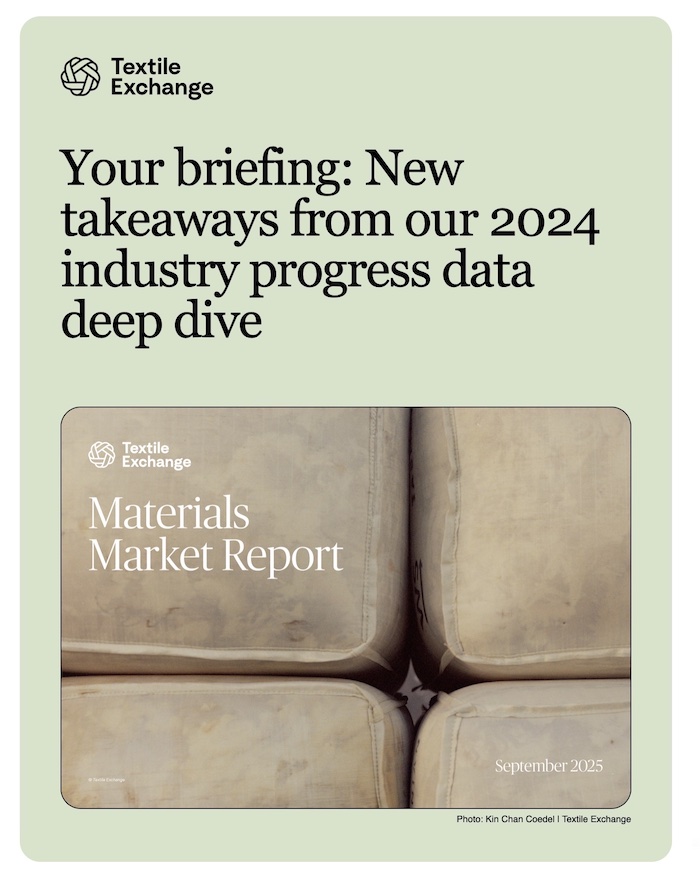
© 2025 Textile Exchange


Download the report:

https://textileexchange.org/knowledge-center/reports/materials-market-report-2025/

More News from Textile Exchange

More News on Man-Made Fibers

#Research & Development

Solid Air Dynamics wins second place at RWTH Innovation Award

On 30 January, RWTH spin-off Solid Air Dynamics was awarded second place in the RWTH Innovation Awards for its research in the field of aerogel fibres. Manufactured from renewable raw materials, aerogel fibres offer outstanding thermal insulation, are extremely lightweight and completely biodegradable, and can consist of over 90 per cent air.

#Raw Materials

2026 production plan set for a record 10 metric tons of recombinant spider silk cocoon per month

Kraig Biocraft Laboratories, Inc. (OTCQB: KBLB) (“the Company”, “Kraig Labs”, or “Kraig’s”), a world leader in spider silk technology*, today announced its 2026 production plan that will drive explosive growth and establish a new global benchmark for spider silk manufacturing.

#Research & Development

Award-winning research for sustainable carbon fibre cycles

Sustainable recycling of carbon fibres is possible through targeted electrochemical surface modification, which makes the sizing of carbon fibres resistant to solvolysis. ITA PhD student Sabina Dann was awarded the MSW Award from RWTH Aachen University for her master's thesis on this development. The award ceremony took place on 12 November 2025 in Aachen.

#Yarns

Eastman introduces Naia™ Lyte at Première Vision Paris, marking a major breakthrough in fiber tenacity for cellulose acetate filament yarn performance

Eastman unveils Naia™ Lyte, a new cellulose acetate filament yarn that represents an important milestone in performance for lightweight and premium fabrics, at Première Vision Paris. Presented for the first time to the international fashion and textile community, Naia™ Lyte expands the capabilities of acetate yarn by introducing enhanced tenacity, unlocking new creative and technical possibilities for designers, mills and brands.

Latest News

#Recycling / Circular Economy

Circulose restarts commercial-scale production at Ortviken plant in Sundsvall

Circulose today announced the restart of its commercial-scale production plant at Ortviken in Sundsvall, Sweden, marking a significant step in scaling next-generation materials for the global fashion industry. The company plans to resume production of CIRCULOSE®, a recycled pulp made entirely from discarded cotton textiles, in the fourth quarter of 2026.

#Textiles & Apparel / Garment

VIATT 2026 to debut German Pavilion, strengthening European participation alongside key Asian textile hubs

Vietnam’s textile and garment sector continues to be a major contributor to the country’s economic growth, with export revenues expected to reach USD 46 billion in 2025, a 5.6% increase from 2024 . From 26 – 28 February, the Vietnam International Trade Fair for Apparel, Textiles and Textile Technologies (VIATT) is set to contribute to economic growth opportunities by accelerating digital transformation and green transition across the entire textile value chain. The upcoming edition will respond to the rising demand for advanced technologies and sustainable materials with the introduction of the German Pavilion, alongside strong exhibitor participation from key Asian sectors, as well as several high-profile fringe events.

#Sustainability

Ying McGuire becomes new CEO of Cascale

Cascale today announced the appointment of Ying McGuire as Chief Executive Officer, effective June 1, 2026.

#Technical Textiles

Sustainable, lightweight, and sound absorbing: Polyester-based front trunk solution for BEVs

As car manufacturers look to further reduce their carbon footprint, Autoneum has developed an innovative front trunk solution for battery electric vehicles (BEVs), made entirely from polyester-based textile. The Ultra-Silent Frunk offers significant weight reduction, improved acoustic and thermal insulation, and uses up to 70 percent recycled material, supporting sustainable and efficient vehicle design. Autoneum, global technology leader in acoustic and thermal management for vehicles, has already received orders for the new frunk from three major OEMs in Asia and Europe to be built in three BEV models. Series production for two BEVs has been underway in China and Germany since last year.

TOP