[pageLogInLogOut]

#EU Textile Strategy

Textile ETP at the European Commission's event on the Textiles Ecosystem Transition Pathway
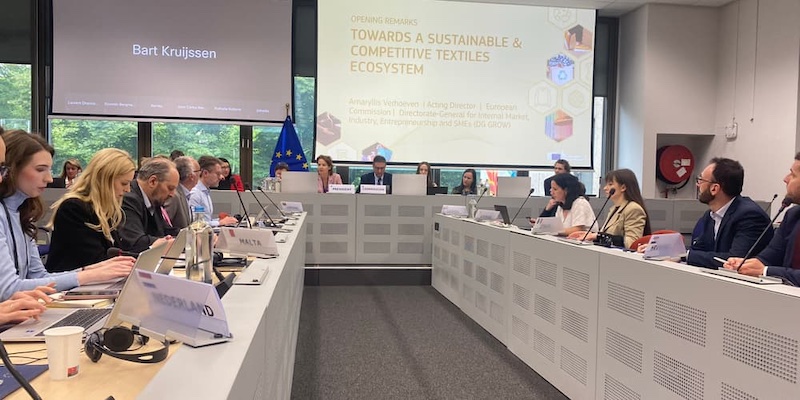
On 4 June 2024, the Textile ETP Secretary General Lutz Walter participated in the European Commission’s Directorate-General for Internal Market, Industry, Entrepreneurship & SMEs (DG GROW) stakeholder event for the Textiles Ecosystem Transition Pathway.
© 2024 Textile ETP
© 2024 Textile ETP


The event updated participants on essential regulatory initiatives under the EU Strategy for Sustainable and Circular Textiles, the EU Pact for Skills, and the implementation of the Transition Pathway for the Textiles Ecosystem. Discussions also covered the European Partnership on Textiles under Horizon Europe, emphasizing the need for industry resilience and competitiveness.

ETP Secretary General Lutz Walter introduced the Textiles of the Future Partnership under Horizon Europe, highlighting its strategic importance for more research and innovation in the sector. This initiative aims to support the textile industry's green and digital transformation while reinforcing Europe's leadership in textile research, technology development, and higher education.

Dirk Vantyghem, Director General of EURATEX, praised DG GROW’s efforts: "it was great to see so many stakeholders committed to implementing the Textiles Transition Pathway. EURATEX will continue its focus on ensuring quality legislation and helping our companies prepare for that transition."

This event also highlights the collaborative effort within the European textile sector to achieve sustainable growth and technological advancement. With the support from initiatives such as the Transition Pathway and Horizon Europe, stakeholders are working together to build a robust and ready for the future textile industry in Europe.

Published in June 2023, the Textiles Ecosystem Transition Pathway outlines 50 actions critical for the EU textiles ecosystem's green and digital transition, enhancing its resilience and competitiveness. For more information about the Transition Pathway for the Textiles Ecosystem, please visit here:

https://op.europa.eu/en/publication-detail/-/publication/6392f189-0416-11ee-87ec-01aa75ed71a1



More News from Textile ETP

#Recycling / Circular Economy

From local actions to industrial innovations: SOLSTICE shares mid-project results

Since its launch in May 2024, the SOLSTICE project is accelerating the transition from linear models to circular regional ecosystems in the textile industry, focusing on four key territories: Grenoble-Alpes Métropole (France), Berlin (Germany), Prato (Italy), and Catalonia (Spain). By mid-project, SOLSTICE has already revealed both regional disparities and promising solutions to strengthen textile repair, reuse, and recycling infrastructure.

#Recycling / Circular Economy

Textile ETP wraps up T-REX's Policy Roundtable

The T-REX project’s policy roundtable in Brussels on November 12 was a pivotal gathering of experts and leaders committed to advancing Europe’s sustainability efforts. Concluding the event, Secretary General Lutz Walter reflected on the discussions and emphasized the core themes that resonated throughout the day.

#Textiles & Apparel / Garment

Shaping new horizons for the textile sector: 18th Textile ETP Conference 2024

The 18th Textile ETP Annual Conference in Mechelen brought together industry leaders, experts, and innovators for two dynamic days of discussions and insights, focusing on sustainability, innovation, funding, and the future of the textile sector.

#Recycling / Circular Economy

Textile ETP and partners launch new textile recycling and upcycling innovation project PESCO-UP

Launched today, the PESCO-UP project focuses on transforming mixed polyester/cotton waste into high-quality and clean materials for the next use cycle, aligning with the EU's 2025 textile waste mandatory collection.

More News on EU Textile Strategy

#Sustainability

Textile Exchange Conference 2025 kicks off next week in Lisbon

From October 13 to 17, 2025, the Textile Exchange Conference will take place at the Lisbon Congress Centre, bringing together brands, supply-chain partners, innovators, farmers, NGOs, academics, and more for a week of collaborative learning and exchange. Under the theme “Shifting Landscapes”, this year’s agenda highlights the urgent need for the textile industry to adapt rapidly to changing environmental, political, and economic conditions, while linking adaptation to broader systems transformation.

#EU Textile Strategy

CEMATEX strengthens EU representation and advocacy for the European textile machinery industry

CEMATEX, the European Committee of Textile Machinery Manufacturers, has reinforced its role as the voice of the EU textile machinery industry by enhancing its presence and engagement with EU institutions and stakeholders.

#EU Textile Strategy

Germany pushes ahead with Producer Responsibility for Textiles

Germany is taking a leading role in shaping extended producer responsibility (EPR) for textiles – a regulatory concept that is gaining traction across the European Union. EPR requires companies that manufacture or sell products such as clothing, home textiles, and shoes to take financial and operational responsibility for the end-of-life management of these goods.

#EU Textile Strategy

2024 is a turning point for the European textiles and clothing industry

From 6 to 9 June 2024, European citizens will vote for a new European Parliament and, based on the results, a new European Commission will be formed. In view of this important election, EURATEX publishes a Manifesto, presenting 15 requests which will help to ensure a competitive European textiles and clothing industry.

Latest News

#Raw Materials

New study shows low environmental impact by Cotton made in Africa Organic Cotton from Tanzania

Today, the Aid by Trade Foundation (AbTF) is announcing the results of a comprehensive life-cycle analysis (LCA) for cotton produced in Tanzania under the Cotton made in Africa Organic (CmiA Organic) standard. The study emphasises the small ecological footprint of CmiA Organic verified cotton. This can largely be traced back to the absence of synthetic pesticides, artificial fertilisers, and artificial irrigation. Consequently, CmiA Organic cotton can help the textile industry meet regulatory requirements as well as science-based targets. The results also show that the consequences of climate change threaten the livelihoods of these cotton farmers, even though the type of agriculture they practise barely contributes to climate change.

#Raw Materials

Better Cotton Initiative strengthens regenerative focus in standard update

The Better Cotton Initiative (BCI) has strengthened the regenerative focus of its field-level standard with the launch of a new version of its Principles & Criteria (P&C), which marks the next step in the organisation’s journey to becoming a regenerative standards system.

#Man-Made Fibers

Selenis and Kintra Fibers partner to scale 100% bio-based synthetic fiber technology

Selenis, a leading global specialty polyester manufacturer, today announced a strategic manufacturing partnership with materials science company Kintra Fibers to scale Kintra’s patented fiber-grade PBS resin - a 100% bio-based and biodegradable material designed for textile applications.

#Functional Fabrics

PERFORMANCE DAYS proves its relevance as the industry’s key meeting point

Held on March 18–19, 2026, PERFORMANCE DAYS once again confirmed its position as a leading international platform for functional textiles. A total of 3.366 trade visitors and around 560 exhibitors gathered in Munich, with the event already kicking off successfully on DAY 0, which received highly positive feedback for its interactive format. Despite challenging conditions caused by the public transport strike in Munich, the event saw strong attendance and a consistently high level of activity across both exhibition days.

TOP