#Digital Printing
From a bedroom startup to 3,000 designs: How Lonely Kids Club built its business with DTG printing
For independent clothing brands, balancing creative freedom with the economics of production can be a considerable challenge. Offering a wide variety of designs traditionally involves decisions about minimum order quantities, inventory and the risk of unsold products. Digital textile printing has opened up alternative approaches, enabling smaller businesses to develop collections around actual customer demand.
Sydney-based Lonely Kids Club provides an interesting example. Founded in 2011 by Warwick Levy after a period of travelling in Europe, the independent clothing label began in his bedroom. What started as a small creative venture has gradually developed into a business with a catalogue of approximately 3,000 graphic T-shirt designs.
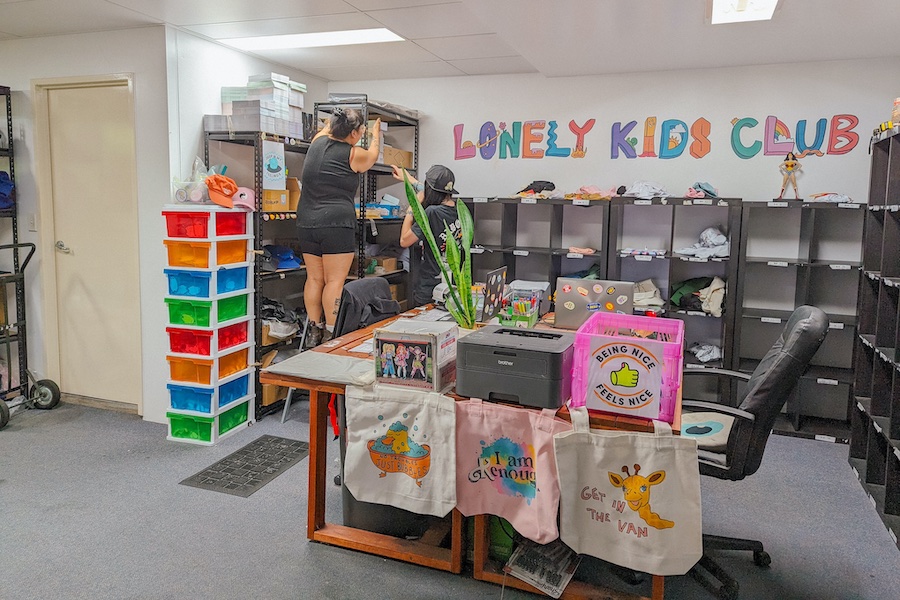
Since 2020, Lonely Kids Club has operated from its own production studio in Artarmon, Sydney. Here, the team handles garment printing, pressing, quality control, packing and shipping in-house. Many designs are created internally, while collaborations with independent artists contribute to the company's distinctive collection. Rather than producing large quantities of each design in advance, Lonely Kids Club uses direct-to-garment (DTG) printing to decorate individual garments when orders are received. This allows the company to maintain an extensive collection without having to stock every design as a finished product.
Growing a collection without growing finished-goods inventory
For Lonely Kids Club, the ability to keep designs available over long periods is central to its business model. Unlike conventional collection cycles, where less popular designs may be discontinued because of inventory costs, on-demand production makes it possible to serve smaller audiences without committing to large production runs.
"An older design can stay available even if it only sells occasionally, because we don’t need to make a whole batch in advance. It gives us room for more unusual artwork and smaller audiences," explains Warwick Levy, founder of Lonely Kids Club.
The collection includes original illustrations, designs developed by the team and collaborations with independent artists. Its broad range of motifs reflects the brand's emphasis on individuality, humour and creative expression.
This flexibility is particularly valuable for independent designers and smaller brands whose collections appeal to specific communities or niche interests. It also allows Lonely Kids Club to expand its catalogue gradually, rather than relying exclusively on seasonal releases. However, offering thousands of designs introduces its own organisational challenges. Each customer order must be matched with the correct artwork, garment size and colour before printing can begin.
Every shirt is a different production job
In an on-demand printing business, consecutive orders may have very little in common. One customer may order a dark T-shirt with a colourful graphic, while the next requires a completely different design on a light garment in another size.
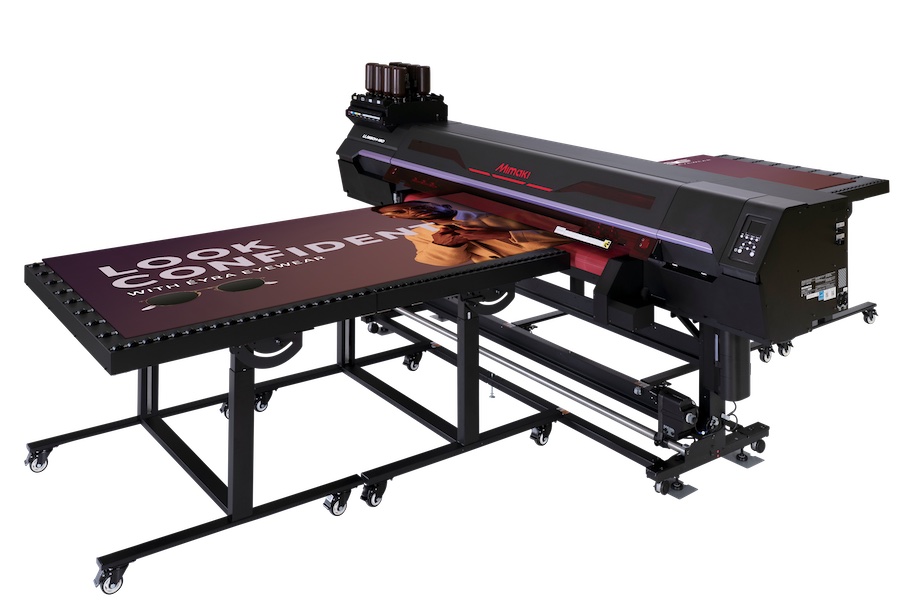
Lonely Kids Club uses Epson DTG printing technology, including an Epson SureColor F3000, to handle its individual orders. Production volumes can range from approximately 100 to 300 prints per day, depending on demand. This requires a workflow capable of handling frequent changes in artwork, garment sizes and colours.
"The next shirt on the platen can be a completely different design, size or colour, so getting the right blank and artwork together matters," Warwick explains.
For Lonely Kids Club, maintaining consistent print quality under these conditions requires careful preparation and regular quality checks.
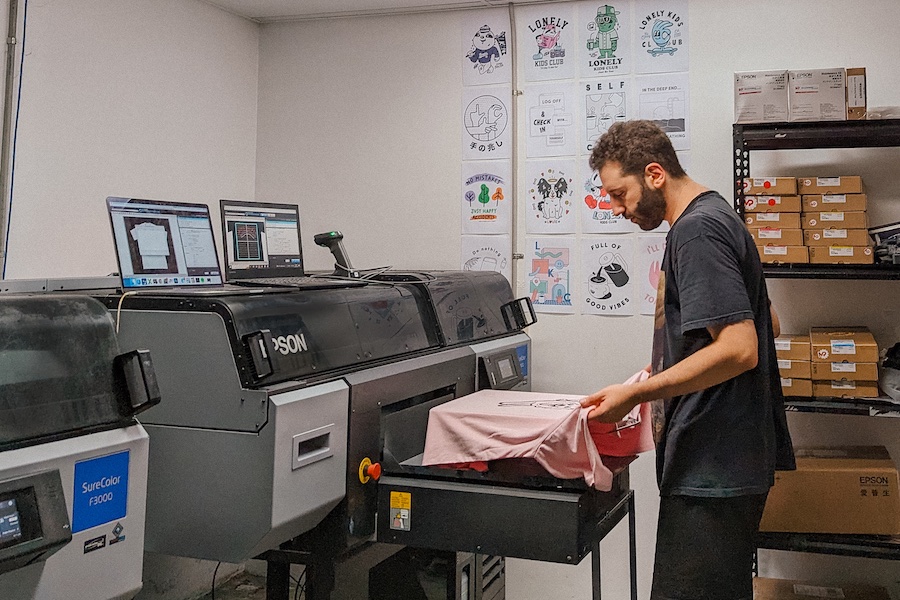
One of the most demanding stages is pretreatment, particularly when printing on darker garments. Warwick identifies pretreatment marks as a common reason for rejecting shirts during final inspection. The company tests colours on the actual garments and dedicates approximately one to one and a half hours per week to maintaining its printers. Finished prints are inspected before packing, regardless of how busy production becomes. Some improvements have come from relatively simple changes. Switching the connection between computers and printers from Wi-Fi to USB, for example, reduced communication glitches.
These practical details illustrate how production reliability depends not only on printing equipment, but also on the organisation of everyday operations.
Where automation could make a difference
Although digital printing eliminates many of the preparation steps associated with conventional printing methods, not every part of the production workflow is automated.
At Lonely Kids Club, linking individual customer orders to the corresponding digital artwork remains one area with potential for improvement. The company uses a QR-based system that can open the relevant print file, but the connection between the code and the artwork still has to be established manually. As a result, this functionality is not always used.
"Making it easier to link artwork to each job would save us time," Warwick says.
Another area of interest is the integration of pretreatment and printing. Since pretreatment accounts for a significant share of the maintenance effort in the current production setup, greater consistency and simpler handling could offer practical advantages. Warwick is following developments in integrated systems, but remains cautious about investing in new equipment before its reliability has been demonstrated in everyday use. "Pretreatment takes the most maintenance in our current setup, so improving its consistency would make a real difference. I’m watching the newer options, but I’d rather give them time to prove themselves before committing."
For smaller businesses, such investment decisions are particularly important. Improvements must deliver tangible benefits in productivity, quality or operating costs rather than simply introducing additional technological complexity.
Producing what customers actually order
Beyond operational flexibility, the on-demand model offers potential advantages in resource efficiency. By printing garments only after receiving an order, Lonely Kids Club avoids the need to produce large quantities of finished printed products in anticipation of future sales. Designs that attract only occasional demand can remain in the catalogue without creating stocks of unsold merchandise.
This reduces the risk of overproduction at the garment decoration stage and can help limit waste associated with obsolete collections or unsold printed inventory.
According to information published by the company, Lonely Kids Club also takes steps to reduce waste in its production processes. These include reusing printing cartridges, working with a local partner in Western Sydney to manage leftover inks and incorporating fabric offcuts into selected handmade products.

However, the model does not eliminate the environmental footprint of apparel manufacturing. Blank garments must still be produced and stocked, while printing consumes inks, pretreatment chemicals and energy. Production errors or rejected prints can also result in waste.
Nevertheless, aligning garment decoration with actual demand offers a practical way to reduce one source of unnecessary production. For smaller brands, the economic advantage of avoiding unsold finished goods can therefore coincide with potential environmental benefits.
Lessons from fifteen years of independent production
The experience of Lonely Kids Club demonstrates that building an extensive product range does not necessarily require large-scale manufacturing or substantial inventories of finished garments.
Since 2011, the company has developed a model that combines original design, collaborations with independent artists and flexible digital production. Its catalogue of approximately 3,000 designs reflects the possibilities of maintaining a broad creative offering while producing individual garments according to customer demand. At the same time, Warwick's experiences underline the importance of reliable processes. Pretreatment quality, regular maintenance, accurate job preparation and final inspection remain essential, even when production is digitally driven. For smaller apparel brands, independent designers and printing businesses, Lonely Kids Club provides a practical example of how established DTG technology can support a specialised business model.
The lesson is not that digital printing removes the challenges of apparel production, but that it allows businesses to organise part of that production differently – with greater flexibility, less dependence on finished-goods inventory and more room for creative experimentation.