[pageLogInLogOut]

#Yarn & Fiber

Gebr. Otto expands near-shoring portfolio: yarns with ‘EU-COTTON’ certification now in the programme
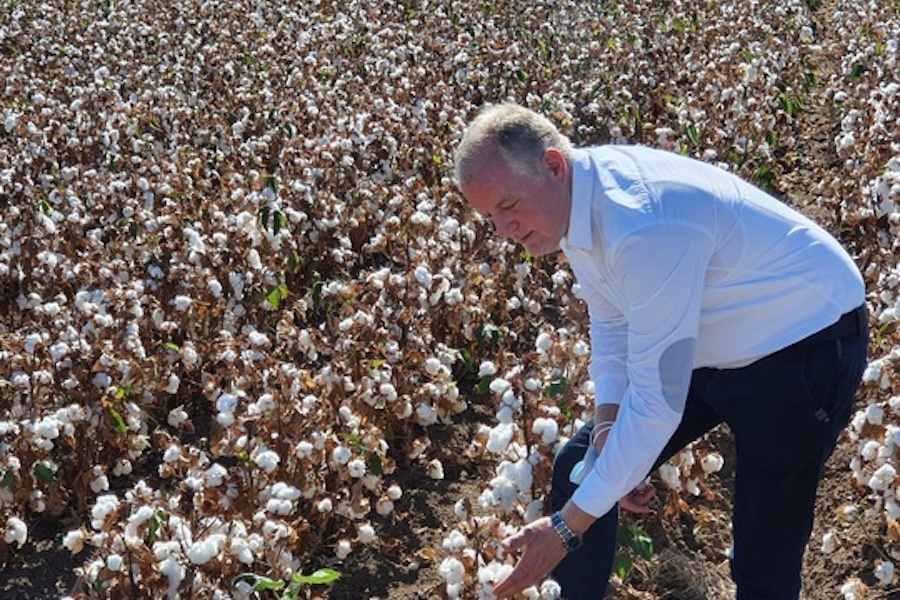
Since this spring, Gebr. Otto has cotton yarns with the ‘EUCOTTON’ certification in its programme. The fibres for these yarns come from Greece and Spain, both countries with a long tradition in cotton production and extensive know-how. For Gebr. Otto, the EUCOTTON yarns are an ideal addition to the product portfolio, which focuses on sustainable and innovative yarns. Short distances and regional partners, both in procurement and in further processing, are also part of the strategy of the traditional textile company with spinning, twisting and dyeing mills.
Gebr. Otto attaches great importance to a transparent and responsible supply chain. Gebr. Otto sources cotton fibres from Andalusia for its ‘Cotton since 1901’ brand. Picture: © 2025 Gebr. Otto


Apart from that, the local approach is becoming increasingly important for Gebr. Otto in view of the latest developments in customs policy.

‘We are pleased that we at Gebr. Otto can now also offer EUCOTTON yarns,’ says Andreas Merkel, managing director of the Upper Swabian textile company Gebr. Otto. ’The EUCOTTON initiative is timely and forward-looking for many reasons.’

Small market share, high quality

The European appetite for new textiles is considerable, but the possibilities for tracing the origin of the textiles are limited. In addition, the fibres ‘grown in Europe’ are of exceptionally high quality, and demand worldwide is high.

European raw cotton comes from Spain and Greece. So far, a quarter of these fibres have also been processed in Europe. The rest is exported, sometimes via long detours to Southeast Asia, before returning to the EU as textile end products. ‘This makes little sense for ecological reasons alone,’ says Otto CEO Merkel. In view of the increasing trade restrictions and problems in global supply chains, European sourcing must be prioritised. ‘It should be our aim to process the majority of European cotton in Europe, especially since it is of exceptionally high quality.’

Advantages of European cotton growing

The high quality of EUCOTTON yarns is based on advanced production methods, including exclusively mechanical harvesting. The careful harvesting methods ensure that the fibres are almost free of impurities, for example from foreign fibres. The latest technology is also used for cleaning and ginning.

Cotton fibres from the Spanish and Greek harvests are exceptionally uniform in terms of fibre length, strength and thickness. ‘All of this contributes to the spinnability of the fibres,’ says Andreas Merkel. ‘They can also be processed in an enormous variety of ways.’

Responsibility grown

Beyond the technical advantages of the raw material, EUCOTTON offers important benefits in terms of ecological and social responsibility: the GMO-free seeds protect the ecosystem and natural resources. The same goal is pursued by water management: cotton growing is water-intensive and measures such as drip irrigation and precision farming can reduce the impact. The principle of minimisation also applies to the use of pesticides and insecticides.

‘If we source our cotton from Europe, we can be sure that the legal framework, for example with regard to working hours and occupational safety, is being adhered to,’ adds Andreas Merkel.

Short distances create reliability

In addition to transparency and high quality, reliable and fast availability are another argument in favour of EUCOTTON. ‘Of course, high-quality cotton also grows elsewhere in the world, for example in Peru or the USA. However, it then has to endure a six- to eight-week sea voyage before it arrives in Germany.’ From Spain, the raw cotton reliably travels by truck to the doorstep of the processor in just five days.

EUCOTTON captures the spirit of the times

‘At Gebr. Otto, we have long placed great value on short, reliable and transparent supply chains,‘ explains Andreas Merkel. “Although we do not fall under the Supply Chain Act due to the size of our company, we meet its requirements, for example with cotton yarns from our brand ”Cotton since 1901: Made in Germany’’. For these ultra-fine cotton yarns, Gebr. Otto processes extra-long-staple cotton fibres from Andalusia in southern Spain.

The company has had very good experiences with this approach: ‘We are increasingly aware of our customers’ desire to offer transparency to the end customer.’ Gebr. Otto's experiences with the new EUCOTTON addition are correspondingly positive: “High-quality European brand manufacturers are very interested in yarns with this label,” says Merkel.
More News from Gebr. Otto Baumwollfeinzwirnerei GmbH + Co. KG

More News on Yarn & Fiber

#Man-Made Fibers

Lenzing advances its transformation: Higher EBITDA, stronger free cash flow and more than EUR 200 million in cost savings

The business performance of the Lenzing Group in 2025 was affected particularly in the second half of the year by external factors such as international tariff measures, subdued demand and declining market prices. As a result, revenue decreased slightly by 2.3 percent to EUR 2.6 billion, primarily due to lower fiber sales volumes and lower prices for fibers and pulp, which were further negatively impacted by currency developments. Nevertheless, thanks to the comprehensive Performance Program, Lenzing was able to improve its operating performance and key financial indicators compared with the previous year.

#Man-Made Fibers

“Lead Transformation – Generate Impact”: Lenzing presents its 2025 Annual and Sustainability Report

The Lenzing Group has published its 2025 Annual and Sustainability Report, entitled LEAD TRANSFORMATION – GENERATE IMPACT. The report shows how Lenzing is actively shaping change in the industry and making a lasting impact: economically, ecologically, and socially. Lenzing is consistently focused on the future: with targeted investments in premiumization, excellence, innovation, and sustainability, the company is strengthening its position as a leading provider of sustainable, cellulose-based premium fibers. The combined report is available in digital format.

#Raw Materials

Lenzing Group positions bio‑based materials as a strategic asset for Europe’s economic security

The Lenzing Group, a leading supplier of regenerated cellulose fibers for the textile and nonwovens industries, hosted a high‑level roundtable in Brussels to discuss how bio‑based materials can strengthen Europe’s economic security and support the shift toward a fossil‑free future. Organized in cooperation with Euractiv, the event brought together representatives of the European Commission, the UK Mission to the EU, academia, civil society, and industry.

#Yarn & Fiber

Teijin Carbon strengthens high‑end sports offering with advanced prepreg and resin technologies for next‑generation bicycle performance

High‑end bicycle manufacturers are entering a new era in which modern frames and components must be lighter, stiffer, tougher and more sustainable – all while enabling fast, repeatable and cost‑efficient production. To support this shift, Teijin Carbon is expanding its portfolio of advanced prepreg systems developed specifically for premium road, gravel and mountain bike applications.

Latest News

#Europe

Commission presents proposal for EU Inc. - unlocking the full potential of the Single Market for Europe's entrepreneurs

Today, the European Commission presented its proposal for EU Inc., a new single set of corporate rules, building the cornerstone and starting point for the EU's 28th regime. EU Inc. is an optional, digital-by-default European corporate framework. It will make it easier for businesses to start, operate and grow across the EU – incentivising them to stay in Europe, and encourage those who once looked elsewhere to return.

#Man-Made Fibers

OnceMore® from Södra brings end-to-end traceability for circular Man-made Cellulosic Fibers (MMCF) using TextileGenesis

OnceMore® from Södra, the world’s first large-scale process for recycling blended fabrics into high‐quality dissolving pulp, will begin using TextileGenesis, a Lectra company, to strengthen traceability from raw material to retail across the value chain. OnceMore® produces dissolving pulp made from blended textile waste and wood sourced from responsibly managed Swedish forests. By integrating TextileGenesis, OnceMore® supports the growing need for verified data and secure, transparent tracking throughout increasingly complex supply chain.

#Sustainability

Experts publish APAC policy priorities

Cascale today announced the publication of its APAC Policy Priorities Paper, developed by the Asia-Pacific (APAC) Policy Member Expert Team (MET) to identify key regional sustainability challenges and provide practical, aligned recommendations for policymakers and industry stakeholders across Asia-Pacific.

#Spinning

Temco launches a new DTY all-in-one solution

Temco introduces the DTY All-in-One Solution – a fully harmonized set of components engineered to give customers a highly stable, low maintenance and reproducible process environment. The solution reduces interruptions, extends component lifetimes and supports consistent yarn quality across all machine positions. All-in-One Solution – a fully harmonized set of components engineered to provide maintenance and reproducible process environment.

TOP