[pageLogInLogOut]

#Techtextil 2026

Gebr. Otto highlights versatility at Techtextil with regional supply chains, yarn innovations and new hygiene segment
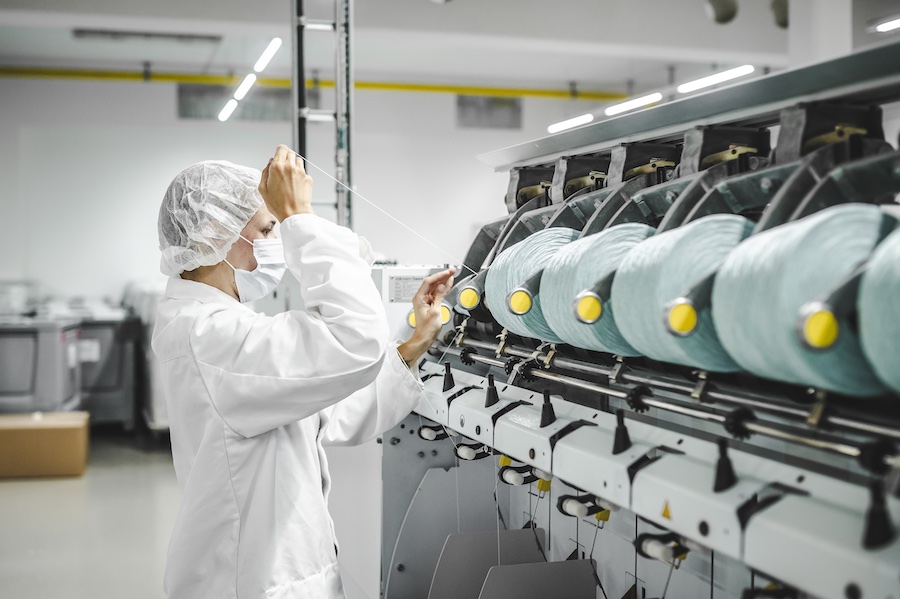
Under strictly controlled conditions, yarns for hygiene products are produced in Gebr. Otto’s hygiene area. © 2026 Gebr. Otto
At this year’s Techtextil, Gebr. Otto places its versatility at the center of its presentation. In addition to spinning, twisting and dyeing – traditionally focused on fine cotton – textile processors will also find a competent development partner for technical specialty solutions. The Dietenheim-based spinning mill has now built up a decade of experience in the production of technical yarns, particularly from aramids. A new hygiene segment has also been established, where yarns for medical and hygiene products are currently being produced. In the future, this department could also develop textile products for the food sector. Gebr. Otto will once again be present at the BW-i joint stand, booth D81, hall 12.1. What is wound onto the spool is determined by the customer: Gebr. Otto develops according to specific customer requirements and transforms its own ideas into yarn innovations.

A future rooted in tradition

“The name Gebr. Otto has stood for fine cotton products since 1901,” says Andreas Merkel, Managing Director of Gebr. Otto. The company will celebrate its 125th anniversary in July this year.

Alongside cotton yarns and threads, the company has continuously expanded its product portfolio. Today, a key focus lies on technical yarns, particularly those made from aramids and other flame-retardant fibers.

Processing these fibers is highly demanding. Their extremely high tensile strength combined with low elasticity requires very precise spinning processes, as even minor irregularities in the drafting system can lead to fiber breakage. In addition, aramid fibers are stiff and exhibit lower fiber-to-fiber friction, making specific process adjustments necessary to achieve the desired yarn strength.

“We operate within a very narrow process window when working with aramids,” explains Oliver Kächler, long-standing plant manager and authorized signatory at Gebr. Otto. These yarns are used, for example, in flame-retardant underwear for firefighters.

Room to spin ideas into innovation

Gebr. Otto has been operating its technical spinning mill in Balzheim for almost ten years. Its development illustrates the company’s ability to adapt and evolve: in the mid-1990s, Spinning Mill I (built in 1958) was shut down, and cotton yarn production was relocated to the newly built, modern Spinning Mill II.

The freed-up space continued to serve as a place for innovation: products such as absorbent kapok pads, tampons with kapok cores and cotton swabs were developed there, although without lasting market success. Nevertheless, the experience gained proved valuable. In 2004, Gebr. Otto became the first spinning mill to successfully process kapok fibers in combination with cotton into a yarn.

Another forward-looking development is recot2, a cotton yarn consisting of 25% recycled process waste and 75% virgin cotton. The company developed its own spinning process for this yarn, which was launched in 2008. “We were perhaps a bit ahead of our time,” says Andreas Merkel with a smile. “Circular economy has only become truly relevant in recent years.”

Initial trials with aramid fibers began in the 2000s. The company’s broad material expertise enabled the “Otto Engineering Team” to achieve strong results early on – and gave Spinning Mill I its current purpose.

“We are never satisfied with the status quo, but continuously search for new products, more sustainable solutions and new market segments,” Merkel adds.
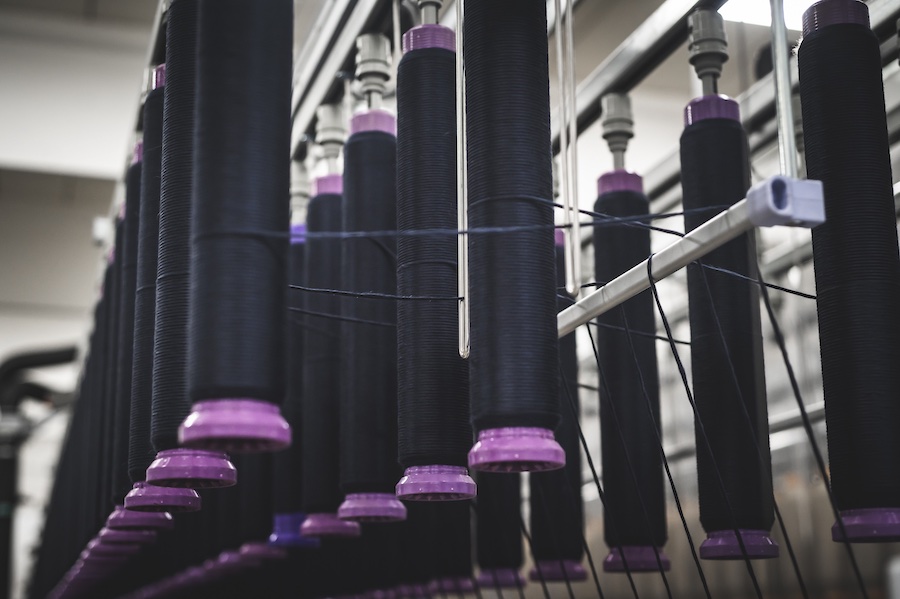
Aramid fibers place high demands on the spinning process: the combination of extremely high tensile strength and low elasticity requires maximum precision in processing. © 2026 Gebr. Otto


Hygiene segment: potential for medical and food applications

In line with its corporate philosophy, Gebr. Otto has operated its own hygiene area since early 2025. Under strictly controlled conditions, yarns for medical and hygiene applications are produced here. This includes dedicated pest monitoring, protective equipment for personnel and changing facilities with black/white separation. Access to the hygiene area is only possible via airlock systems.

“We are confident that this setup will allow us to address additional customers from the food and medical sectors in the future,” says Merkel.

Ongoing developments

One recently completed project is “Eco Yarn”, a collaboration with the Recycling Atelier Augsburg of the Institute of Textile Technology Augsburg (ITA), Augsburg University of Applied Sciences, and industry partners Schwob and Weseta.

The project team succeeded in breaking down used rental textiles into fibers, reprocessing them and spinning them into a new yarn blended with 70% virgin cotton.

Currently under development is the “Innocell” project in cooperation with the German Institutes of Textile and Fiber Research (DITF).
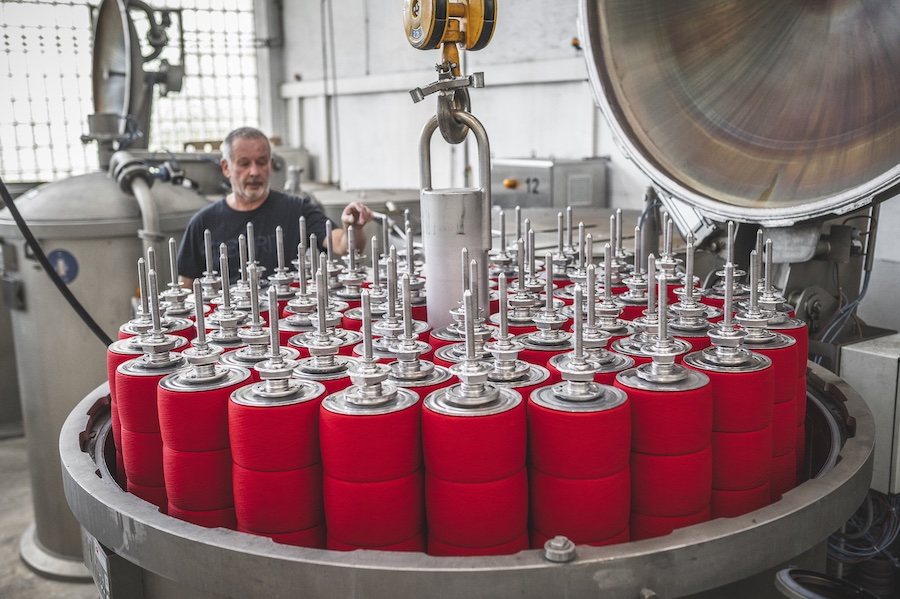
At its state-of-the-art dyeing facility, Gebr. Otto brings color to yarn – and to life. © 2026 Gebr. Otto


Cotton remains the core

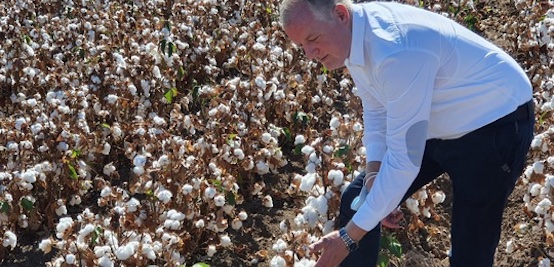
Alongside technical innovations, cotton remains central to Gebr. Otto’s business. Since spring 2025, the company has offered cotton yarns certified with the EUCOTTON label. The fibers originate from Greece and Spain and stand for short, transparent supply chains within Europe.

Another example of regional value creation is the “Lokalstoffmacher” project. “It is often assumed that regional products are automatically more expensive,” says Merkel. “However, when considering transport, duties, taxes and improved planning reliability, the price difference is often significantly reduced.” Project partners Edelweiss Jersey, Textilveredlung Keller and Gebr. Otto are considering expanding their cooperation beyond cotton yarns.

The company is also working on a yarn made from organic cotton and native hemp grown in Germany. The regionally cultivated winter hemp is processed by a project partner and then spun together with cotton or TENCEL. Hemp requires significantly less water than cotton and is therefore considered particularly resource-efficient. A special processing method enables the fibers to be prepared for spinning with cotton.

“We are looking forward to this year’s Techtextil – and to demonstrating our versatility to visitors,” concludes Merkel.
More News from Gebr. Otto Baumwollfeinzwirnerei GmbH + Co. KG

More News on Techtextil 2026

#Techtextil 2026

FET’s revolutionary gel spinning system wins Techtextil Innovation Award

FET has received the prestigious Techtextil Innovation Award 2026 in the New Production Technology category. The Techtextil Innovation Award honours outstanding ideas in textile technology, sustainability, AI and the creation of technical textiles, selected by an international jury of experts. Ranging from new materials to new production technologies, this award recognises progressive ideas that are driving forces for numerous industries, such as automotive, medical and construction.

#Techtextil 2026

Young talents honoured – 60 years Walter Reiners Foundation

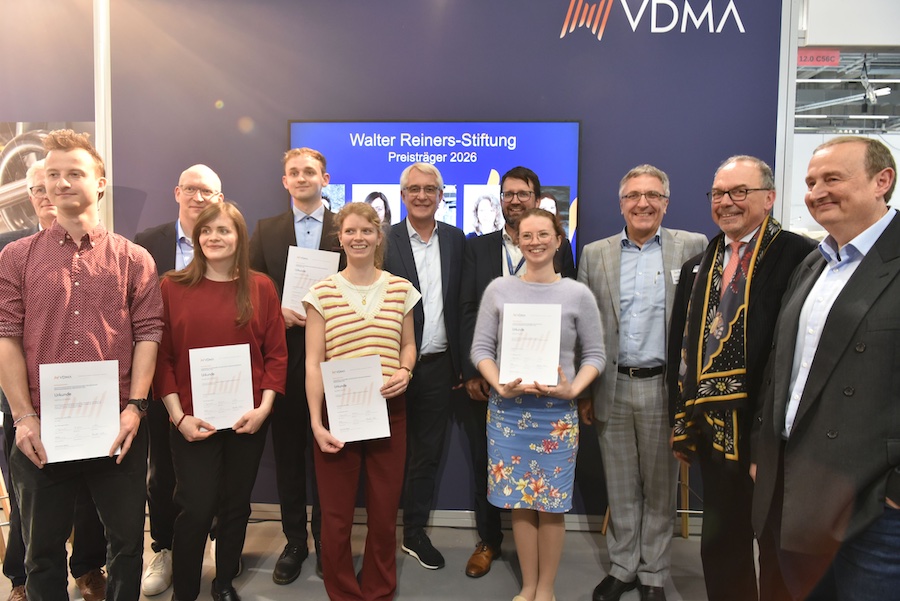
At the Techtextil trade fair in Frankfurt at the end of April, Peter D. Dornier, chairman of the VDMA’s Walter Reiners Foundation, presented awards to five successful young engineers. Promotion and sustainability awards were presented in the categories of bachelor’s/project theses and diploma/master’s theses. Academic theses are eligible for the sustainability awards if, for example, they develop solutions for resource-efficient products and technologies.

#Techtextil 2026

Techtextil 2026: KARL MAYER impresses as an innovative sector partner

KARL MAYER looks back with satisfaction on its participation in Techtextil 2026. From April 21 to 24, the international industry leader used the trade show in Frankfurt to meet with numerous key customers at its booth and, at the same time, establish many new contacts. Most visitors came from Germany, followed by major markets such as Poland, the United Kingdom, Turkey, France, and Portugal.

Latest News

#INDEX 2026

“We clearly see that reliability, flexibility, service and total cost of ownership are becoming increasingly important again.”

The nonwovens industry continues to face a challenging market environment. Nevertheless, AUTEFA Solutions reports successful projects, new line sales and growing demand for energy-efficient and flexible solutions. In this interview, André Imhof of AUTEFA Solutions talks about competitiveness against Chinese suppliers, new service and recycling concepts, the growing importance of application development and the opportunities created by countercyclical investments.

#INDEX 2026

“Needle punching technology is more universal and sustainable than ever!”

Needle punching technology was long regarded as a rather traditional and comparatively slow technology within the nonwovens industry. In this interview, Johann Philipp Dilo explains why needle punching is more relevant than ever today – ranging from energy efficiency and resource conservation to hygiene applications, new machine concepts and design-oriented nonwoven solutions.

#Research & Development

Textile climate control system in workwear – exhibition at the 2026 SME Innovation Day!

Conventional protective workwear often reaches its limits during strenuous physical activity. In particular, the transport of sweat and excess body heat poses a problem. The German Institutes of Textile and Fiber Research (DITF) conducted research on flow-optimized, air-conducting textile structures that enable targeted climate control directly on the body. These structures can be integrated straight into protective work garments. The textile climate control system supports the body’s natural thermoregulation. This contributes to improved workplace safety and comfort.

#Nonwovens

PET spunbond from China – EDANA welcomes imposition of provisional anti-dumping measures

On 13 May 2026, after eight months of investigation, the European Commission imposed provisional anti-dumping duties of 45.6-50.0% on imports of PET spunbond from China. EDANA welcomes this expression of the Commission’s clear determination to protect EU industries from the unfair trade practices of Chinese producers.

TOP