[pageLogInLogOut]

#Textile chemistry

How to defossilise the chemical industry: RCI’s new policy proposals for a renewable carbon future

A new report presents policy proposals to facilitate the transition from fossil carbon to renewable carbon from biomass, CO2 and recycling in Europe.

The European chemical industry, a cornerstone of manufacturing with significant economic impact and a key enabler for many other industries, is at a crossroads. The sector is facing an acute crisis due to global competition, rising energy costs and regulatory burdens. Once a leader in patents and production, Europe now trails behind China and the US, reflecting signs of declining competitiveness. The sector’s heavy reliance on fossil fuels for raw materials (over 90%) exacerbates its challenges, creating dependencies and limiting control over its carbon footprint at a time when Europe is grappling with the need for a green transition to ensure long-term prosperity and competitiveness. As a result, there are clear signs of ongoing deindustrialisation in the EU chemical industry. 

Amidst these challenges lies an opportunity: Defossilising Europe’s chemical sector by transitioning to renewable carbon sources such as biomass, carbon capture and utilisation (CCU) and recycling. This shift is not merely an environmental necessity, but a strategic move to enhance Europe’s industrial competitiveness and resilience in the global marketplace. However, progress is hampered by regulatory barriers, the slow expansion of renewable energy, insufficient demand for sustainable products and limited uptake of new technologies.

To address these barriers, the Renewable Carbon Initiative (RCI) has released a comprehensive report outlining ten policy proposals designed to accelerate the transition to renewable carbon in feedstocks and materials. Developed in collaboration with experts from nova-Institute and RCI members, these proposals aim to bridge the gap between innovation and large-scale implementation. 

A vision for defossilisation: Driving change through targeted policies

The defossilisation of Europe’s chemical industry requires not only a clear commitment to defossilisation but also an actionable policy framework that supports, guides and incentivises the transition to renewable carbon. At the heart of this vision is an overarching commitment to defossilisation – a high-level agreement that establishes the foundation on which all future European policies can build upon. To create concrete market demand for sustainable products from renewable carbon, mandatory targets for the use of renewable carbon in chemicals and materials should be implemented. This can either be achieved by novel regulation or adaptation of existing regulations such as the Packaging and Packaging Waste Regulation (PPWR), the End-of-Life of Vehicles Regulation (ELVR) or the Ecodesign for Sustainable Products Regulation (ESPR) – and an adaptation of the EU Emission Trading System (ETS) or an alternative European Carbon Utilisation Trading System (CUTS).

To make the transition to renewable carbon a reality, EU policy further needs to enable sustainable access to renewable carbon feedstocks while ensuring competitiveness at both global and sectoral levels. To achieve this, RCI’s policy proposals include concrete suggestions to facilitate access to more waste as a feedstock, secure local access to biomass from agriculture, forestry and carbon capture, lead the way on international trade of renewable carbon feedstocks, balance regulation between energy and material uses to maximise synergies and ramp up availability of affordable renewable energy e.g. by favourable conditions for alignment with defossilisation targets. 
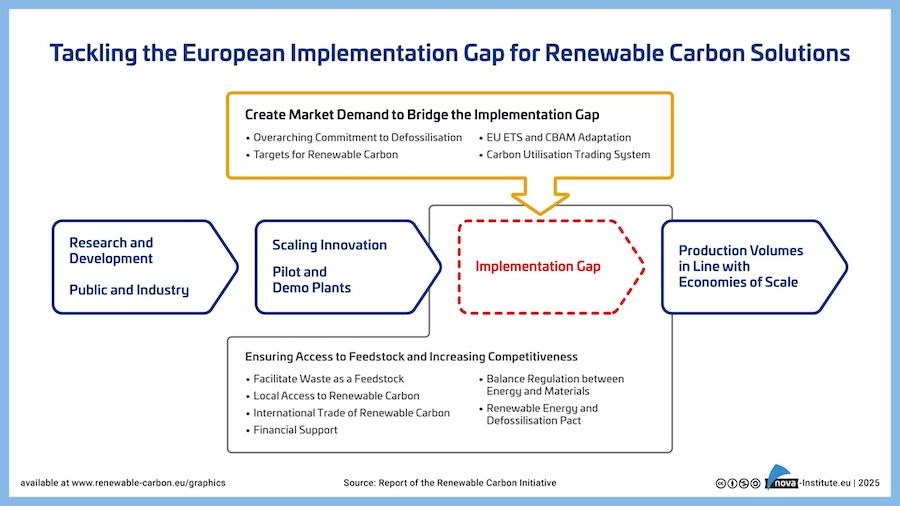
A new report by the Renewable Carbon Initiative outlines 10 concrete policy proposals to facilitate the transition of Europe’s chemical industry to renewable carbon. These proposals are aimed to support the target of a clean, but competitive chemical industry in Europe with increased resilience and lower fossil dependence. © nova-Institute


A new report by the Renewable Carbon Initiative outlines 10 concrete policy proposals to facilitate the transition of Europe’s chemical industry to renewable carbon. These proposals are aimed to support the target of a clean, but competitive chemical industry in Europe with increased resilience and lower fossil dependence. © nova-Institute

Addressing the implementation gap to unleash innovation

The transition to renewable carbon is not just about environmental sustainability; it is about securing Europe’s industrial future and maintaining its global competitiveness in a rapidly changing world. By pioneering renewable carbon technologies, the EU can unlock economic benefits and unleash its innovation potential while advancing climate neutrality ambitions. 

Addressing defossilisation and supporting the transition to renewable carbon will provide a comprehensive and reliable framework for the transformation of the chemicals and materials sector – in particular addressing the implementation gap from innovation to scaled product.

As highlighted by the EU Competitiveness Compass: “To shift the economy towards clean production and circularity, the EU needs to develop lead markets and policies to reward early movers.” The RCI’s policy proposals are in line with this vision by addressing key challenges and providing actionable solutions.

More News from nova-Institut für politische und ökologische Innovation GmbH

#Recycling / Circular Economy

Advanced Recycling Conference 2026 to showcase innovations – Call for abstracts

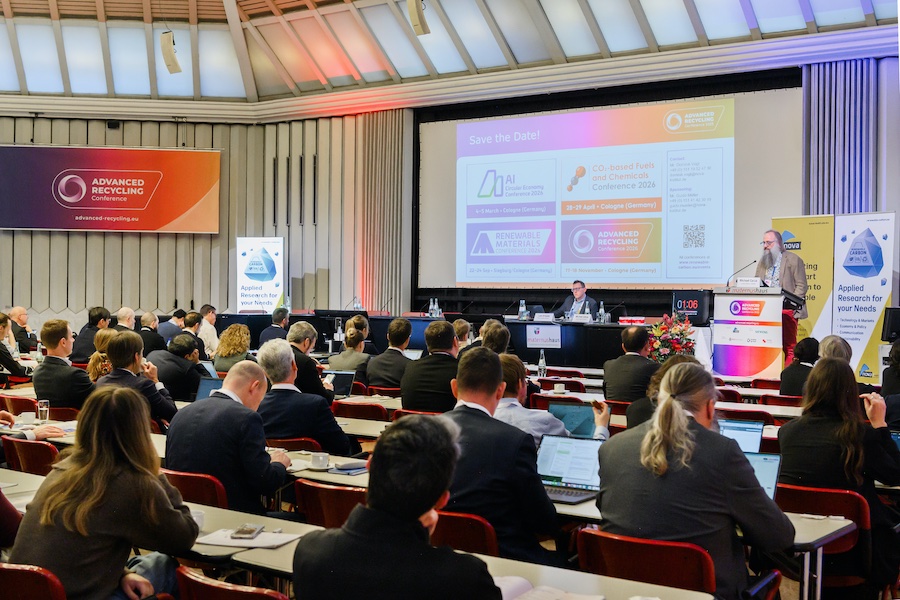
The call for abstracts is now open for the Advanced Recycling Conference (ARC) 2026, taking place on 17–18 November 2026 in Cologne, Germany, and online. Europe’s leading platform for advanced recycling brings together hands-on solutions and cutting-edge research on recycling technologies for various waste streams like plastics, polymers, textiles or automotive, highlighting progress towards a circular renewable carbon economy.

#Recycling / Circular Economy

AI Circular Economy Conference 2026 fuels innovation at the intersection of AI and Circular Economy

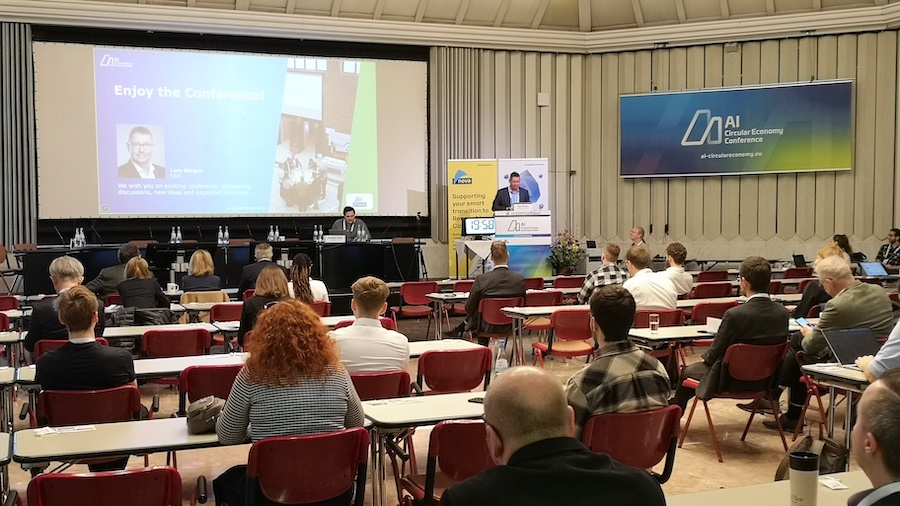
The AI Circular Economy Conference 2026, organised by nova-Institute, brought together 116 participants from 15 countries in Cologne and online to explore the transformation of the chemical and materials industry supported and accelerated by artificial intelligence. During the two-day event, leading experts from industry, research, start-ups and the investment community discussed how AI can maximise the potential of renewable carbon creating efficient circular value chains. The conference featured 24 presentations and multiple panel discussions, highlighting the growing convergence of digital technologies and circular material systems. It demonstrated how artificial intelligence is progressing from the experimental stage to real industrial implementation within the circular economy.

#Research & Development

Pioneer of the first hour: Michael Carus steps down after more than 30 years from nova-Institute’s Management

After more than three decades at the helm, founder and CEO Michael Carus is set to step down as head of the Renewable Carbon division on 1 March 2026. Lars Börger as the new CEO, will take over this key position of the nova-Institute together with COO Linda Engel, while Carus will remain with the research and consulting company as a senior advisor and shareholder. This change takes place after a one-year transition phase, as planned.

#Sustainability

The nova-Institute establishes new Renewable Feedstock Department to lay the groundwork for industrial defossilisation

The transition from fossil-based to renewable carbon – sourced from biomass, CO₂ utilisation and recycling – is the cornerstone of a climate-neutral chemical industry. The nova-Institute’s new department is dedicated to providing the essential data, analyses and strategic roadmaps required to secure a reliable future feedstock supply and make this transition a commercial and ecological reality.

More News on Textile chemistry

#Techtextil 2026

Covestro to exhibit solutions for a more sustainable and productive textile industry at Techtextil 2026

Covestro will present a broad portfolio of material innovations for textile coatings, adhesive films and thermoplastic polyurethanes (TPUs) at Techtextil 2026 (Hall 11.0, Booth C79). The exhibits will demonstrate how advanced solutions can enhance durability, recyclability and manufacturing efficiency across applications such as automotive, infrastructure, protective apparel and sportswear. A particular focus will be on more sustainable coating technologies, including antimicrobial systems based on INSQIN® in combination with AGXX from Heraeus Precious Metals, as well as the integration of Pontacol® thermoplastic adhesive films into Covestro’s offering.

#Textile chemistry

Orta and Archroma launch denim collection dyed with wool waste

Archroma, a global leader in specialty chemicals, and Orta Anadolu, the premium Türkiye-based denim manufacturer behind the ORTA brand, today announced a collaboration to bring circular dye chemistry into commercial denim production.

#Denim

Archroma expands denim possibilities at Kingpins Amsterdam

Archroma, a global leader in specialty chemicals, will present a portfolio of six sustainable denim innovations at Kingpins Amsterdam from April 15-16, 2026. Under the theme “Creating Possibilities in Denim”, the showcase reflects Archroma’s commitment to giving brands and mills solutions that are as commercially compelling as they are environmentally responsible.

#Techtextil 2026

TANATEX to spotlight compliance-driven innovation at Techtextil 2026

At Techtextil 2026, TANATEX Chemicals will present a focused innovation story built around a clear market need: helping textile manufacturers meet increasingly demanding sustainability and compliance requirements without compromising critical performance.

Latest News

#Raw Materials

New study shows low environmental impact by Cotton made in Africa Organic Cotton from Tanzania

Today, the Aid by Trade Foundation (AbTF) is announcing the results of a comprehensive life-cycle analysis (LCA) for cotton produced in Tanzania under the Cotton made in Africa Organic (CmiA Organic) standard. The study emphasises the small ecological footprint of CmiA Organic verified cotton. This can largely be traced back to the absence of synthetic pesticides, artificial fertilisers, and artificial irrigation. Consequently, CmiA Organic cotton can help the textile industry meet regulatory requirements as well as science-based targets. The results also show that the consequences of climate change threaten the livelihoods of these cotton farmers, even though the type of agriculture they practise barely contributes to climate change.

#Raw Materials

Better Cotton Initiative strengthens regenerative focus in standard update

The Better Cotton Initiative (BCI) has strengthened the regenerative focus of its field-level standard with the launch of a new version of its Principles & Criteria (P&C), which marks the next step in the organisation’s journey to becoming a regenerative standards system.

#Man-Made Fibers

Selenis and Kintra Fibers partner to scale 100% bio-based synthetic fiber technology

Selenis, a leading global specialty polyester manufacturer, today announced a strategic manufacturing partnership with materials science company Kintra Fibers to scale Kintra’s patented fiber-grade PBS resin - a 100% bio-based and biodegradable material designed for textile applications.

#Functional Fabrics

PERFORMANCE DAYS proves its relevance as the industry’s key meeting point

Held on March 18–19, 2026, PERFORMANCE DAYS once again confirmed its position as a leading international platform for functional textiles. A total of 3.366 trade visitors and around 560 exhibitors gathered in Munich, with the event already kicking off successfully on DAY 0, which received highly positive feedback for its interactive format. Despite challenging conditions caused by the public transport strike in Munich, the event saw strong attendance and a consistently high level of activity across both exhibition days.

TOP