#Techtextil 2026
Smart textiles can also be sustainable, eco-friendly and AI-powered – ITA at Techtextil 2026
ITA Aachen embraces the concept of sustainability and, through its exhibits, presents solutions to specific contemporary challenges:
1. 4D-printed textiles
4D textiles are textile structures capable of selectively altering their shape or function over time. The ‘fourth dimension’ refers to their response to external stimuli such as temperature, humidity, light or electrical impulses. These are typically based on active materials such as shape-memory polymers, shape-memory alloys or hygroscopic fibres, which are integrated into textile structures. Their role lies in the development of adaptive, functional systems: from climate-regulating clothing and textile-based actuators in soft robotics to self-deploying or medical applications. 4D textiles transform textiles from passive flat structures into responsive, intelligent systems.
2. AlgaeTex sports shoe
Algae have immense potential as a bio-based raw material to replace petroleum in synthetic textiles: they grow rapidly and can absorb carbon dioxide more efficiently than other bio-based raw materials derived from land plants. Furthermore, their cultivation requires less land – including land unsuitable for other crops – and avoids the use of pesticides. The use of algae as a renewable resource for the production of biopolymers and textiles circumvents the challenges of competing with low fuel prices by creating higher-value applications. In this way, the German textile industry can act as a catalyst for the shift away from fossil fuels towards a bioeconomy in which algae represent an important source of biomass.
The AlgaeTex project demonstrates that the production of thermoplastic biopolymers from algae for textile applications is technically feasible. These novel biopolymers are melt-spun and processed into high-quality textiles that are of significance to the sporting goods industry, such as knitted shoe uppers or T-shirts.
3. Visionary Agrotextiles
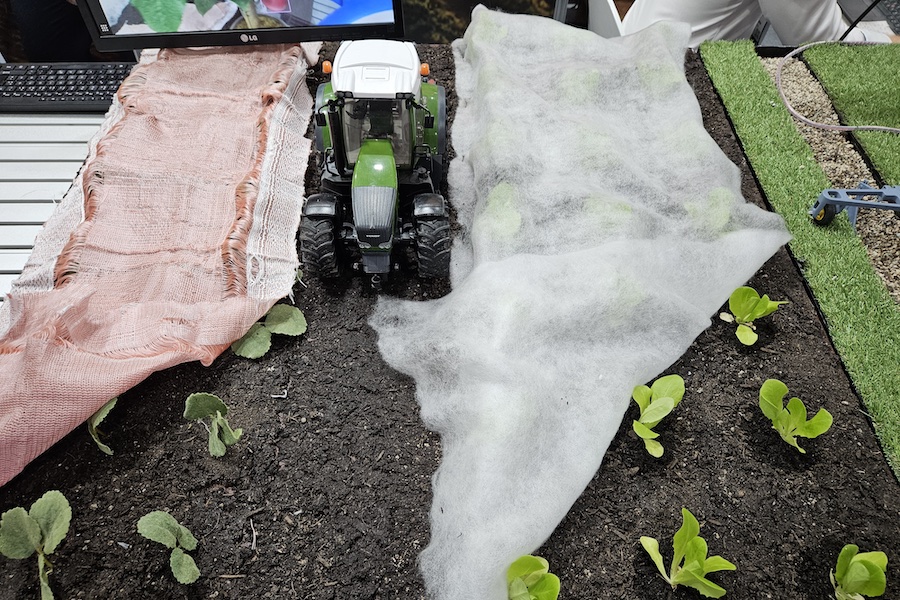
Agrotextiles are of particular importance for specialised crops such as strawberries, lettuce and kohlrabi, as they have a significant influence on growing conditions. For instance, they can raise soil temperature, channel water to the plants and protect seedlings from external influences, particularly during early growth stages. Agrotextiles consist almost exclusively of petrochemically produced polymers that are not biodegradable. This demonstrator therefore showcases a carded fleece made from biodegradable polymers, which is used to bring forward the harvest in strawberry fields. In the same crop but serving a different purpose, a monofilament net is on display; its deep red colour and a coating of ultra-fine silicate particles serve to protect the plants from invasive insect species.
4. Bionic Oil Adsorber
On various biological surfaces, oil is adsorbed from the water’s surface and transported along floating leaves.
ITA postdoctoral researcher Dr Leonie Beek has transferred this effect to a technical textile using her Bionic Oil Adsorber (BOA), which, at maturity level 4, can remove up to 4 litres of diesel per hour from the water.
The BOA differs from technical solutions in that the oil-water separation takes place without external energy and without toxic substances. The work on the BOA has been recognised with the Bionics Award – only in German available - and the Paul Schlack Prize.
5. BioPEtex – A PE-based, solution-dyed and sustainable T-shirt made from organic raw materials
In the multi-billion-pound fibre market, fossil-based polyesters (PES) dominate the clothing sector, accounting for 52% of the market. Unfortunately, PET, the most commonly used PES, cannot be produced on an industrial scale as 100% bio-based material, unlike polyethylene (PE). Bio-based PE (bioPE), a drop-in polymer derived from fermented starches or sugars, has properties identical to those of fossil-based PE and is easily recyclable. It is also more cost-effective than other biopolymers used in fibres and can be processed at lower temperatures, which saves energy. Solution-dyed bioPE offers significant environmental benefits: it consumes 50% less energy and water than conventional dyeing processes and emits 60% less CO2.
Life cycle assessments (LCA) predict that PE could significantly reduce the textile industry’s ecological footprint, with solution-dyed bio-PE further enhancing this reduction. Furthermore, PE textiles are IR-transparent and thus provide passive cooling for the body.
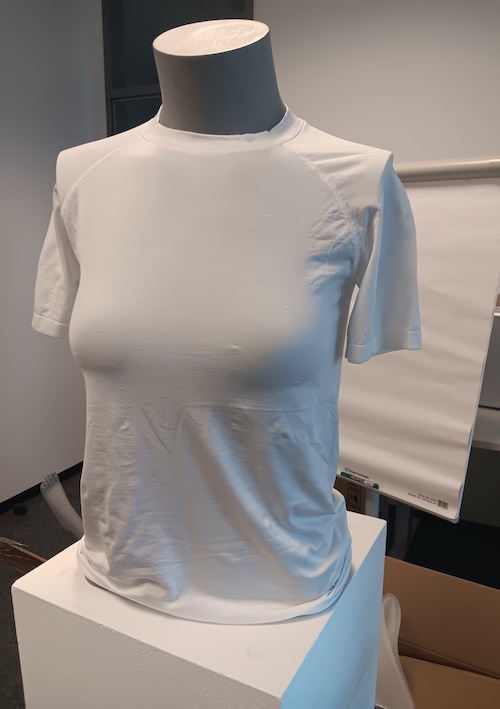
Despite these advantages, PE is not yet used in the clothing industry. Preliminary research findings from the ITA suggest that PE can be processed into spun, dyed filaments and knitted fabrics with promising textures. The T-shirt on display is spun and dyed and features an elastic surface made from bio-based raw materials. A bio-based elastic finish enhances the T-shirt, which is made from a single source and is thermomechanically recyclable.
6. FungalFibers – Leggings
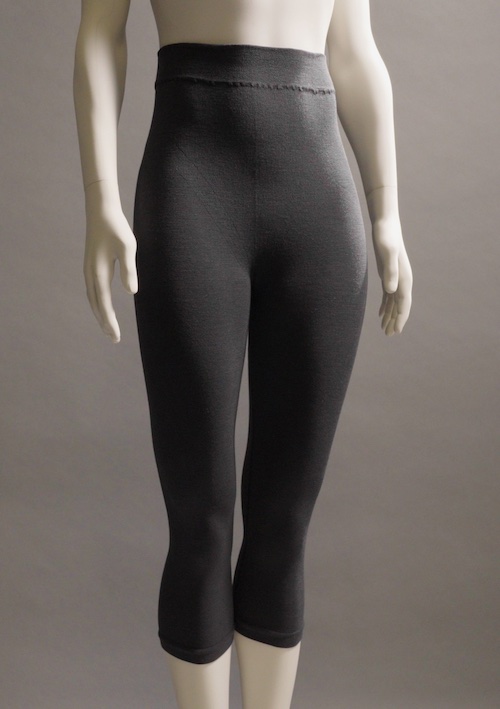
Against a backdrop of limited resources such as oil, water and arable land, as well as increasing environmental degradation and potential for conflict, there is significant social and commercial interest in providing competitive, socially and environmentally sustainable alternative raw materials for the textile industry. The aim of this project is to develop a completely new process chain for the production of bio-based, vegan textiles from chitosan fibres (filament and staple fibre yarns).
Chitosan is chemically closely related to chitin, the second most abundant substance in nature after cellulose. It occurs naturally in a variety of sources: in insects, crab and shellfish shells, and as a structural component of the cell walls of all fungi. Chitin can therefore be obtained from by-products of crab meat production, insect protein or fungal biomass waste from industrial processes. Chitosan, in turn, can be easily produced from chitin through deacetylation.
ITA Group will be presenting the latest developments in sustainable textile products and production processes at Techtextil 2026, taking place from 21 to 24 April 2026 in Frankfurt am Main. The exhibits from ITA Augsburg gGmbH and ITA Technologietransfer GmbH will be on display at the Elmatex joint stand in Hall 12.0, Booth D05.
ITA Group will showcase various approaches to mechanical and thermo-mechanical recycling, addressing potential applications in the textile, materials and automotive industries. ITA Augsburg gGmbH, which specialises in mechanical textile recycling, will present innovations in the fields of composites, mechanical textile recycling and artificial intelligence in production. These include sound and thermal insulation panels from the “IsoTex” project, a towel from the “EcoYarn” recycling project, and the “ColoSens” demonstrator, an AI-based solution for automated colour recognition of fibres in the recycling process.
ITA Technologietransfer GmbH demonstrates thermo-mechanical recycling using numerous examples within the Fabric2Fabric cycle. Using a 3D-printed car seat demonstrator as an example, the recyclable filament yarns are incorporated into a seat cover.
In addition, ITA Technologietransfer GmbH is showcasing its patented ‘Textile Anchor’ concept, an innovative anchoring system designed to protect and secure structures in geotechnical environments such as mountains, in the ground and underwater, as well as for use in building construction. The textile anchor offers an ultra-lightweight solution with high flexibility and optimal adaptability, and is manufactured from extremely durable or biodegradable and sustainable textiles.
At ITA Group’s ‘shared booth’, ITA Technologietransfer GmbH will be providing information on innovations from various industrial partners:
- technofibres s.a. from Luxembourg offers solution-dyed PET and sustainable trPET filament yarns with a wide range of matting levels, filament cross-sections and packaging options for bespoke solutions, even in the smallest batch sizes, making it unique in Europe.
- Idemitsu Kosan Co., Ltd. from Japan offers Xarec™, a syndiotactic polystyrene (SPS) fibre for use in fabrics and nonwovens. The advantages of this semi-crystalline high-performance material, which acquires its syndiotactic structure through the polymerisation of polystyrene and a metallocene catalyst, are demonstrated in nonwoven samples for the filtration sector in comparison with conventional materials.
- The Swedish company Luma Wire Tech AB is an innovative specialist in fine wires, with expertise in advanced plating. Each wire, ranging from 4 to 300 microns and produced from tungsten, molybdenum, or other advanced materials, is tailored to meet each customer’s specific needs— available either uncoated or with high-performance coatings of gold, silver, palladium, or other.