[pageLogInLogOut]

#Sustainability

Textile Exchange Conference 2025: Setting the course for systemic change

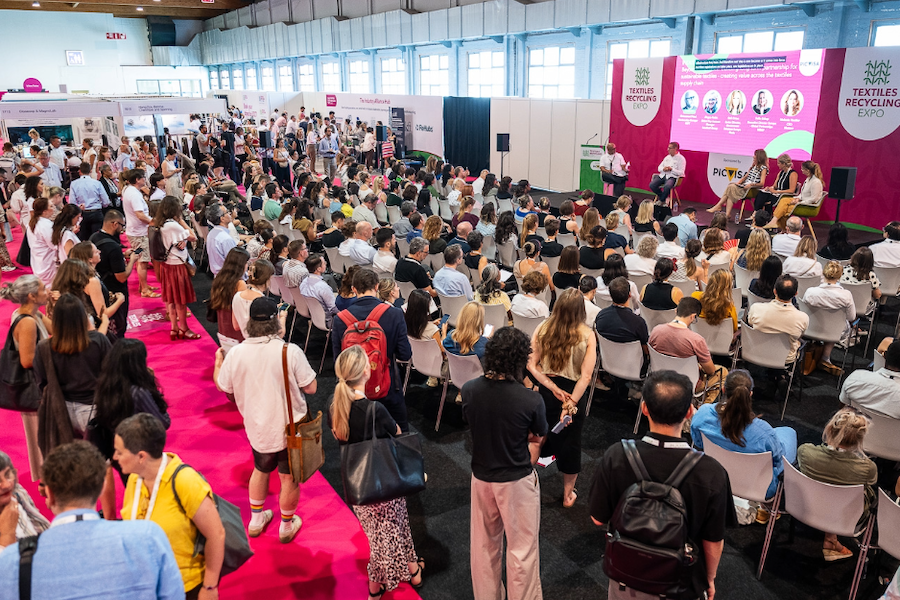
The 2025 Textile Exchange Conference brought together more than 1,600 participants on site in Lisbon and online, marking two days of intense dialogue on the future of sustainable and regenerative material systems. With a focus on collaboration, data-driven progress, and systemic transformation, the sessions highlighted both the challenges and the opportunities in building a truly resilient textile industry.


Day 1: From preferred materials to preferred systems

The opening day set the tone for the week, centering on how the industry can transition from isolated material improvements to holistic, regenerative production systems. In the morning plenary, Textile Exchange CEO Claire Bergkamp and Jonathan Hall, Managing Partner at Kantar’s Sustainable Transformation Practice, outlined the state of progress and the scale of transformation still required.

“When we dig beneath the noise, it’s clear consumers still care,” Hall said, citing Kantar data showing that 67% of people view environmentalism as extremely important in light of increasingly visible climate impacts.

Sessions throughout the day emphasized that systemic change requires measurable data, regional context, and shared accountability. Speakers called for more collaborative investment, outcome-based measurement, and tools that make impact data accessible from farm to brand level.

The afternoon plenary featured Deb Chachra, author of How Infrastructure Works, and Ashley Gill, Chief Standards and Strategy Officer at Textile Exchange, who presented the organization’s five-year strategy for accelerating impact through preferred production systems.

“Our goal is to build thriving landscapes, resilient communities, and a more sustainable future,” Gill said, introducing the new Materials Matter System. The initiative will integrate existing standards—including those for wool, mohair, alpaca, recycled materials, and organic cotton—into a unified framework, maintaining traceability while aligning the sector around shared sustainability outcomes.

Day 2: Overcoming barriers and enabling change

The second day explored the economic, policy, and social enablers needed to scale preferred production systems and strengthen resilience across the value chain.

In the morning plenary, Tariq Fancy, Lecturer at Stanford Graduate School of Business and former Chief Investment Officer for Sustainable Investing at BlackRock, challenged the audience to focus on long-term, practical solutions.

“Real progress comes from the boring but brilliant ideas—those that increase efficiency, reduce waste, and make business sense,” Fancy said.

The afternoon session, moderated by Robin Mellery-Pratt (Matter), brought together John Roberts, CEO of Australian Wool Innovation, and Vanessa Barboni Hellik, CEO of Another Tomorrow. Their discussion centered on building resilience through brand–producer collaboration and long-term supply partnerships to support farmers facing volatility.

Common threads: Data, finance, and verification

Across both days, five cross-cutting priorities emerged:

+++ Economic alignment – Shared investment models and long-term contracts are essential to make regenerative systems financially viable, especially for producers at Tier 4.

+++ Regulatory engagement – As EU textile policy evolves, proactive participation and alignment with circular standards will be crucial.

+++ Landscape-level action – Context-specific approaches are needed to link climate, nature, and social goals with material sourcing.

+++ Verification and transparency – Credible data and adaptable verification frameworks are vital to scaling impact and meeting new legislative demands.

+++ Internal enablers – True transformation requires engaging decision-makers across legal, finance, and marketing teams to embed sustainability into business strategy.

Looking ahead

As the Textile Exchange Conference 2025 continues, a clear message resonates: achieving a regenerative and equitable textile industry will demand collaboration across the entire value chain—supported by sound data, transparent standards, and shared responsibility.

More News from Textile Exchange

#Raw Materials

Textile Exchange publishes cotton Life Cycle Assessment study to strengthen impact data

Textile Exchange has published the first in a series of seven Life Cycle Assessment (LCA) studies designed to improve the quality and robustness of environmental impact data for raw material production across the fashion, textile, and apparel industry. The first LCA study focuses on cotton and addresses critical data gaps and methodology variability through new high-quality data across key producing countries. The study includes organic, regenerative, recycled, and country averages for conventional cotton production systems, providing a clearer picture of the associated environmental impact.

#Sustainability

Textile Exchange unveils commitment-based pathway for members to accelerate responsible raw material production

Textile Exchange has unveiled further details about its new membership structure, designed to guide the fashion, textile, and apparel industry in a collective course of action toward preferred production systems for raw materials and fibers.

#Yarns

Textile Exchange publishes the final criteria for its new Materials Matter Standard, marking a pivotal shift in connecting certification to impact

Textile Exchange has published the final criteria for its Materials Matter Standard—a major milestone in the organization’s multi-year transition toward a unified, impact-driven standards system for raw material production and primary processing. 

#Sustainability

Textile Exchange evolves its membership structure to unlock the next stage of collective action for climate and nature

Textile Exchange is excited to announce that it is evolving its membership structure to a more action-oriented, impact-driven model designed to provide clearly defined pathways that help organizations respond to the climate and nature crisis.

More News on Sustainability

#Natural Fibers

Global Standard gGmbH launches second public consultation for GRTS Draft 2 for the textile industry (1–30 April 2026)

Global Standard gGmbH is pleased to announce the release of Draft 2 of the Global Responsible Textile Standard (GRTS) for its second public consultation. The consultation will be open from 1 April 2026 to 30 April 2026, inviting stakeholders across the textile and apparel value chain to provide input and contribute to the further development of this new Standard.

#Sustainability

Practical toolkit to drive coordinated climate action launched

An open-access workshop toolkit enables brands, suppliers, policymakers and investors across the textile industry to apply the System Map in their own work, identifying leverage points to halve emissions and enable a just transition.

#Sustainability

Experts publish APAC policy priorities

Cascale today announced the publication of its APAC Policy Priorities Paper, developed by the Asia-Pacific (APAC) Policy Member Expert Team (MET) to identify key regional sustainability challenges and provide practical, aligned recommendations for policymakers and industry stakeholders across Asia-Pacific.

#Sustainability

GOTS version 8.0 released: advanced supply chain accountability, from fibre to finished product

Global Standard is pleased to announce the release of GOTS Version 8.0, the latest update to the world's leading processing standard for organic textiles. The updated Standard strengthens requirements for air emissions and waste management, as well as criteria for product safety. It introduces new provisions on circularity, microfibre management and updates in residue testing. Version 8.0 also elevates due diligence obligations and formalises governance requirements, including ESG disclosure, anti-corruption policies and conflict-of-interest safeguards, to support credible, responsible business conduct.

Latest News

#Raw Materials

New study shows low environmental impact by Cotton made in Africa Organic Cotton from Tanzania

Today, the Aid by Trade Foundation (AbTF) is announcing the results of a comprehensive life-cycle analysis (LCA) for cotton produced in Tanzania under the Cotton made in Africa Organic (CmiA Organic) standard. The study emphasises the small ecological footprint of CmiA Organic verified cotton. This can largely be traced back to the absence of synthetic pesticides, artificial fertilisers, and artificial irrigation. Consequently, CmiA Organic cotton can help the textile industry meet regulatory requirements as well as science-based targets. The results also show that the consequences of climate change threaten the livelihoods of these cotton farmers, even though the type of agriculture they practise barely contributes to climate change.

#Raw Materials

Better Cotton Initiative strengthens regenerative focus in standard update

The Better Cotton Initiative (BCI) has strengthened the regenerative focus of its field-level standard with the launch of a new version of its Principles & Criteria (P&C), which marks the next step in the organisation’s journey to becoming a regenerative standards system.

#Man-Made Fibers

Selenis and Kintra Fibers partner to scale 100% bio-based synthetic fiber technology

Selenis, a leading global specialty polyester manufacturer, today announced a strategic manufacturing partnership with materials science company Kintra Fibers to scale Kintra’s patented fiber-grade PBS resin - a 100% bio-based and biodegradable material designed for textile applications.

#Functional Fabrics

PERFORMANCE DAYS proves its relevance as the industry’s key meeting point

Held on March 18–19, 2026, PERFORMANCE DAYS once again confirmed its position as a leading international platform for functional textiles. A total of 3.366 trade visitors and around 560 exhibitors gathered in Munich, with the event already kicking off successfully on DAY 0, which received highly positive feedback for its interactive format. Despite challenging conditions caused by the public transport strike in Munich, the event saw strong attendance and a consistently high level of activity across both exhibition days.

TOP