[pageLogInLogOut]

#Sustainability

Ten bold ideas to decarbonise fashion: Meet the winners of Global Change Award 2025

The H&M Foundation has revealed the ten winners of the Global Change Award 2025 – spotlighting groundbreaking ideas aimed at decarbonising the fashion industry in a just way. Each winner will receive a €200,000 grant and take part in the yearlong GCA Changemaker Programme – one of the few programmes of its kind focused on early-stage fashion innovation. Designed to accelerate the industry’s journey toward net-zero, the programme offers a mix of innovation support, systems thinking and personal growth.
The non-profit H&M Foundation announces ten early-stage innovations set to reshape the fashion industry – from clean tech recycling in China to community-powered circularity in Ghana © 2025 H&M Foundation


This year’s winners come from across the globe – from Germany to Ghana, India to the UK – with ideas spanning from smart recycling and heat pumps designed to replace outdated gas and oil steam boilers to radically inclusive circular systems. All are united by a shared goal: to halve the industry’s greenhouse gas emissions every decade and reach net-zero by 2050 – in a way that’s just for both people and planet.

"GCA is about more than specific innovations. It’s about reimagining the entire fashion system. One innovation alone won’t fix fashion – we need to shake the foundations and innovate how we innovate. That’s why we back bold thinkers at the very start of their journeys. These changemakers aren’t just solving problems, they’re challenging outdated systems and showing us what a new future could look like. It’s time to stop tweaking and start transforming", states Annie Lindmark, Programme Director H&M Foundation.

The 2025 winners and their innovations:

Responsible Production

DecoRpet (China) – A low-temperature decolorisation process that slashes energy use while delivering high-quality recycled PET for new textile production. Changemakers: Youbing Mu, Xiaobo Wu & Shuang Su

Thermal Cyclones (United Kingdom) – Revolutionary industrial heat pumps that can replace traditional boilers and reduce energy consumption by over 75%. Changemakers: James Parkin & Chris Benson

Pulpatronics (United Kingdom) – Metal-free, chipless RFID paper tags – recyclable, cost-effective, and made with carbon-based ink. The future of sustainable traceability. Changemakers: Chloe So & Barna Soma Biro

Sustainable Materials & Processes

CircularFabrics (Germany) – NYLOOP® tech recovers high-quality nylon from blended textile waste – closing the loop on one of fashion’s most used materials. Changemakers: Josephine Mayer, Miguel Chacon-Teran, Ruben Serrano

A Blunt Story (India) – UNCRUDE® is a plastic-free sole made from bio-based and recycled materials – a clean break from fossil-based footwear. Changemaker: Chandni Batra

Brilliant Dyes (United Kingdom) – Harnessing the power of cyanobacteria, this start-up creates biodegradable dyes with a low-energy extraction method. Changemaker: Mohammad Redwanur Rahman

Decarbonization Lab (Bangladesh) – A dedicated R&D space pioneering lowemission with a focus on textile treatments and dyeing techniques to modernise outdated industry practices. Changemaker: Mohammad Abbas Uddin

Renasens (Sweden) – Waterless, chemical-free technology that turns blended textile waste into raw materials – no depolymerisation, no pollution. Changemaker: Jade A. Bouledjouidja

Mindful Consumption

Loom (United Kingdom) – An intuitive tech platform that connects users with designers to upcycle unworn clothes into one-of-a-kind pieces. Changemaker: Daisy Harvey

Wildcards

The Revival Circularity Lab (Ghana) – A creative hub in Accra’s Kantamanto Market that turns textile waste into value – empowering artisans and building local circularity. Changemaker: Yayra Agbofah

All ten winners will now join the GCA Changemaker Programme – a hands-on, yearlong initiative delivered by the H&M Foundation with GCA partners Accenture and KTH Royal Institute of Technology. The programme focuses on advancing each early-stage idea while equipping changemakers with the tools to grow personally, think systemically and develop solutions that will benefit both people and the planet.

"To truly decarbonise fashion, we need to reimagine every part of the value chain – from how fibres are made to how garments are reused. These changemakers remind us that transformation starts with imagination and action. Their ideas demonstrate concrete ways to challenge the status quo and move the industry towards a net-zero future," says Karl-Johan Persson, Founder and Board Member of the H&M Foundation.

As the Global Change Award enters its tenth year, its mission remains more urgent than ever: to back diverse changemakers with bold ideas and spark system-wide transformation that benefits both people and planet. Since 2015, the GCA has supported 56 innovations with a combined grant of €10 million, constantly evolving to meet the industry’s greatest challenge – decarbonisation.

Neither H&M Foundation nor the GCA partners, take any equity or intellectual property rights in the innovations. The idea is to find the changemakers and innovations that have the potential to drive meaningful change for the entire industry. The winners are free to collaborate with whomever they want.



More News from H&M Group

#Sustainability

Practical toolkit to drive coordinated climate action launched

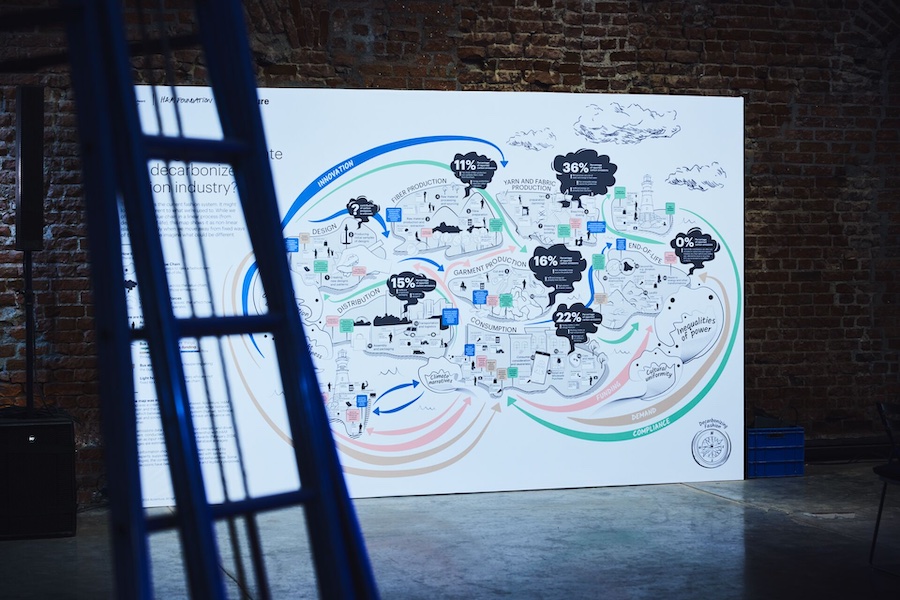
An open-access workshop toolkit enables brands, suppliers, policymakers and investors across the textile industry to apply the System Map in their own work, identifying leverage points to halve emissions and enable a just transition.

#Sustainability

Pioneering open-source framework shows how early innovation drives a just and net-zero fashion future

The non-profit H&M Foundation, in collaboration with Accenture, has unveiled From Signals to Systems Change, an insight report calling on the fashion industry to rethink its role in transformation. At its core is the Reimagined System Map, a pioneering open-source framework that visualises how early-stage innovation could drive a just and net-zero textile future.

#Sustainability

H&M Foundation funds pioneering initiative to build the factories of the future

The H&M Foundation is committing SEK 53 million (approx. EUR 5 million) towards Future Forward Factories, a five-year initiative led by Fashion for Good, to address fashion’s most polluting stage: tier 2 textile processing.

#Textiles & Apparel / Garment

Global Change Award 2026: Nominations now open

On 1 September, the H&M Foundation launched the nomination round for the Global Change Award 2026. The international innovation challenge is looking for early-stage ideas that can drive the textile and fashion industry towards circularity and climate neutrality.

More News on Sustainability

#Natural Fibers

Global Standard gGmbH launches second public consultation for GRTS Draft 2 for the textile industry (1–30 April 2026)

Global Standard gGmbH is pleased to announce the release of Draft 2 of the Global Responsible Textile Standard (GRTS) for its second public consultation. The consultation will be open from 1 April 2026 to 30 April 2026, inviting stakeholders across the textile and apparel value chain to provide input and contribute to the further development of this new Standard.

#Raw Materials

Textile Exchange publishes cotton Life Cycle Assessment study to strengthen impact data

Textile Exchange has published the first in a series of seven Life Cycle Assessment (LCA) studies designed to improve the quality and robustness of environmental impact data for raw material production across the fashion, textile, and apparel industry. The first LCA study focuses on cotton and addresses critical data gaps and methodology variability through new high-quality data across key producing countries. The study includes organic, regenerative, recycled, and country averages for conventional cotton production systems, providing a clearer picture of the associated environmental impact.

#Sustainability

Experts publish APAC policy priorities

Cascale today announced the publication of its APAC Policy Priorities Paper, developed by the Asia-Pacific (APAC) Policy Member Expert Team (MET) to identify key regional sustainability challenges and provide practical, aligned recommendations for policymakers and industry stakeholders across Asia-Pacific.

#Sustainability

GOTS version 8.0 released: advanced supply chain accountability, from fibre to finished product

Global Standard is pleased to announce the release of GOTS Version 8.0, the latest update to the world's leading processing standard for organic textiles. The updated Standard strengthens requirements for air emissions and waste management, as well as criteria for product safety. It introduces new provisions on circularity, microfibre management and updates in residue testing. Version 8.0 also elevates due diligence obligations and formalises governance requirements, including ESG disclosure, anti-corruption policies and conflict-of-interest safeguards, to support credible, responsible business conduct.

Latest News

#Raw Materials

New study shows low environmental impact by Cotton made in Africa Organic Cotton from Tanzania

Today, the Aid by Trade Foundation (AbTF) is announcing the results of a comprehensive life-cycle analysis (LCA) for cotton produced in Tanzania under the Cotton made in Africa Organic (CmiA Organic) standard. The study emphasises the small ecological footprint of CmiA Organic verified cotton. This can largely be traced back to the absence of synthetic pesticides, artificial fertilisers, and artificial irrigation. Consequently, CmiA Organic cotton can help the textile industry meet regulatory requirements as well as science-based targets. The results also show that the consequences of climate change threaten the livelihoods of these cotton farmers, even though the type of agriculture they practise barely contributes to climate change.

#Raw Materials

Better Cotton Initiative strengthens regenerative focus in standard update

The Better Cotton Initiative (BCI) has strengthened the regenerative focus of its field-level standard with the launch of a new version of its Principles & Criteria (P&C), which marks the next step in the organisation’s journey to becoming a regenerative standards system.

#Man-Made Fibers

Selenis and Kintra Fibers partner to scale 100% bio-based synthetic fiber technology

Selenis, a leading global specialty polyester manufacturer, today announced a strategic manufacturing partnership with materials science company Kintra Fibers to scale Kintra’s patented fiber-grade PBS resin - a 100% bio-based and biodegradable material designed for textile applications.

#Functional Fabrics

PERFORMANCE DAYS proves its relevance as the industry’s key meeting point

Held on March 18–19, 2026, PERFORMANCE DAYS once again confirmed its position as a leading international platform for functional textiles. A total of 3.366 trade visitors and around 560 exhibitors gathered in Munich, with the event already kicking off successfully on DAY 0, which received highly positive feedback for its interactive format. Despite challenging conditions caused by the public transport strike in Munich, the event saw strong attendance and a consistently high level of activity across both exhibition days.

TOP