[pageLogInLogOut]

#Recycling / Circular Economy

Commission clarifies rules on plastic bottles recycling

The new rules include chemical and mechanical recycling technologies to help Member States meet the recycled-content target set under the Single-Use Plastics Directive
© 2026 European Commission
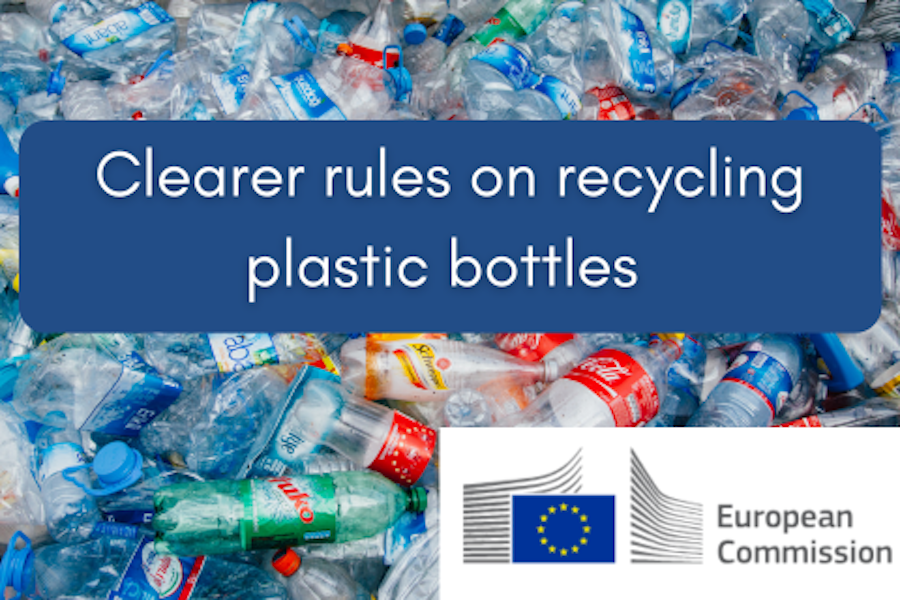
The European Commission today adopted new rules on recycling of single-use plastic beverage bottles made primarily of polyethylene terephthalate (PET bottles). These rules establish, for the first time, a methodology to calculate, verify and report chemically recycled content. This is part of the Commission’s December 2025 plastics package.


The new rules will ensure transparency in calculating recycled content in new single-use PET bottles. This is key to creating a level playing field and providing investment security for the plastic recycling sector. The new rules can be applied to any recycling technology, including chemical and mechanical recycling technologies. This will help Member States meet the recycled-content target set under the Single-Use Plastics Directive.

Mechanical recycling is currently the most widely used method for recycling plastics. This is typically used to sort, clean, shred and remold plastics into new products. However, some plastic waste streams cannot be effectively recycled mechanically. This includes for example plastic waste with food residues, additives and mixed materials which reduce recyclability. In these cases, chemical recycling can complement mechanical recycling. In contrast to mechanical recycling, chemical recycling breaks down plastics into smaller molecules, which can be reused for feedstocks for new plastics or other chemicals. This helps to return more plastic waste streams to the circular economy, including for products that have to meet high-quality standards like food-contact packaging.

In a first phase, the EU will count as recycled plastics material from the Union and EEA countries, where compliance with EU environmental rules can be fully verified. From 21 November 2027, recycled plastic from OECD countries will also count, unless excluded under the Waste Shipment Regulation. Also material from non-OECD countries will count when covered by arrangements ensuring equivalent standards related to human health and environmental protection requirements, for example in the Waste Framework Directive and the Packaging and Packaging Waste Regulation.

Recycled content is counted towards EU targets based on credible, traceable and environmentally sound standards.

Next steps

The Implementing Act will be published in the Official Journal shortly and will enter into force 20 days later.

More News from European Commission

#Europe

EU and Australia strengthen relations with Security and Defence Partnership and Trade Agreement

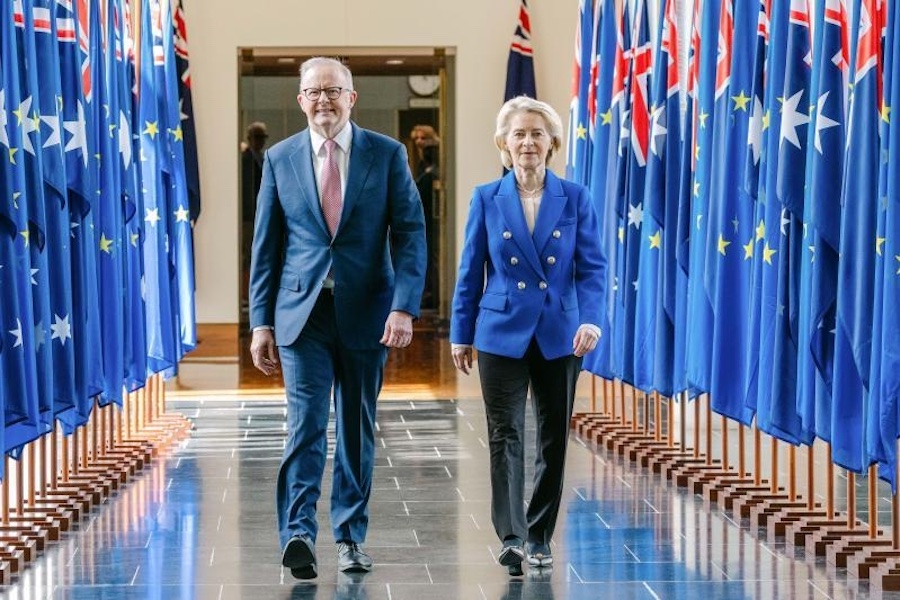
The EU and Australia have today announced the adoption of a groundbreaking Security and Defence Partnership. They have also concluded negotiations for an ambitious and balanced free trade agreement (FTA) and agreed to launch formal negotiations for the association of Australia to Horizon Europe, the world's largest funding programme for research and innovation. With these steps, the EU and Australia are delivering mutually beneficial outcomes and further reinforcing their already close relations in a time of geopolitical uncertainty.

#Europe

Commission presents proposal for EU Inc. - unlocking the full potential of the Single Market for Europe's entrepreneurs

Today, the European Commission presented its proposal for EU Inc., a new single set of corporate rules, building the cornerstone and starting point for the EU's 28th regime. EU Inc. is an optional, digital-by-default European corporate framework. It will make it easier for businesses to start, operate and grow across the EU – incentivising them to stay in Europe, and encourage those who once looked elsewhere to return.

#Europe

New EU rules to stop the destruction of unsold clothes and shoes

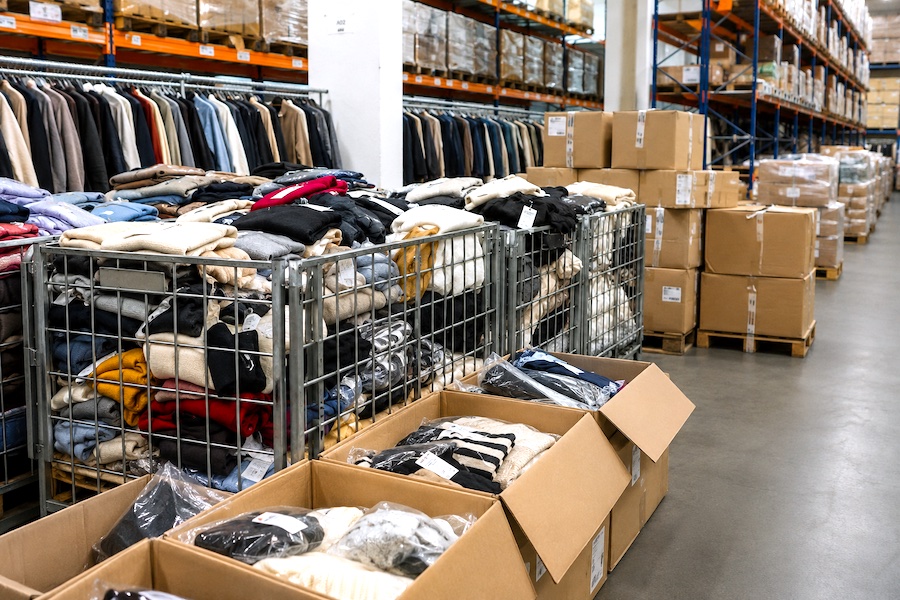
The European Commission today (Feb 9) adopted new measures under the Ecodesign for Sustainable Products Regulation (ESPR) to prevent the destruction of unsold apparel, clothing, accessories and footwear.

#Europe

Commission adopts a first-ever EU Visa Strategy

Today, the European Commission is adopting its first-ever EU Visa Strategy. It sets out a framework for a visa policy that is more strategic and that advances the EU's long-term interests, allowing it to be better equipped for growing mobility as well as the consequences of regional instability and geopolitical competition.

More News on Recycling / Circular Economy

#Recycling / Circular Economy

Ence and ShareTex begin initial testing of the ATENEA innovation project to promote textile recycling in Spain

Ence and ShareTex are making progress on the Atenea R&D project, which aims to develop a complete value chain for textile recycling in Spain. Specifically, the goal of the ATENEA project—which is funded by the Center for Technological Development and Innovation (CDTI)—is to connect all the necessary stages for the recovery of textile waste, from collection and management, through recycling and transformation into new raw materials, to their incorporation into new textile products.

#Recycling / Circular Economy

DePoly Inaugurates its Showcase Plant in Monthey Switzerland

What if used plastic bottles, PET packaging material and polyester textiles could become raw materials just as high performing as virgin resources? That is the ambition of DePoly, a circular materials company based in Sion, Switzerland which inaugurated its Showcase Plant in Monthey on July 6th & 7th. The first depolymerization facility of its kind and scale in Switzerland, this industrial Showcase Plant represents a major milestone in the company's growth and its journey toward commercialization.

#Recycling / Circular Economy

Recyc'Elit presents progress in chemical recycling of polycotton waste

French recycling technology company Recyc'Elit showcased the latest progress in its chemical recycling technology during the second National Polymer Recycling Conference, organised by AXELERA and POLYMERIS in Clermont-Ferrand, France, on 30 June and 1 July 2026.

#Research & Development

Geotextiles made from recycled materials: GREEN leads the way into the industry

For the industry, recycled materials are creating new opportunities in geotextile production. In the GREEN project, the Fraunhofer Cluster of Excellence Circular Plastics Economy CCPE demonstrates that recycled polypro-pylene (PP), polyethylene terephthalate (PET), and high-density polyeth-ylene (HDPE) can be processed into nonwovens, fibers, and membranes that meet industrial requirements. This creates opportunities for use in existing production lines and new value chains in the geotextile market.

Latest News

#Sustainability

Global Standards establishes new non-profit foundation to strengthen governance

Global Standards gGmbH, the nonprofit organisation behind the globally recognised Global Organic Textile Standard (GOTS), announced a new governance structure designed to support its long-term mission and reinforce organisational autonomy of its Voluntary Sustainability Standards and programmes.

#Textile chemistry

DyStar releases FY2025 sustainability report, marking a new milestone towards its 2030 targets

DyStar, a leading specialty chemicals company with more than a century of expertise in product development and innovation, today announced the release of its FY2025 Sustainability Report, marking a significant milestone in its sustainability journey and reinforcing its commitment to long-term value creation.

#Research & Development

TERIS reaches milestone: Fraunhofer consortium develops new standards for tire analysis

In the “TERIS” project, the Fraunhofer institutes ICT, IGD, and IWM—led by the Fraunhofer Institute for Structural Durability and System Reliability LBF—have reached a decisive milestone. For the first time, the teams aim to generate, analyse, and predict tire wear in the laboratory in a standardized and practical manner. As part of this milestone, results are now available on reference abrasion, particle analysis, tribological models, AI-based surface analysis, a test bench concept, and methods for accelerated aging and VOC detection. The tire industry, testing services, and environmental agencies will in future benefit from reliable, rapid laboratory procedures for emissions assessment.

#Textile processing

Pathfinder expands into Mexico to support growth across Latin America

Pathfinder Australia Pty Ltd, a global manufacturer of advanced cutting room technology for the textile and related industries, today announced the launch of Tecnología de Corte Pathfinder, S. de R.L. de C.V., its new Mexico-based subsidiary.

TOP