[pageLogInLogOut]

#Recycling / Circular Economy

AI Circular Economy Conference 2026 fuels innovation at the intersection of AI and Circular Economy

Industry, research and AI development experts explore how digital intelligence accelerates the transition to renewable carbon and circular materials
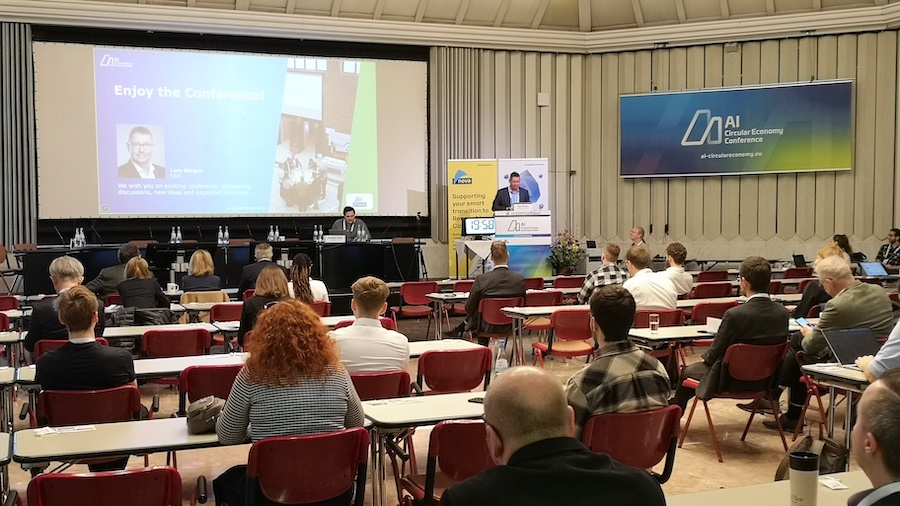
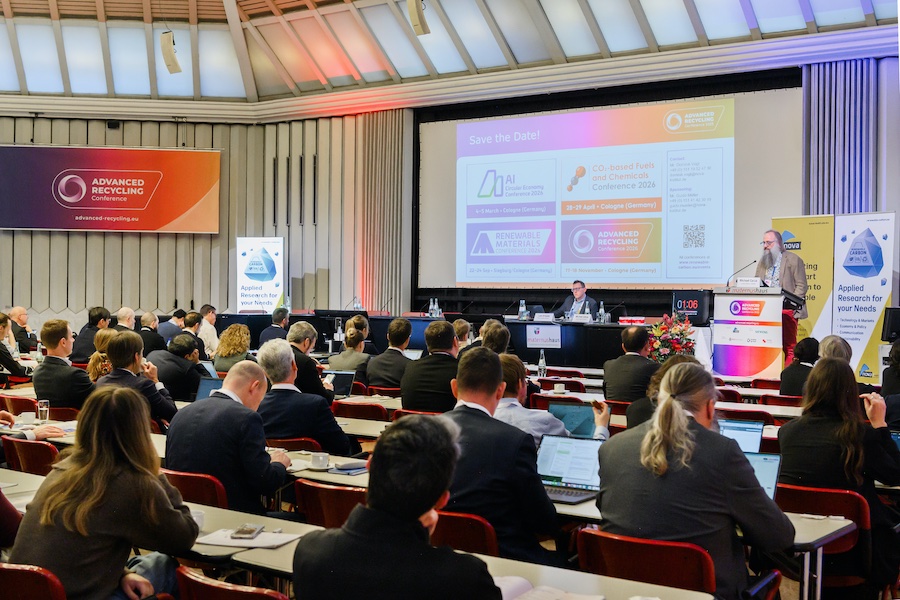
Lars Börger, CEO of the nova-Institute, opens the AI Circular Economy Conference 2026 and welcomes international participants in Cologne. Source: © nova-Institut
The AI Circular Economy Conference 2026, organised by nova-Institute, brought together 116 participants from 15 countries in Cologne and online to explore the transformation of the chemical and materials industry supported and accelerated by artificial intelligence. During the two-day event, leading experts from industry, research, start-ups and the investment community discussed how AI can maximise the potential of renewable carbon creating efficient circular value chains. The conference featured 24 presentations and multiple panel discussions, highlighting the growing convergence of digital technologies and circular material systems. It demonstrated how artificial intelligence is progressing from the experimental stage to real industrial implementation within the circular economy.

Where two worlds meet: Artificial Intelligence and the Circular Economy

As Lars Börger, CEO of nova-Institute, put it, the conference motto can be summarised as follows: “When two bubbles meet, they collide. In that moment of collision, something new can emerge, often something bigger and more powerful than either bubble on its own.”

Artificial intelligence and the circular economy are two rapidly evolving fields. When they intersect, they create opportunities for innovation, efficiency and systemic change. Therefore, the conference focused not only on technological progress, but also on new forms of collaboration, open data ecosystems, and interdisciplinary exchange between software developers, materials scientists, industrial practitioners, and policy experts.

Five thematic blocks show the breadth of AI applications

The conference programme was divided into five sections, each of which focused on a different aspect of AI applications within the circular economy. Across the event, speakers from industry, start-ups, academia and investment illustrated how AI is increasingly being applied along the entire circular value chain — from production and materials development to recycling, resource management and market decision-making.

Examples from companies, start-ups and research institutions such as Covestro, Schneider Electric, ExoMatter, Volkswagen, RWTH Aachen University and the European Circular Bioeconomy Fund (ECBF) showed how AI-driven tools are already supporting industrial transformation. Applications ranged from digital twins, predictive maintenance and real-time process optimisation in manufacturing to machine learning approaches that accelerate the discovery of new catalysts, polymers and bio-based materials. At the same time, AI-powered sorting technologies, hyperspectral imaging and advanced data platforms are helping industries better understand complex waste streams, improve feedstock quality and enable higher-value recycling pathways.

Across many presentations, one message became clear: AI alone is not the solution. Its real potential emerges when high-quality data, industrial expertise and digital capabilities come together — enabling companies to make better decisions, optimise processes and gradually build more efficient and circular material systems.

AI as a catalyst for the renewable carbon economy?

One message emerged clearly from across all sessions: artificial intelligence is rapidly becoming a key enabler of the renewable carbon economy.

AI has the potential to significantly improve productivity, sustainability and competitiveness in the chemical and materials industries by accelerating material discovery and digital twins, advancing recycling and optimising supply chains. 

By facilitating faster innovation cycles, improving resource efficiency and enabling smarter decision-making, AI can assist in the transition from fossil-based value chains to circular systems centred on biomass, captured CO₂ and recycled materials.

Partners

The AI Circular Economy Conference 2026 is supported by a strong network of partners and media organisations committed to advancing innovation at the intersection of artificial intelligence and the circular economy.

Strategic partners of the conference include organisations and industry networks closely connected to the transformation towards renewable carbon and circular material systems, such as CLIB – Cluster Industrial Biotechnology, IBB Netzwerk GmbH, Chemie-Cluster Bayern, C.A.R.M.E.N. e.V., the Renewable Carbon Initiative (RCI), kunststoffland NRW, the Institute for Textile Technology (ITA) of RWTH Aachen University, the German AI Association (KI Bundesverband), and CO₂ Value Europe. 

Continuing the dialogue on AI and circular innovation

The discussion on artificial intelligence and circular economy will continue at several upcoming nova-Institute conferences. The topic of AI as an enabler for circular and renewable carbon value chains will also play an important role at the Carbon Capture & Utilisation Conference (CCU) from 28–29 April 2026 in Cologne, the Renewable Materials Conference (RMC), 22–24 September 2026 in Siegburg/Cologne, and the Advanced Recycling Conference (ARC), 17–18 November in Cologne.

Across these events, experts from industry, research and technology will continue exploring how digital intelligence, data infrastructures and AI-driven tools can accelerate innovation, improve resource efficiency and support the transition towards a circular and renewable carbon economy.

More News from nova-Institut für politische und ökologische Innovation GmbH

#Recycling / Circular Economy

Advanced Recycling Conference 2026 to showcase innovations – Call for abstracts

The call for abstracts is now open for the Advanced Recycling Conference (ARC) 2026, taking place on 17–18 November 2026 in Cologne, Germany, and online. Europe’s leading platform for advanced recycling brings together hands-on solutions and cutting-edge research on recycling technologies for various waste streams like plastics, polymers, textiles or automotive, highlighting progress towards a circular renewable carbon economy.

#Research & Development

Pioneer of the first hour: Michael Carus steps down after more than 30 years from nova-Institute’s Management

After more than three decades at the helm, founder and CEO Michael Carus is set to step down as head of the Renewable Carbon division on 1 March 2026. Lars Börger as the new CEO, will take over this key position of the nova-Institute together with COO Linda Engel, while Carus will remain with the research and consulting company as a senior advisor and shareholder. This change takes place after a one-year transition phase, as planned.

#Sustainability

The nova-Institute establishes new Renewable Feedstock Department to lay the groundwork for industrial defossilisation

The transition from fossil-based to renewable carbon – sourced from biomass, CO₂ utilisation and recycling – is the cornerstone of a climate-neutral chemical industry. The nova-Institute’s new department is dedicated to providing the essential data, analyses and strategic roadmaps required to secure a reliable future feedstock supply and make this transition a commercial and ecological reality.

#Recycling / Circular Economy

Advanced Recycling Conference 2025 fuels innovation across key waste streams

The Advanced Recycling Conference (ARC) 2025 brought together nearly 220 experts from 28 countries to spotlight pioneering advancements and foster industry collaboration in recycling across diverse waste streams including plastics, textiles, automotive and other materials.

More News on Recycling / Circular Economy

#ITM 2026

BB Engineering unveils new, patented “Val-uePack” spin pack at ITM

At the upcoming ITM in Istanbul, taking place June 9–13 at the Tüyap Fair Convention and Congress Center in Hall 7, Booth 702B, BB Engineering will once again be represented at a joint booth with its parent company, Barmag, and its representative, Tekstil Servis. The German machine manufacturer will show-case its expertise in man-made fiber and recycling technology, presenting its entire product portfolio, which includes compo-nents such as extruders and filters, as well as complete sys-tems for spinning synthetic fibers, air-texturing, and PET recy-cling.

#Recycled Fibers

Syre expands partnership with Target to advance next-generation recycled materials at scale

Advancing next-generation materials to support scalable circular solutions across global retail Stockholm, May 2026 — Syre, the textile impact company hyperscaling textile-to-textile recycling today announced an expanded collaboration with Target to accelerate the adoption of next-generation recycled materials across retail at scale.

#Recycling / Circular Economy

Project REWEAR investigates diverse economies of rewear as a global practice of circularity

Every year, European households discard millions of tonnes of clothing. Around a quarter of what gets separately collected is exported, much of it classified as rewearable. A significant share ends up in markets like Kantamanto in Accra, Ghana, where an estimated 15 million garments arrive every week. New research published today reveals what happens when that clothing arrives.

#Recycling / Circular Economy

RE&UP contributes to Global Fashion Summit 2026 circularity discussion

RE&UP contributed to the global conversation on textile circularity at Global Fashion Summit 2026 in Copenhagen, where Fatih Konukoğlu, Chairman of RE&UP and Vice Chairman of Sanko Holding, took part in both the keynote session “The New Rules” and the panel discussion “A Reckoning and Renewal for Circular Horizons”, alongside leaders from H&M Group, Looper Textile Co. and Sourcing Journal.

Latest News

#INDEX 2026

“We clearly see that reliability, flexibility, service and total cost of ownership are becoming increasingly important again.”

The nonwovens industry continues to face a challenging market environment. Nevertheless, AUTEFA Solutions reports successful projects, new line sales and growing demand for energy-efficient and flexible solutions. In this interview, André Imhof of AUTEFA Solutions talks about competitiveness against Chinese suppliers, new service and recycling concepts, the growing importance of application development and the opportunities created by countercyclical investments.

#INDEX 2026

“Needle punching technology is more universal and sustainable than ever!”

Needle punching technology was long regarded as a rather traditional and comparatively slow technology within the nonwovens industry. In this interview, Johann Philipp Dilo explains why needle punching is more relevant than ever today – ranging from energy efficiency and resource conservation to hygiene applications, new machine concepts and design-oriented nonwoven solutions.

#Research & Development

Textile climate control system in workwear – exhibition at the 2026 SME Innovation Day!

Conventional protective workwear often reaches its limits during strenuous physical activity. In particular, the transport of sweat and excess body heat poses a problem. The German Institutes of Textile and Fiber Research (DITF) conducted research on flow-optimized, air-conducting textile structures that enable targeted climate control directly on the body. These structures can be integrated straight into protective work garments. The textile climate control system supports the body’s natural thermoregulation. This contributes to improved workplace safety and comfort.

#Nonwovens

PET spunbond from China – EDANA welcomes imposition of provisional anti-dumping measures

On 13 May 2026, after eight months of investigation, the European Commission imposed provisional anti-dumping duties of 45.6-50.0% on imports of PET spunbond from China. EDANA welcomes this expression of the Commission’s clear determination to protect EU industries from the unfair trade practices of Chinese producers.

TOP