[pageLogInLogOut]

#Recycling / Circular Economy

Samsara Eco opens first plant to scale circular plastics
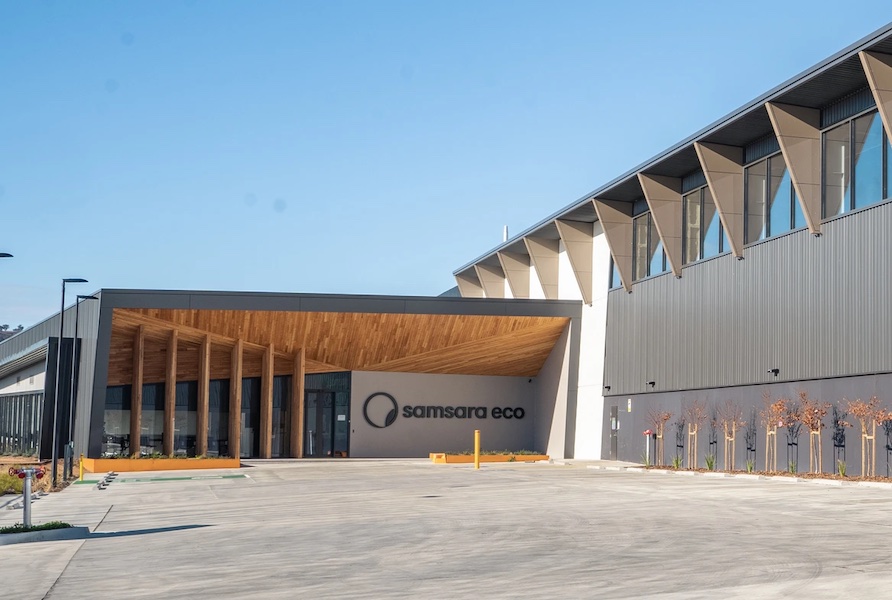
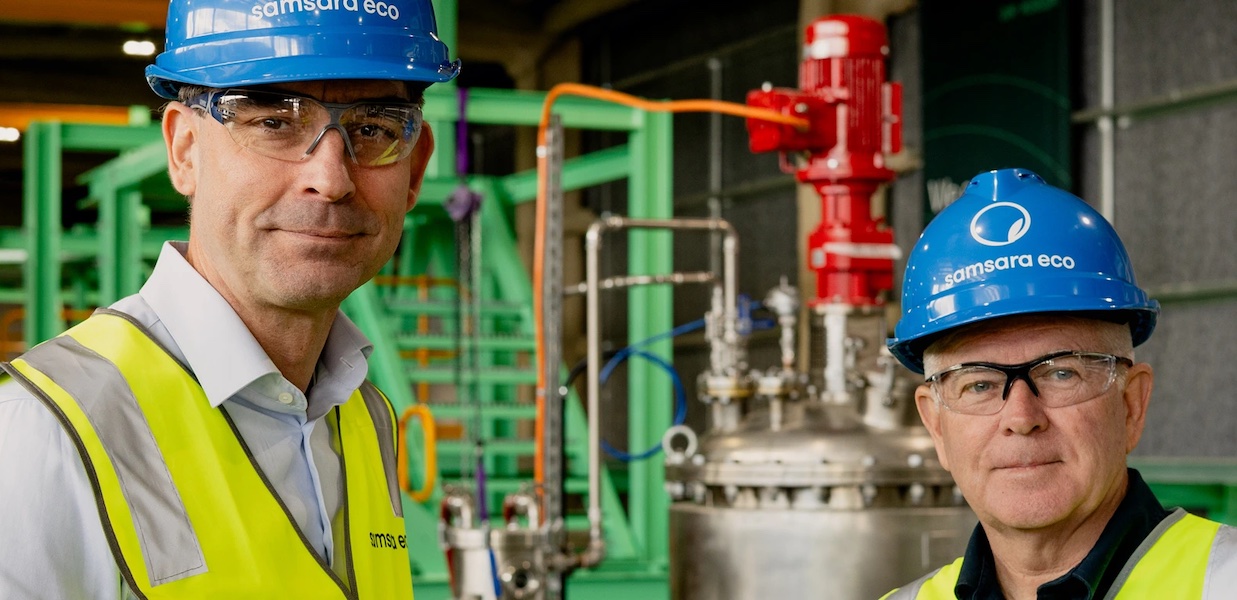
Australian biotech innovator, Samsara Eco, has today opened its first plant, representing a significant milestone in the fight against plastic waste. The new plant will exponentially increase the company’s ability to produce virgin-identical, low-carbon circular materials like recycled nylon 6,6 and polyester with broad applications across apparel, packaging and automotives, at scale.
Exterior photography of Samsara Eco's first plant in Jerrabomberra, Australia. © 2025 Samsara Eco


Located in Jerrabomberra, regional Australia, the new headquarters and plant houses EosEco, Samsara Eco’s breakthrough enzymatic recycling technology. The technology uses AI-crafted enzymes to break down mixed plastics destined for landfill into recycled raw materials, ready for brands to incorporate into their next product line. The facility also houses expanded enzyme production facilities, allowing Samsara Eco to further build out its proprietary AI-powered enzyme discovery and development platform to find recycling solutions for a broader range of plastics. 

“The opening of Jerrabomberra is a proud milestone for us and the broader circular economy. In just four years, we’ve scaled from bench research through to pilot, demonstration, and now our first plant. This is a true tipping point for circularity, shifting circular materials from early-stage innovation to mainstream reality. 

“Brand demand and supportive new regulations are helping to clear the path forward. Our new facility will help brands deliver circularity with the capacity to produce the equivalent of hundreds of thousands of garments annually,” said Paul Riley, CEO and founder of Samsara Eco.

The circular materials made at Jerrabomberra will feature in upcoming product lines for global brands like lululemon, as well as pilot programs and trials with brands across textiles, automotive and packaging. The facility will also host world-first research including finding recycling solutions for the likes of spandex with The LYCRA Company, and our collaboration with Deakin University’s Recycling and Clean Energy Commercialisation Hub, part of the Australian Government’s Trailblazer Universities Program.

Today, only 10% of plastics are recycled and less than 1% of textiles are recycled into new textiles, perpetuating a linear economy. Samsara Eco aims to rewrite those numbers by recycling the unrecyclable to keep high-value materials out of the landfill.

“This isn't just about building a plant. It's about building a circular future where materials don’t have an end-of-life. Instead, they are infinitely recycled, reducing the world’s reliance on finite resources,” continued Riley.

Jerrabomberra provides a runway for Samsara Eco’s first nylon 6,6 commercial plant, which is being designed with engineering partner, KBR and due to open in Asia in 2028. The 20,000 tonne facility will be the first of a fleet of international commercial facilities, which will use Samsara Eco’s EosEco technology to turn waste into virgin-identical raw materials. 

“Our Jerrabomberra plant marks a significant milestone in Australia’s advanced manufacturing and circular economy journey,” added Riley. “Our technology supports Australia’s net-zero targets while driving economic growth, resilience, and productivity. We're creating an entirely new industry to unlock major export opportunities and bring new skills to market, while also helping to position Australia as a leader in circular technology and a global exporter of circular materials. 

“We’re grateful for the support we’ve received from our global investors including Main Sequence and Temasek, as well as the local community, who have supported us every step of the way to make Jerrabomberra a reality.”

Samsara Eco’s consortium of global investors i backed the opening commented on the milestone:

Carley Phillips, Principal, at Greycroft: “Samsara Eco’s new Jerrabomberra facility marks an important step towards scaling circular materials and showcasing the power of technology to transform industries. We are excited to continue supporting the team as they bring this innovation to market and drive the growth of the circular economy.” 

Jan Marchewski, Associate at Hitachi Ventures said: “We’ve been deeply impressed by Samsara Eco’s ability to deliver every milestone on time and on budget – an extraordinary achievement for a deep tech company. The opening of the Jerrabomberra facility is a powerful testament to the team’s execution excellence. This hub will enable Samsara Eco to test AI-discovered enzymes at scale in collaboration with partners, further cementing its market leadership in enzymatic recycling.”

Phil Morle, Partner at Main Sequence commented: “Samsara Eco opening its first plant for infinite plastic recycling in regional Australia is an exemplar of Australian ingenuity leading the world to create industries for the next generation of growth. In this case, the first step to eradicating the problem of plastic waste.”


More News from Samsara Eco

#Recycled Fibers

Samsara Eco and European Outdoor Group launch the Nylon Materials Collective

Australian biotech, Samsara Eco and the European Outdoor Group (EOG) today launched the Nylon Materials Collective, a collaboration designed to make high-performance, virgin-identical recycled nylon accessible to more outdoor brands and accelerate the industry’s shift toward a truly circular textiles future.

#Recycling / Circular Economy

Samsara Eco appoints first General Manager of Asia to lead expansion

Samsara Eco has announced the appointment of Dr Lars Kissau as its first General Manager of Asia. Based in Singapore, Kissau will lead the company's expansion across Asia as it scales operations and sprints towards the opening of the company's first commercial nylon 6,6 facility in 2028.

#Recycling / Circular Economy

KBR selected as key commercialization partner for Samsara Eco’s first-of-a-kind enzymatic recycling plant

KBR (NYSE: KBR) announced today it will support biotech innovator, Samsara Eco, to design its first-of-a-kind plastics and textile enzymatic recycling plant, due for completion in early 2028.

#Recycling / Circular Economy

Industry heavyweights join Samsara Eco to accelerate its enzymatic recycling technology

Australian biotech innovator, Samsara Eco, has expanded its global leadership team with the appointment of material science and engineering veterans, Brock Thomas as Chief Innovation Officer and Isaac Iverson as Executive Director of Product. Thomas and Iverson bring decades of experience working within the polymer space in the US and will lead the scaling of the company’s enzymatic recycling technology and first-of-a-kind facilities.

More News on Recycling / Circular Economy

#Recycling / Circular Economy

Reju opens its first R&D Center in the U.S. in Conshohocken, Pennsylvania

Reju, the company specializing in textile regeneration, today announced the opening of a Research and Development (R&D) Center in Conshohocken, Pennsylvania, the company's first proprietary research center in North America. Located within Technip Energies' existing Advanced Materials and Catalysts research center, the lab will allow Reju to accelerate the rollout of its recycling technologies and develop its next-generation circular solutions.

#Recycling / Circular Economy

Textiles Recycling Expo 2026 builds on successful debut with record attendance, global participation and expanded industry collaboration

The second edition of Textiles Recycling Expo concluded on 24–25 June at Brussels Expo, reinforcing its position as Europe's leading exhibition and conference dedicated exclusively to textile recycling and circularity.

#Recycling / Circular Economy

New skills for a circular textile economy

Based on the results of a comprehensive analysis, the Erasmus+ project Skills4Circularity is developing three practical training modules covering recycling technologies, eco-design for the circular economy and sustainable manufacturing. The content of the first module, Recycling Technologies, has now been developed and validated together with industry representatives. The module provides participants with knowledge of regulatory requirements, material sorting and the preparation of textile waste for recycling.

#Recycling / Circular Economy

RE&UP establishes Fiber Club consortium to scale Next-Gen material sourcing

Originally developed as an umbrella framework by innovation platform Fashion for Good, the RE&UP Fiber Club aims to accelerate the commercial adoption of circular Next-Gen materials across the global fashion ecosystem.

Latest News

#Dyeing, Drying, Finishing

Ferraro S.p.A. acquires the “Finishing” business unit of Cibitex S.r.l.

Ferraro S.p.A. and Cibitex S.r.l. are pleased to announce the completion of the agreement pursuant to which Ferraro S.p.A. has acquired the “Finishing” business unit of Cibitex S.r.l., specialized in the development and manufacturing of technological solutions for textile finishing.

#Weaving

Itema reaffirms its commitment to the Syrian textile industry at NasTex 2026

From July 18th to 21st, Itema will exhibit at NasTex at the Damascus Fairground (Hall 11 – Stand C02), marking its return to one of the Middle East’s historically significant textile markets. Itema will showcase advanced weaving technology designed to support the competitiveness and technological evolution of Syrian manufacturers and announces a new partnership with Growfast Agency as the sole agent of Itema in Syria.

#Knitting & Hosiery

KARL MAYER's HKS 2-SE Expands Possibilities for Premium Stretch WARP KNITS

Warp knitted fabrics with a woven look are more in demand than ever in the fashion and apparel industries. Stretch WARP KNITS, in particular, impress with their freedom of movement, breathability, and virtually wrinkle-free wear – thereby opening up new style worlds such as smart casual or business casual. When it comes to the highly efficient production of premium-quality stretch WARP KNITS, the HKS 2-SE has long been the machine of choice. KARL MAYER’s best-selling tricot machine produces standard elastic fabrics characterized by high gauges, smooth, delicate surfaces, and a soft hand feel.

#Textiles & Apparel / Garment

Catalyst Club launches in Florence: Where conversations become catalysts for change

The first chapter of Catalyst Club debuted in Florence, bringing together creative directors, entrepreneurs, manufacturers, journalists and innovators from across the fashion and textile industry for an evening of dialogue, exchange and connection.

TOP