[pageLogInLogOut]

#Man-Made Fibers

Textile Exchange publishes comprehensive polyester LCA study
© 2026 Textile Exchange
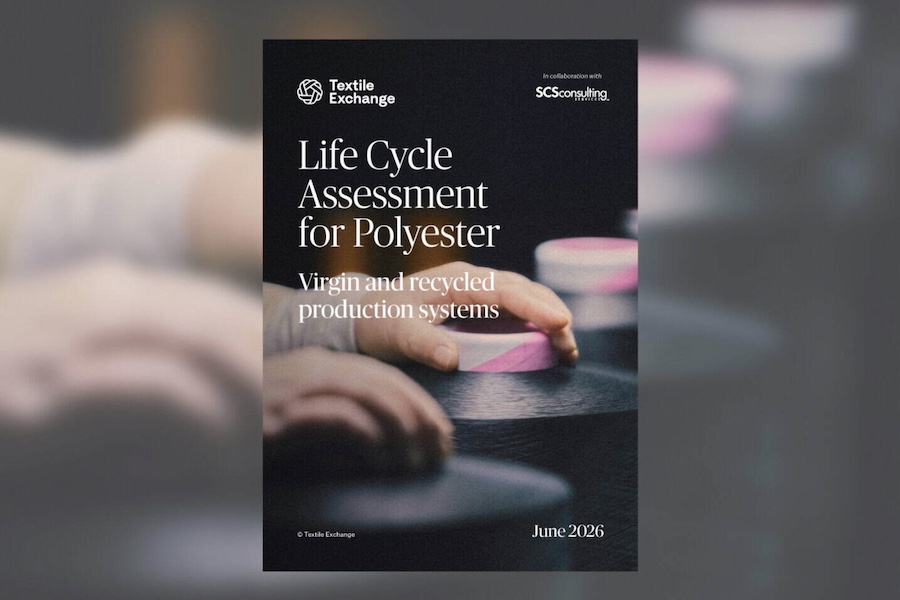
Textile Exchange has released a new Life Cycle Assessment (LCA) study on polyester, providing detailed data on the environmental impacts of both virgin and recycled polyester production. The study aims to strengthen understanding across the fashion, textile and apparel industries and support more informed decision-making regarding polyester sourcing and production.

According to Textile Exchange, the study identifies key environmental hotspots across different polyester production routes and includes new data on both thermomechanical and chemical recycling technologies. It also provides what is believed to be the first publicly available data on the environmental impacts of virgin polyethylene terephthalate (PET) production in Southeast Asia, a region that accounts for more than half of global virgin PET production.

The assessment focuses on virgin polyester production in Southeast Asia and recycled polyester production in China, Europe and the United States. Like all Textile Exchange LCA studies, it follows a cradle-to-gate approach, covering impacts from resource extraction through fiber formation. In addition, the study incorporates a broader “LCA+” methodology, including an assessment of human rights impacts associated with polyester production.

One of the central findings is that the environmental performance of polyester depends heavily on the production technology used. Key impact hotspots identified include the production of virgin fossil-based feedstocks, waste collection and sorting for recycled polyester, energy consumption and transportation.

To support industry-wide environmental modelling and progress tracking, the data from the study will be integrated into several major sustainability databases, including the Higg Materials Sustainability Index (MSI), Ecoinvent and the Quantis World Apparel and Footwear Life Cycle Assessment Database (WALDB). Textile Exchange notes that the data is primarily intended as proxy data for situations where source-specific LCA data is unavailable.

The polyester study is the second publication in Textile Exchange’s ongoing series of fiber-specific LCA studies. Earlier this year, the organization published its cotton LCA study, with additional assessments scheduled for release throughout 2026 and 2027.

To ensure scientific rigor and impartiality, the study was conducted in accordance with ISO standards, led by specialized LCA consultants, reviewed by independent expert panels and developed in consultation with a broad range of industry stakeholders.

Textile Exchange emphasizes that, as with all LCA data, results should be interpreted carefully and within their intended context. The organization advises against direct comparisons between different studies, regions or production systems, as methodological choices, assumptions and system boundaries can significantly influence outcomes.

Explore the full LCA study:

https://textileexchange.org/knowledge-center/reports/polyester-life-cycle-assessment/?utm_source=polyesterlca_email&utm_medium=email&utm_campaign=polyesterLCA&utm_term=null&utm_content=general

More News from Textile Exchange

#Raw Materials

Textile Exchange publishes cotton Life Cycle Assessment study to strengthen impact data

Textile Exchange has published the first in a series of seven Life Cycle Assessment (LCA) studies designed to improve the quality and robustness of environmental impact data for raw material production across the fashion, textile, and apparel industry. The first LCA study focuses on cotton and addresses critical data gaps and methodology variability through new high-quality data across key producing countries. The study includes organic, regenerative, recycled, and country averages for conventional cotton production systems, providing a clearer picture of the associated environmental impact.

#Sustainability

Textile Exchange unveils commitment-based pathway for members to accelerate responsible raw material production

Textile Exchange has unveiled further details about its new membership structure, designed to guide the fashion, textile, and apparel industry in a collective course of action toward preferred production systems for raw materials and fibers.

#Yarns

Textile Exchange publishes the final criteria for its new Materials Matter Standard, marking a pivotal shift in connecting certification to impact

Textile Exchange has published the final criteria for its Materials Matter Standard—a major milestone in the organization’s multi-year transition toward a unified, impact-driven standards system for raw material production and primary processing. 

#Sustainability

Textile Exchange evolves its membership structure to unlock the next stage of collective action for climate and nature

Textile Exchange is excited to announce that it is evolving its membership structure to a more action-oriented, impact-driven model designed to provide clearly defined pathways that help organizations respond to the climate and nature crisis.

More News on Man-Made Fibers

#Man-Made Fibers

DYNEEMA® and NP Aerospace advance personal protection for military servicewomen

Dyneema®, owned by Avient Corporation, an innovator of materials solutions, is supplying its high-performance unidirectional (UD) materials to world-leading armor manufacturer NP Aerospace, enabling the production of armor systems designed specifically to fit the female body. With 2,000 new armor systems, including 4,000 plates, made in the United Kingdom (UK) and delivered in June 2026, this collaboration addresses a long-standing lack of high-quality personal protection specially built for female defense and security personnel.

#Recycled Fibers

Indorama Ventures enables brands to scale circular textiles through proven, traceable supply chains

Indorama Ventures, a global leader in recycled polyester staple fibers and filament yarns, will exhibit at Textiles Recycling Expo in Brussels on June 24–25. At the event, the company will show how brands and textile manufacturers can build traceable, circular textile supply chains by working with proven partners who deliver recycled materials on an industrial scale.

#Man-Made Fibers

Grasim Industries announces fresh investment of ₹3094 Crore to expand Lyocell capacity

Grasim Industries Limited, the flagship company of the Aditya Birla Group and a global leader in cellulosic fibres, today announced an investment of ₹3,094 crore, for Phase II Lyocell capacity of 110K TPA at Harihar, Karnataka. This expansion will consist of 2 lines of 55K TPA (150 Tons per day) each. The first line is expected to be commissioned by 2028, and the second line is expected to be commissioned by 2030.

#Yarn & Fiber

Lenzing AG appoints Georg Kasperkovitz as Chief Executive Officer

The Supervisory Board of Lenzing AG has appointed Georg Kasperkovitz, Member of the Management Board and Chief Operations Officer, as Chief Executive Officer (CEO) of Lenzing AG with effect from June 1, 2026.

Latest News

#Textiles & Apparel / Garment

Autopsy, the new trend book by Texworld Apparel Sourcing Paris, deciphers the fractures of our time through 12 creative signals

Presented during Texworld Apparel Sourcing Paris, from August 31 to September 2, 2026, at the Paris-Le Bourget Exhibition Center, Autopsy offers a reinterpretation of the contours of fashion in a world undergoing profound transformation, balancing radical introspection and sensitive renewal.

#Associations

Keeping products moving with Swedish automation at FILTECH 2026

At FILTECH 2026, taking place in Cologne from June 30th to July 2nd, members of TMAS – the Swedish textile machinery association – will highlight how the country’s engineering expertise is enabling filtration manufacturers to increase productivity, improve traceability and reduce dependence on labour-intensive manual processes.

#ITM 2026

Global Mmeeting of textile technologies, ITM 2026, attracts great interest

ITM 2026, one of the world's most prestigious organizations in the field of textile technologies, opened its doors with the participation of over 1,000 companies and company representatives from 59 countries, as well as thousands of professional visitors from nearly 100 country. Attracting thousands of international visitors on its first day, ITM 2026 once again demonstrated its status as a global meeting point for the textile industry with its advanced technologies on display, newly established business connections, and record-breaking international participation.

#Recycling / Circular Economy

Countdown to Textiles Recycling Expo 2026: Brussels prepares for Europe’s textile recycling gathering

With only two weeks remaining until the start of the second edition of the Textiles Recycling Expo 2026, preparations are entering the final phase. The exhibition and conference, dedicated exclusively to textile recycling and circularity, will take place on 24–25 June 2026 at Brussels Expo and is expected to attract stakeholders from across the textile recycling value chain.

TOP