[pageLogInLogOut]

#Man-Made Fibers

Toray develops AURLIST™ polyester filament fiber with luxurious luster and ultra-fine structure

Toray Industries has developed AURLIST™, a new polyester filament fiber designed to combine luxurious luster, soft loft and a subtle fibrillated surface texture. The company primarily targets applications in women’s apparel such as tops, bottoms and dresses.

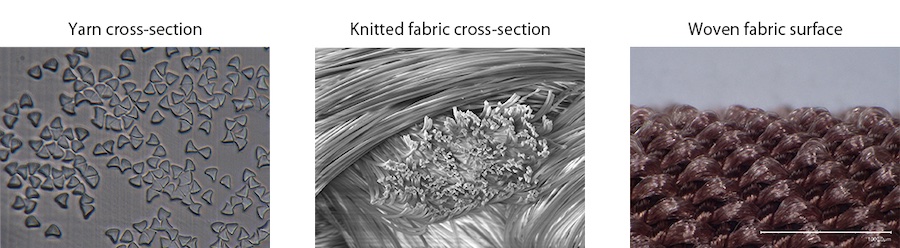
The new fiber is produced using Toray’s proprietary NANODESIGN® conjugate spinning technology, which enables precise control of composite fiber cross-sections. With this approach, the company succeeded in producing polyester filaments with a diameter of around one micron – roughly one-tenth that of silk. The fibers feature ultra-fine fan-shaped cross-sections that create complex diffuse reflection, generating a distinctive sheen and lightly raised surface effect.

According to Toray, the fiber structure combines two polymers with different shrinkage and luster characteristics. This combination results in a material that offers the brushed softness typically associated with microfibers together with fullness and an elegant rayon-like sheen, while retaining the easy-care performance typical of polyester filament yarns.

Toray will market the new fiber within its premium filament series Toray Premium GOUSEN select®, which focuses on advanced polymer and composite spinning technologies for high-performance textiles.

The company expects initial sales of around ¥130 million in fiscal 2026 (ending March 31, 2027) and aims to increase revenue from the new fiber to ¥200 million by fiscal 2030.
AURLIST  -A new sensory Polyester filament fiber © 2026 Toray
AURLIST -A new sensory Polyester filament fiber © 2026 Toray


More News from Toray Engineering Co. Ltd.

#Recycling / Circular Economy

Toray develops recycling technology that retains carbon fiber strength and surface quality

Toray Industries, Inc., announced today that it has developed a recycling technology that can decompose diverse carbon fiber reinforced plastics (CFRP) made from thermosetting resins while retaining the strength and surface quality of those fibers. The company drew on this technology to create a nonwoven fabric employing recycled carbon fibers.

#Composites

HEAD launches more sustainable(1) BOOM RAW racquet on Earth Day by using Toray’s bio-circular carbon fibers

HEAD continues to innovate with the launch of the BOOM RAW tennis racquet, an encouraging development in the search for a more sustainable future for racquet sports. All of the carbon fibers are bio-circular carbon fibers in the limited-edition and highly innovative BOOM RAW racquet, which offers the same explosive power - along with the same fun, feel and easy playability - as the regular, in-line BOOM racquet. The bio-circular carbon fibers are manufactured by Toray and its subsidiary Toray Carbon Fibers Europe.

#Recycling / Circular Economy

Companies in Japan initiate demonstration to expand the automotive recycling process

DENSO CORPORATION and other partners have been chosen by an industry-government-academia collaborative project aiming to expand the recycle content for automobile in the fiscal year 2023 supported by Ministry of the Environment, Japan.

#Yarn & Fiber

Toray develops durable reverse osmosis membrane

Toray Industries, Inc., announced today that it has developed a highly durable reverse osmosis (RO) membrane (see glossary note 1). This innovative offering guarantees the long-term provision of high-quality water. It also maintains the superior removal performance of Toray’s existing membranes vital for reusing industrial wastewater and treating sewage.

More News on Man-Made Fibers

#Research & Development

Elastic yarns to become more recyclable and environmentally friendly in future

On 29 April 2026, ITA student Tobias Dickmeiß was awarded a sponsorship prize by the Wilhelm Lorch-Stiftung for his innovative approach, to replacing conventional elastane with elastic yarns made from thermoplastic copolyester elastomers (TPC). Thanks to their thermoplastic nature and compatibility with typical polyesters used in the textile industry, elastic TPC yarns offer improved recyclability. Furthermore, the use of the melt-spinning process in yarn production eliminates the need for solvents that are harmful to the environment and human health.

#Texprocess 2026

AMANN reviews successful Texprocess 2026 and highlights innovations for circularity and performance

AMANN Group has drawn a positive conclusion following four successful days at Texprocess 2026 in Frankfurt. The company highlighted the many inspiring discussions, valuable exchanges, and new connections established with partners, customers, and industry experts during the event.

#Raw Materials

ECCO introduces first shoe featuring innovative protein-based fibre

ECCO, in partnership with Spinnova, announces the launch of the limited edition ECCO BIOM® 720, a first-of-its-kind shoe utilising an often overlooked leather by-product, transformed into a protein-based fibre. The fibres are produced using patented technology that advances material innovation while reducing waste and supporting full resource use across the leather and textile industry.

#Man-Made Fibers

The LYCRA Company strengthens sustainability leadership, appoints Alistair Williamson as VP of Product Sustainability

The LYCRA Company has appointed longtime executive Alistair Williamson as vice president of product sustainability, reaffirming its commitment to developing sustainable solutions for apparel and personal care products. In this role, he will guide the company’s next chapter of sustainability strategy and oversee all initiatives aimed at reducing environmental impact across products, operations, and innovation platforms.

Latest News

#INDEX 2026

“We clearly see that reliability, flexibility, service and total cost of ownership are becoming increasingly important again.”

The nonwovens industry continues to face a challenging market environment. Nevertheless, AUTEFA Solutions reports successful projects, new line sales and growing demand for energy-efficient and flexible solutions. In this interview, André Imhof of AUTEFA Solutions talks about competitiveness against Chinese suppliers, new service and recycling concepts, the growing importance of application development and the opportunities created by countercyclical investments.

#INDEX 2026

“Needle punching technology is more universal and sustainable than ever!”

Needle punching technology was long regarded as a rather traditional and comparatively slow technology within the nonwovens industry. In this interview, Johann Philipp Dilo explains why needle punching is more relevant than ever today – ranging from energy efficiency and resource conservation to hygiene applications, new machine concepts and design-oriented nonwoven solutions.

#Research & Development

Textile climate control system in workwear – exhibition at the 2026 SME Innovation Day!

Conventional protective workwear often reaches its limits during strenuous physical activity. In particular, the transport of sweat and excess body heat poses a problem. The German Institutes of Textile and Fiber Research (DITF) conducted research on flow-optimized, air-conducting textile structures that enable targeted climate control directly on the body. These structures can be integrated straight into protective work garments. The textile climate control system supports the body’s natural thermoregulation. This contributes to improved workplace safety and comfort.

#Nonwovens

PET spunbond from China – EDANA welcomes imposition of provisional anti-dumping measures

On 13 May 2026, after eight months of investigation, the European Commission imposed provisional anti-dumping duties of 45.6-50.0% on imports of PET spunbond from China. EDANA welcomes this expression of the Commission’s clear determination to protect EU industries from the unfair trade practices of Chinese producers.

TOP