[pageLogInLogOut]

#Knitting & Hosiery

20 years of KAMCOS®, two decades of pioneering in warp knitting machine control
With KAMCOS®, KARL MAYER has revolutionised the control of warp knitting machines worldwide. The solution was launched at the ITMA in Birmingham in 2003, was given its name - KARL MAYER Command System, KAMCOS® - in 2005, 20 years ago, and quickly proved popular on the market. KAMCOS® 2 followed at ITMA 2015, providing a further boost to innovation.
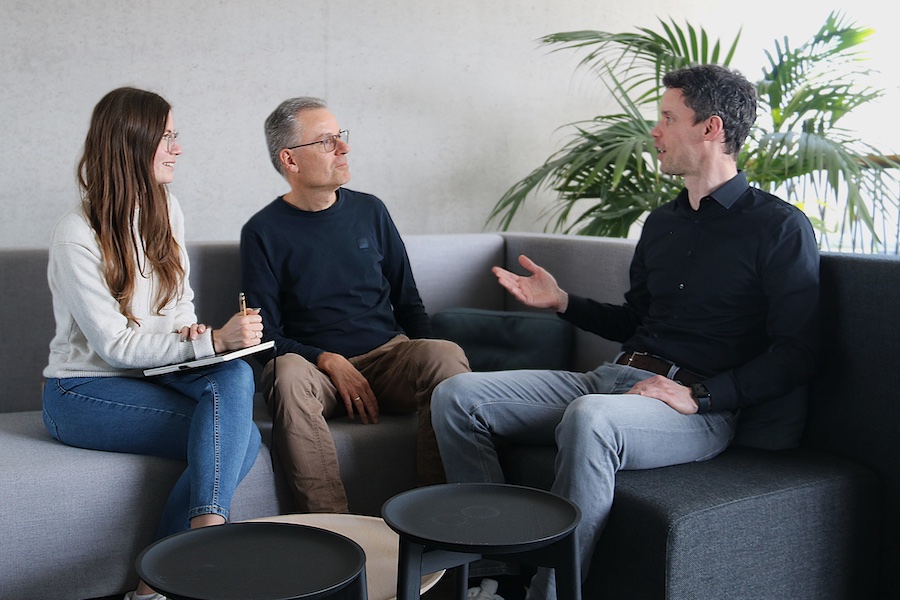
Larissa Ruhmann talks to Mario Görner and Dr Philipp Erler © 2025 KARL MAYER


KARL MAYER is celebrating the anniversary of a revolutionary solution this year

Larissa Ruhmann from the Corporate Communications team at KARL MAYER took the anniversary as an opportunity to talk to the experts at KARL MAYER about the changes that have taken place in warp knitting, but also to find out more about trends and future innovations. Mario Görner, who played a key role in the work on KAMCOS® 1 in the early 2000s, and Dr Philipp Erler, Head of Control Platform at KARL MAYER's Warp Knitting business unit, met with her for an interview.

LR: Mr Görner, as a pioneer from the very beginning of KAMCOS® development, you have helped to write history. What were the biggest changes in the première version?

MG: Thanks to KAMCOS® 1, we were the first to launch a warp knitting machine with pure touch-screen operation. That was very innovative! And it took courage, because there were many doubts and concerns, even internally. But in the end, the advantages were convincing. Touch screen operation itself is already much easier. Another benefit was the ability to enter article data via a standardised user interface instead of on different systems and to retrieve it from a central file instead of from different sources when the article needed to be produced again. The basis for all this was our new platform concept. All control components, i.e. the computers for yarn feed, pattern control and yarn breakage control, were centralised. I had developed a special communication protocol for their exchange with the main control system via a standardised bus system.

LR: You were also involved in the further development. What was new about KAMCOS® 2?

MG: KAMCOS® 2 makes the service considerably easier. Software updates can now be carried out easily, remotely and without our service specialists on site. We have also launched a new era in the operating concept. We asked our customers and our own colleagues for new, useful options for machine handling and developed a new operating philosophy based on their answers. The key point was more usability and an inviting look. For the implementation, a designer created a state-of-the-art user interface with its own colour and operating concept using web technology. This allows for a wide range of customisations without great effort. Our new user interface design received the 2016 DESIGN AWARD from iF International Forum Design GmbH in the “Communication - Apps/Software” discipline.

LR: Mr Erler, let's now look to the future. In which direction is the future work heading? What trends do you see in machine control in general?

PE: We are continuously developing KAMCOS® 2 for all machine segments. There are usually two new releases per year. We incorporate new functionalities into the upgrades, in particular to increase the productivity of the machines. These further developments are significantly influenced by the guiding principles of Industry 4.0 and increasingly also Industry 5.0. We continuously monitor the resulting changes and analyse whether we can use the related potential to optimise KAMCOS® 2.

As KAMCOS® 2 comprises not only the user interface but also the entire control platform, we are also continuously optimising under the „hood“. There is a general trend towards merging the virtual world of IT with the physical world of industrial automation. The combination of IT and OT (operational technology) ensures greater efficiency in development, but also facilitates the implementation of robust cyber security concepts. To this end, legal requirements such as the EU Cyber Resilience Act must be complied with in future.

LR: So you have challenging tasks ahead of you. You and your team can build on the experience of 23 years of KAMCOS® development in realising them. What are the most important lessons learnt?

PE: Compared to other machine control systems, KAMCOS® 2 offers specific strengths. These must be retained. In addition, our proven strategy is and remains: one KAMCOS® for all machines!

Our control platform has evolved over the years. This has shown that traceability, comprehensibility and user-friendliness are still important. Basic modifications must be as self-explanatory as possible to be accepted. Here it is important to find a compromise between the realisation of individual customer wishes and intuitive, clear operation. Even after all these years, this is still a challenge in which the configurability of the user interface by the customer is certainly a key to success.

LR: Thank you for the interesting conversation!
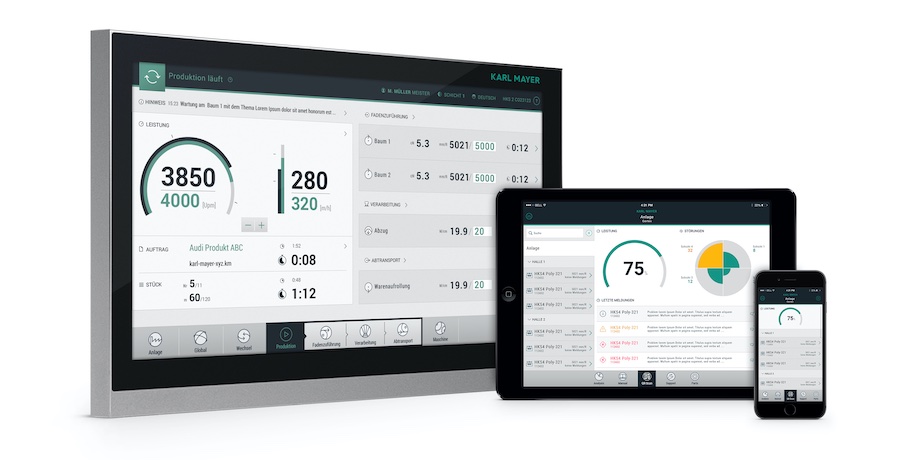
The user interface design received the 2016 IF DESIGN AWARD © 2025 KARL MAYER


More News from KARL MAYER Textilmaschinenfabrik GmbH

#Composites

KARL MAYER strengthens partnerships in the composites industry at JEC World 2026

KARL MAYER further strengthened its role as a reliable and competent partner to the composites industry at JEC World 2026. The global market leader in textile machinery manufacturing used the trade show to meet key customers, establish numerous new contacts, and engage in in-depth technical discussions.

#Knitting & Hosiery

Driving WARP KNIT Inspiration

KARL MAYER sees performance fabrics and next-level textile solutions in particular as potential growth drivers for its customers, as a motor for business development and as real game changers for the entire textile industry. Innovation does not happen by chance. It is the result of close exchange with customers & brands, textile expertise and competence in textile machine engineering. This is why KARL MAYER is investing in progress and collaborative development and opening its TEXTILE INNOVATION CEN-TER (TIC) – a place to be for the entire textile world.

#Knitting & Hosiery

KARL MAYER (China) celebrates its 30th anniversary

On February 6, KARL MAYER (China) celebrated the new year and its 30th anniversary. Employees and the management team at the Changzhou location, as well as representatives from management in Germany, Italy, and Hong Kong, were invited to the festivities. A special highlight was the visit by Lutz Wolf, CEO of KARL MAYER.

#Knitting & Hosiery

KARL MAYER at JEC: Multiaxial reinforced CFRP pultrusion profiles are picking up speed in the mobility sector

KARL MAYER Technical Textiles will be showcasing exciting new application potentials for multiaxial non-crimp fabrics in combination with the pultrusion process at the upcoming JEC in Hall 5, Booth C 46. The advancement of the tried-and-tested pultrusion process enables the cost-efficient production of complex CFRP multi-chamber profiles, which are used in the CETROVO high-speed metro. The world's first carbon-intensive lightweight rail vehicle of this type is designed for speeds of up to 140 km/h.

More News on Knitting & Hosiery

#Techtextil 2026

Groz-Beckert showcases cross-segment innovations for technical textiles in Frankfurt

From April 21 to 24, 2026, Groz-Beckert will present its latest innovations and solutions across the product areas of knitting, weaving, nonwovens and sewing at Techtextil 2026 in Frankfurt (Hall 12, Booth B90).

#Techtextil 2026

Shima Seiki showcases WHOLEGARMENT® and 3D knitting solutions for technical textiles at Techtextil 2026

Leading textile technology solutions provider SHIMA SEIKI MFG., LTD. of Wakayama, Japan, along with its Italian subsidiary SHIMA SEIKI ITALIA S.p.A., will be participating in the Techtextil 2026 exhibition in Frankfurt, Germany next month. On display will be WHOLEGARMENT® and other advanced three-dimensional knitting applications across a wide range of industries besides fashion apparel that are not typically associated with knitting, such as technical textiles using industrial materials and advanced three-dimensional knitting.

#Knitting & Hosiery

SHIMA SEIKI announces partnership with CLO Virtual Fashion

Leading computerized flat knitting innovator SHIMA SEIKI MFG., LTD. of Wakayama, Japan is partnering with digital garment solutions provider CLO Virtual Fashion of Seoul, South Korea for the integration of technology in garment design and simulation.

#Knitting & Hosiery

Huixing acquires insolvent Mayer & Cie.

Insolvency proceedings for the circular knitting and braiding machine manufacturer Mayer & Cie. were opened on December 1, 2025. Immediately following the opening of proceedings, the complete cessation of business operations was initiated. Most employees were subsequently given notice effective the end of February 2026. The production of the remaining orders in the circular knitting segment is expected to be completed by the end of the month. As early as December 2025, Mayer & Cie.’s braiding machine division was sold to an Italian investor.

Latest News

#Raw Materials

New study shows low environmental impact by Cotton made in Africa Organic Cotton from Tanzania

Today, the Aid by Trade Foundation (AbTF) is announcing the results of a comprehensive life-cycle analysis (LCA) for cotton produced in Tanzania under the Cotton made in Africa Organic (CmiA Organic) standard. The study emphasises the small ecological footprint of CmiA Organic verified cotton. This can largely be traced back to the absence of synthetic pesticides, artificial fertilisers, and artificial irrigation. Consequently, CmiA Organic cotton can help the textile industry meet regulatory requirements as well as science-based targets. The results also show that the consequences of climate change threaten the livelihoods of these cotton farmers, even though the type of agriculture they practise barely contributes to climate change.

#Raw Materials

Better Cotton Initiative strengthens regenerative focus in standard update

The Better Cotton Initiative (BCI) has strengthened the regenerative focus of its field-level standard with the launch of a new version of its Principles & Criteria (P&C), which marks the next step in the organisation’s journey to becoming a regenerative standards system.

#Man-Made Fibers

Selenis and Kintra Fibers partner to scale 100% bio-based synthetic fiber technology

Selenis, a leading global specialty polyester manufacturer, today announced a strategic manufacturing partnership with materials science company Kintra Fibers to scale Kintra’s patented fiber-grade PBS resin - a 100% bio-based and biodegradable material designed for textile applications.

#Functional Fabrics

PERFORMANCE DAYS proves its relevance as the industry’s key meeting point

Held on March 18–19, 2026, PERFORMANCE DAYS once again confirmed its position as a leading international platform for functional textiles. A total of 3.366 trade visitors and around 560 exhibitors gathered in Munich, with the event already kicking off successfully on DAY 0, which received highly positive feedback for its interactive format. Despite challenging conditions caused by the public transport strike in Munich, the event saw strong attendance and a consistently high level of activity across both exhibition days.

TOP