[pageLogInLogOut]
You can feel it's Benninger!

#Dyeing, Drying, Finishing

Interstoff opts for advanced Svegea colarette systems

Svegea – a member of TMAS, the Swedish textile machinery association – has delivered no less than six of its EC 200 automatic collarette machines to the Bangladesh-based Interstoff Group in the past 12 months.


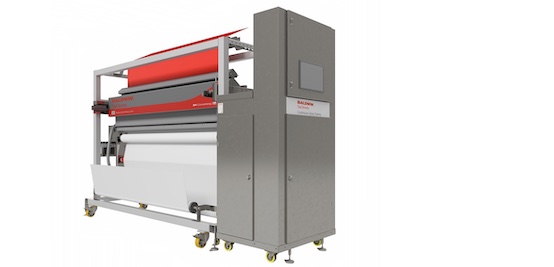
Svegea EC 200 system in situ at Interstoff Apparels.


Interstoff, which belongs to the Pandughar Group, was founded in 2000 as a modest garment factory with just 62 sewing machines.

Today its three divisions – Interstoff Apparels, Interstoff Clothing and South East Textile – have a combined workforce of over 10,000 people, producing around 72 million fully finished and packaged garments each year.

Recognition

Interstoff is further equipped with the very latest knitting and dyeing and finishing machinery sourced from Europe and Japan to enable a daily production capacity of 30,000 kg of fabrics. Through continuous innovation in yarns and processes, the company’s fabrics consistently earn recognition for their environmental responsibility and quality. Its fabric laboratory is certified by leading brands such as H&M, M&S, Sainsbury’s and Tesco.

Two Svegea collarette machines have now been commissioned at each of the three Interstoff divisions for the high speed production of tubular apparel components such as cuffs, collars and neck tapes.

Interstoff chose the EC 200 machines over the faster EC 300 model primarily because some of its fabrics include seams. The faster crush-cutting knife system in Svegea’s EC 300 series can struggle with multiple fabric layers or seams stitched with polyester thread, since it cuts by pressure rather than slicing. By contrast, the EC 200 uses scissor-action knives – two sharp circular blades with a slight overlap – which function like scissors and handle seams without issue.

The machines run directly from turntables at speeds of up to 40 metres per minute, depending on the fabric width, material properties and optimal settings. They are equipped with Svegea’s standard drive system in an electronic master/slave configuration. Each machine has been specially equipped with a third knife set, enabling the simultaneous cutting of up to three bands. This means that total output in linear metres per minute can be significantly higher when cutting multiple bands in parallel.


Efficiency and fabric savings

“Advances in automation continue to make the specialised, bespoke machines we engineer more efficient,” says Svegea Managing Director Håkan Steene. “We have enjoyed great success in Bangladesh over the past few years, working with our invaluable regional partner Tech Cell, and have established strong relationships with the leading integrated garment manufacturing operations in the country.”

“We have had a strong relationship with Svegea over the years and these machines are now helping us to significantly increase production as well as achieving fabric savings and being able to divert manpower to other areas of production,” adds Interstoff Apparels director Shaikh Mohammad Ilias.

“Many of the world’s leading fashion brands have chosen to establish operations in Bangladesh, drawn to the country’s efficiencies and highly integrated network of rapidly responding suppliers,” says TMAS Secretary General Therese Premler-Andersson. “Hoping to build on this success, the Bangladesh government has now initiated plans to achieve exports of ready-made garment worth $50 billion by as early as this year – and approaching $100 billion by 2030. Members of TMAS have been very active in the region recently, providing the latest tools for automating textile and garment manufacturing processes – driving both sustainability and competitiveness. TMAS members look forward to meeting up with new and existing customers at the forthcoming ITMA Asia exhibition in Singapore this October.”

Svegea will be demonstrating both semi- and fully-automatic cutting machines at ITMA Asia + CITME from October 28-31, at stand D109 in Hall 6.
More News from Textile Machinery Association of Sweden

More News on Dyeing, Drying, Finishing

#Dyeing, Drying, Finishing

Smart Quality Control for Technical Textiles

In the end, what matters is the result: a filter that performs reliably, a membrane that remains stable in storm conditions, a composite material with precisely defined properties. But the path to achieving this is demanding. In the production of technical textiles, numerous parameters interact – and even the smallest deviations can have major consequences.

#ITM 2026

The address for environmentally friendly dyeing and finishing systems: ITM 2026

Dyeing and finishing technologies, one of the most critical and value-added areas of the textile sector, have gained strong growth momentum on a global scale. Technologies that are pioneers of this transformation focused on sustainability, quality and efficiency will meet with sector professionals at the ITM 2026 International Textile Machinery Exhibition. Dyeing and Finishing Hall (11–12) will host the latest technologies that increase efficiency, optimize resource use and reduce environmental impact in textile finishing processes.

#Techtextil 2026

iNTERSPARE presents latest developments and upgrade solutions for technical textile finishing at Techtextil

iNTERSPARE Textilmaschinen GmbH will present its latest solutions for technical textile finishing at Techtextil 2026 in Frankfurt (VDMA joint stand, Hall 12 / Stand C55A). The focus will be on further developments within the Krantz, Artos and Babcock (BTM) product lines, in particular the Krantz K30 stenter as well as the reintroduction of the Artos Vari-Flex foulard. The presentation will be complemented by modular solutions for upgrading existing installations and new approaches in automation and digitalization.

Latest News

#INDEX 2026

“We clearly see that reliability, flexibility, service and total cost of ownership are becoming increasingly important again.”

The nonwovens industry continues to face a challenging market environment. Nevertheless, AUTEFA Solutions reports successful projects, new line sales and growing demand for energy-efficient and flexible solutions. In this interview, André Imhof of AUTEFA Solutions talks about competitiveness against Chinese suppliers, new service and recycling concepts, the growing importance of application development and the opportunities created by countercyclical investments.

#INDEX 2026

“Needle punching technology is more universal and sustainable than ever!”

Needle punching technology was long regarded as a rather traditional and comparatively slow technology within the nonwovens industry. In this interview, Johann Philipp Dilo explains why needle punching is more relevant than ever today – ranging from energy efficiency and resource conservation to hygiene applications, new machine concepts and design-oriented nonwoven solutions.

#Research & Development

Textile climate control system in workwear – exhibition at the 2026 SME Innovation Day!

Conventional protective workwear often reaches its limits during strenuous physical activity. In particular, the transport of sweat and excess body heat poses a problem. The German Institutes of Textile and Fiber Research (DITF) conducted research on flow-optimized, air-conducting textile structures that enable targeted climate control directly on the body. These structures can be integrated straight into protective work garments. The textile climate control system supports the body’s natural thermoregulation. This contributes to improved workplace safety and comfort.

#Nonwovens

PET spunbond from China – EDANA welcomes imposition of provisional anti-dumping measures

On 13 May 2026, after eight months of investigation, the European Commission imposed provisional anti-dumping duties of 45.6-50.0% on imports of PET spunbond from China. EDANA welcomes this expression of the Commission’s clear determination to protect EU industries from the unfair trade practices of Chinese producers.

TOP