[pageLogInLogOut]

#Textiles & Apparel / Garment

YKK’s net-zero commitment drives new business strategy for decarbonization and circular economy 

ONE YKK vision anchors new medium-term plan in 2025 integrated report
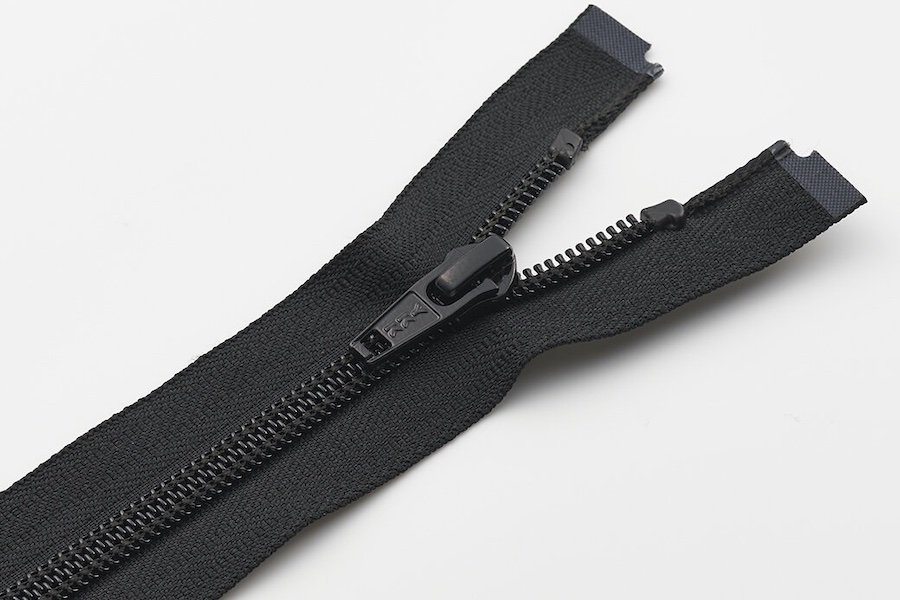
Sustainability is not just a priority at YKK—it is the foundation of its global business strategy. In its latest integrated report, This is YKK 2025, the company outlines its FY2024 achievements and FY2025 initiatives under the banner of Contributing to a Sustainable Society as ONE YKK. These efforts advance the YKK Sustainability Vision 2050, a long-term commitment to climate neutrality and harmony with nature. This vision is structured around five key themes: climate change, material resources, water resources, chemical management, and respect for people—all aligned with the UN Sustainable Development Goals (SDGs).

“Sustainability is not a slogan—it’s a strategy,” said Koichi Matsushima, President, YKK Corporation. “With our Net-Zero commitment and the ONE YKK vision, we are taking bold steps to transform our business, empower our people, and lead the way toward a circular economy.”

Driving toward Net-Zero emissions — Climate change

YKK’s goal to achieve net-zero GHG emissions by FY2050 has been officially validated under the SBTi Net-Zero Standard. The company is targeting a 90% reduction in Scope 1, 2, and 3 emissions by FY2050 compared to FY2018 levels, covering both its operations and supply chain. YKK’s climate leadership has been recognized with a second consecutive CDP “A List” rating and its third designation as a Supplier Engagement Leader. Key achievements include:

• Cut Scope 1 and 2 emissions by 57% from FY2018 levels, reducing total emissions to 234,679t

• Lowered Scope 3 emissions by 14.4%, reducing total emissions to 747,276t across the supply chain

• Boosted renewable energy usage to 61.2% of total power consumption

• Transitioned 45 global sites to 100% renewable energy, including full conversion in the China region

• Expanded solar energy capacity, adding 7 new facilities for a total of 34 operational sites

• Initiated equipment upgrades to phase out coal-fired boilers and reduce fossil fuel dependency


Innovating for circularity and resource efficiency — Material resources

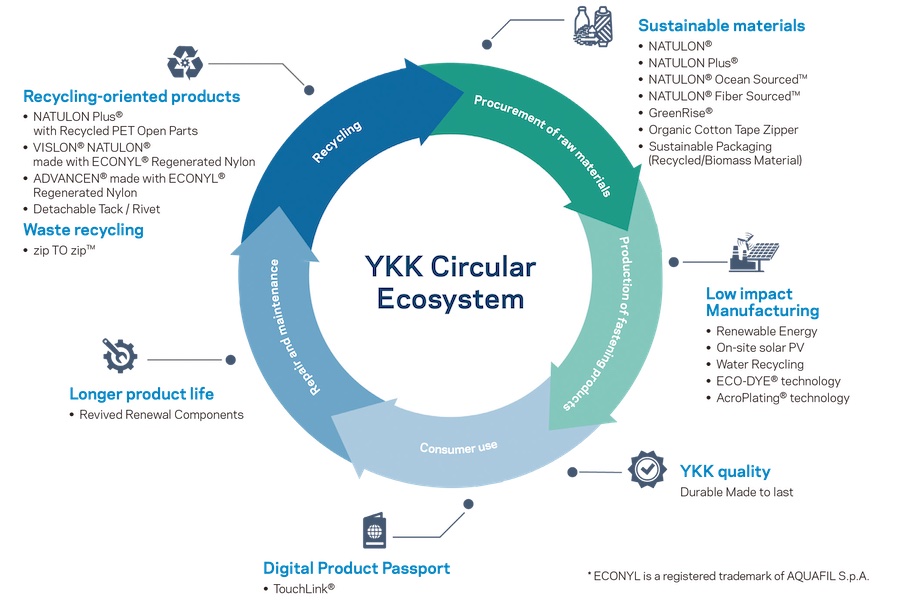
YKK is accelerating circularity through innovative product design and material reuse. Key achievements include:

• Increased use of sustainable materials to 48%, marking a 10-point year-on-year improvement

• Transitioned 20% of packaging materials to sustainable alternatives

• Raised waste recycling rate to 93.9%, up 2 points from the previous year

• Prioritized sourcing from suppliers certified with “The Copper Mark”, and actively encouraged others to pursue certification

• Introduced NATULON Plus® with Recycled PET Open Parts to support garment-to-garment recycling

• Launched Revived Renewal Components, extending garment lifecycles through repairable components

• Conducted in-house recycling trials at the Kurobe Plant for copper and zinc alloys used in zippers

• Promoted environmental stewardship through tree-planting and clean-up initiatives


Strengthening water stewardship — Water resources

YKK continues to reduce water consumption and manage water quality across its operations. Key achievements include:

• Reduced total water intake by 7.5% compared to FY2018, reaching 10.638 million tons

• Monitored and addressed water intensity, which increased by 3.2% year-on-year

• Installed new production and recycling facilities at 15 sites to lower water consumption

• Managed wastewater quality in accordance with ZDHC Wastewater Guidelines

• Implemented water risk mitigation activities to safeguard local ecosystems and communities


Ensuring chemical safety and supply chain compliance — Chemical management

YKK is committed to responsible chemical management throughout its supply chain. Key achievements include:

• Engaged 1,793 suppliers by sharing the updated YKK Restricted Substances List (RSL 2024) and conducting compliance surveys

• Updated the YKK RSL for 2025, reflecting evolving social expectations and customer requirements

• Monitored chemical safety compliance through testing with OEKO-TEX® STANDARD 100 (44 companies) and AFIRM RSL (39 companies)

• Deployed ZDHC MRSL compliance assessments using InCheck reports across 17 production sites

• Identified and replaced non-compliant materials in the YKK RSL (2024 version), driving innovation in sustainable materials and manufacturing processes

• Established a cross-functional task force to address YKK RSL non-compliance across departments

• Initiated regular inspections at chemical management sites to prevent soil contamination and ensure environmental safety


Championing human rights and fair labor practices — Respect people

YKK continues to uphold ethical labor standards and human rights across its global operations. Key achievements include:

• Implemented weekly monitoring systems to manage working hours at all manufacturing sites, ensuring fair labor conditions

• Strengthened human rights due diligence by conducting self-assessments at 51 locations and third-party audits at 24 locations, based on the YKK Global Criteria of Compliance (YGCC)

YKK remains committed to engaging stakeholders and driving sustainability across its global operations. Detailed progress and performance metrics are available in the 2025 Integrated Report, with additional ESG and financial data in the accompanying Data Book. YKK invites stakeholders, partners, and customers to explore the full report and collaborate in shaping a more sustainable and circular future.
© 2025 YKK
© 2025 YKK


More News from YKK

#Textiles & Apparel / Garment

YKK collaborates with Coloro to deliver data-driven color ffeasibility for zippers

YKK Corporation announces its collaboration with Coloro, a leading innovator in color solutions and data for the global fashion industry, to introduce joint matching and feasibility results of Coloro colors in YKK’s zippers.

#Sustainability

YKK recognized with Top ‘A’ rating by CDP for climate change leadership for third consecutive year

YKK Corporation announced its achievement of the highest “A List” rating in the 2025 Climate Change survey conducted by the global environmental disclosure nonprofit, CDP . This marks the third consecutive year YKK has received this prestigious recognition.

#Textile processing

YKK receives ISPO Textrends Awards for circular innovations

YKK Corporation (Headquarters: Chiyoda-ku, Tokyo; President: Koichi Matsushima; hereafter, YKK) is pleased to announce that the ISPO Textrends judges have selected YKK's 3D Composite Puller as the Best Product in the Accessories category. They also selected YKK’s NATULON Plus® Fiber Sourced™ zipper with Recycled PET Open Parts as a Top 5 item in the same category. The competition, held twice a year in conjunction with the ISPO trade show, recognizes the most innovative performance textiles, components, and apparel.

#Sustainability

YKK to exhibit at Textile Exchange Conference 2025 in Lisbon

YKK Corporation (Headquarters: Chiyoda-ku, Tokyo; President: Koichi Matsushima; hereafter, YKK) will exhibit at the Textile Exchange Conference 2025 in Portugal, held from Monday, October 13 to Friday, October 17, to showcase its products and initiatives that contribute to the realization of a circular economy in the fashion industry.

More News on Textiles & Apparel / Garment

#Textiles & Apparel / Garment

VIATT 2026 to debut German Pavilion, strengthening European participation alongside key Asian textile hubs

Vietnam’s textile and garment sector continues to be a major contributor to the country’s economic growth, with export revenues expected to reach USD 46 billion in 2025, a 5.6% increase from 2024 . From 26 – 28 February, the Vietnam International Trade Fair for Apparel, Textiles and Textile Technologies (VIATT) is set to contribute to economic growth opportunities by accelerating digital transformation and green transition across the entire textile value chain. The upcoming edition will respond to the rising demand for advanced technologies and sustainable materials with the introduction of the German Pavilion, alongside strong exhibitor participation from key Asian sectors, as well as several high-profile fringe events.

#Sustainability

Ying McGuire becomes new CEO of Cascale

Cascale today announced the appointment of Ying McGuire as Chief Executive Officer, effective June 1, 2026.

#Europe

Antwerp Declaration community urges EU leaders to deliver emergency measures as Europe’s competitiveness crisis deepens

EURATEX, representing the European textile and fashion industry, joins the Antwerp Declaration Community’s call on EU Heads of State and Government to adopt emergency measures that restore industrial competitiveness and deliver tangible results for Europe’s manufacturing base in 2026.

#Textiles & Apparel / Garment

Pets in fashion: functional and sustainable textiles find new market at Intertextile Apparel

China’s pet economy is booming, especially amongst younger generations, and pet apparel – from designer outfits to functional garments – was a RMB 3.5 billion (over USD 500 million) market in 2024, growing more than 20% annually¹. To help exhibitors harness this trend, Intertextile Shanghai Apparel Fabrics – Spring Edition 2026 will launch the Pet Boutique, presenting a range of innovative, sustainable materials that prioritise both functionality and comfort for pets.

Latest News

#Recycling / Circular Economy

Circulose restarts commercial-scale production at Ortviken plant in Sundsvall

Circulose today announced the restart of its commercial-scale production plant at Ortviken in Sundsvall, Sweden, marking a significant step in scaling next-generation materials for the global fashion industry. The company plans to resume production of CIRCULOSE®, a recycled pulp made entirely from discarded cotton textiles, in the fourth quarter of 2026.

#Technical Textiles

Sustainable, lightweight, and sound absorbing: Polyester-based front trunk solution for BEVs

As car manufacturers look to further reduce their carbon footprint, Autoneum has developed an innovative front trunk solution for battery electric vehicles (BEVs), made entirely from polyester-based textile. The Ultra-Silent Frunk offers significant weight reduction, improved acoustic and thermal insulation, and uses up to 70 percent recycled material, supporting sustainable and efficient vehicle design. Autoneum, global technology leader in acoustic and thermal management for vehicles, has already received orders for the new frunk from three major OEMs in Asia and Europe to be built in three BEV models. Series production for two BEVs has been underway in China and Germany since last year.

#Raw Materials

Modern testing methods for raw cotton

The 38th International Cotton Conference Bremen will take place from 25 to 27 March 2026 at the Bremen Parliament. This conference has traditionally stood for in-depth expertise and international exchange. The program will focus on technical innovations, market trends, and regulatory frameworks across the entire value chain – from agriculture to the circular economy. With high-profile speakers, the conference is regarded as the key meeting point for the global cotton industry. Today’s focus: Cotton quality and testing methods.

#Spinning

Rieter responds to higher raw material prices

Global political and economic developments have been leading to rising raw material and energy costs for some time. The textile machinery industry is also affected by this trend. Rieter machines and components consist to a large extent of steel, copper, aluminum and electronics. These materials in particular have seen higher demand and higher prices in recent months.

TOP