[pageLogInLogOut]

#Textile processing

Automatex introduces game changing quilting machine
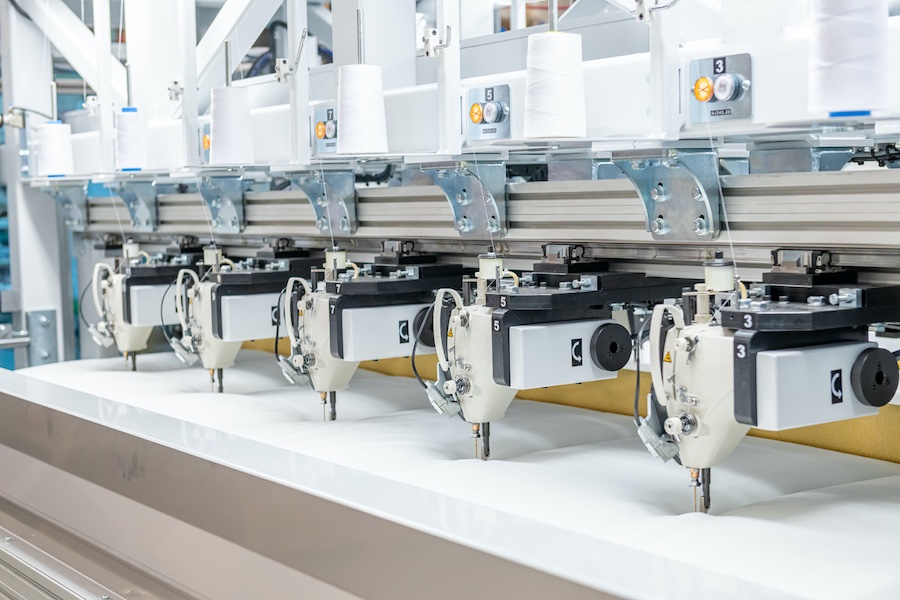
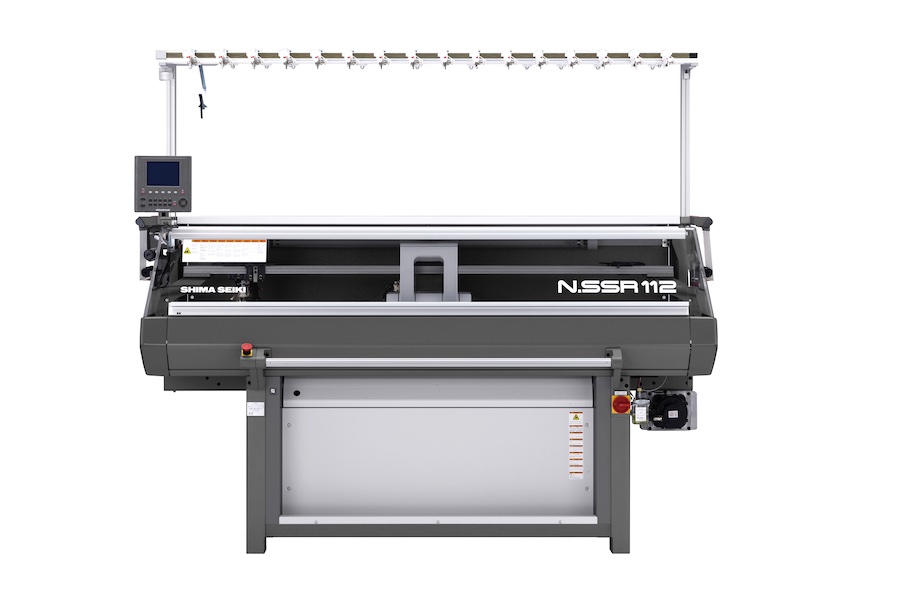
The quilting module is equipped with twelve modified servo-driven lock stitch sewing heads © 2026 Automatex
Having achieved rapid market success with its fully automated fitted sheet system, Automatex, a member of TMAS, the Swedish textile machinery association, has developed a game changing quilting machine which doubles productivity compared to what has previously been achievable.

The P12-PB Automatic Lock Stitch Quilting Unit is engineered to deliver continuous, programmable quilting while reducing manual intervention in the stitching of bedding and padded home textiles.

“Across our member companies we are seeing automation move beyond individual machines towards intelligent, interconnected production environments,” says TMAS General Secretary Therese Premler-Andersson. “Solutions like this demonstrate how textile technology manufacturers are pushing the boundaries of consistency, productivity and digital control in areas that were traditionally dependent on operator skill.”

Maximising uptime

Designed for high-volume manufacturers, the new P12-PB platform feeds fabric and filling directly into a quilting module equipped with twelve modified servo-driven lock stitch sewing heads. Arranged in two programmable banks of six, the heads allow producers to switch between straight line quilting and different shaped patterns without mechanical changeover, enabling flexible production runs while maintaining consistent stitch geometry. 

At the core of the Automatex system is an automation architecture focused on maximising uptime. Each sewing head incorporates an automatic bobbin case changer supported by a retrieval system, allowing uninterrupted production during thread depletion. Thread break detectors further minimise defects, while servo indexing ensures accurate needle positioning across the working width. A colour touch screen interface simplifies pattern programming and machine operation and remote access capability enables troubleshooting and technical support without on-site intervention. 

Operating at speeds of up to 12 metres per minute, the P12-PB is suitable for filling weights from 100-450gsm with stitch lengths between 3-4 mm. The machine produces various stitching patterns and straight lines at 21.7cm needle spacing, supporting a wide range of quilt constructions. It has been engineered for installation within standard industrial utility frameworks. 

The new P12-PB platform  © 2026 Automatex<br />
The new P12-PB platform © 2026 Automatex


Continuous production

Automatex has also designed the unit for full line integration. 

“The P12-PB can be connected directly in-line with our automated sewing and folding systems to form a continuous production chain, from fibre processing through to finished product handling,” says Automatex Director of Business Development Chuck deSousa. “This approach reflects a broader industry shift toward labour-light manufacturing, traceable production and repeatable quality across large batch volumes.”

More News from Automatex

More News on Textile processing

#Textile processing

YKK joins ZDHC as a Signatory Supplier, strengthening commitment to eliminating hazardous chemicals

YKK Corporation (Headquarters: Chiyoda-ku, Tokyo; President: Koichi Matsushima; hereafter, YKK) has joined ZDHC (Zero Discharge of Hazardous Chemicals) as a Signatory Supplier as of May 2026.

#Textile processing

trinamiX mobile NIR spectroscopy: New applications for the footwear and textile industry

trinamiX GmbH expands its solution portfolio for the circular economy, now enabling the identification of materials used in the footwear and textile industries. With its mobile near-infrared (NIR) spectroscopy solutions, trinamiX supports manufacturers, sorters, recyclers, and brand owners in reliably identifying materials and improving transparency across increasingly complex value chains.

#Texprocess 2026

Texprocess 2026: Style3D | ASSYST showcases AI, 3D, 2D and automation and meets strong industry response

Four days, countless discussions and a clear signal from the industry: the future of fashion is digital and AI-driven. At Texprocess 2026, Style3D | ASSYST demonstrated how AI, 3D and automation are already fundamentally transforming processes from design to production.

#Techtextil 2026

Speed and connectivity: Techtextil and Texprocess provided market-ready solutions for industries under pressure

With more than 36,000 visitors and 1,700 exhibitors from a total of 112 countries, Techtextil and Texprocess 2026 demonstrated how innovation comes into industrial use. The convergence of research, industry and application proved to be a breeding ground for new material solutions, manufacturing and processing technologies. Natural fibres, performance apparel, connected systems and AI-driven processing technologies emerged as key growth and future markets.

Latest News

#INDEX 2026

“We clearly see that reliability, flexibility, service and total cost of ownership are becoming increasingly important again.”

The nonwovens industry continues to face a challenging market environment. Nevertheless, AUTEFA Solutions reports successful projects, new line sales and growing demand for energy-efficient and flexible solutions. In this interview, André Imhof of AUTEFA Solutions talks about competitiveness against Chinese suppliers, new service and recycling concepts, the growing importance of application development and the opportunities created by countercyclical investments.

#INDEX 2026

“Needle punching technology is more universal and sustainable than ever!”

Needle punching technology was long regarded as a rather traditional and comparatively slow technology within the nonwovens industry. In this interview, Johann Philipp Dilo explains why needle punching is more relevant than ever today – ranging from energy efficiency and resource conservation to hygiene applications, new machine concepts and design-oriented nonwoven solutions.

#Research & Development

Textile climate control system in workwear – exhibition at the 2026 SME Innovation Day!

Conventional protective workwear often reaches its limits during strenuous physical activity. In particular, the transport of sweat and excess body heat poses a problem. The German Institutes of Textile and Fiber Research (DITF) conducted research on flow-optimized, air-conducting textile structures that enable targeted climate control directly on the body. These structures can be integrated straight into protective work garments. The textile climate control system supports the body’s natural thermoregulation. This contributes to improved workplace safety and comfort.

#Nonwovens

PET spunbond from China – EDANA welcomes imposition of provisional anti-dumping measures

On 13 May 2026, after eight months of investigation, the European Commission imposed provisional anti-dumping duties of 45.6-50.0% on imports of PET spunbond from China. EDANA welcomes this expression of the Commission’s clear determination to protect EU industries from the unfair trade practices of Chinese producers.

TOP