[pageLogInLogOut]

#Textile processing

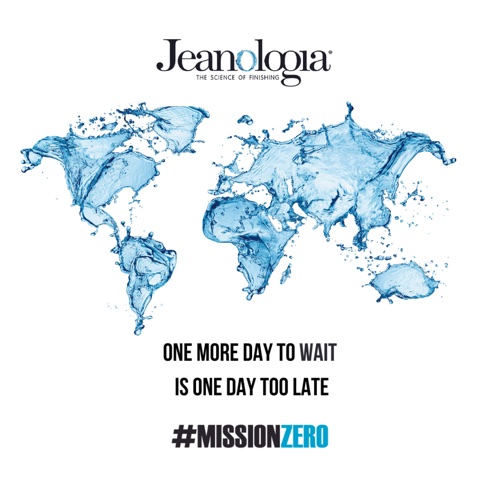
Jeanologia calls for shared responsability on World Water Day

Coinciding with World Water Day celebrations and under the slogan "Water, a shared responsibility," the eco-efficient textile technology company, Jeanologia, calls on this productive sector, appealing for a real change, away from greenwashing and towards concrete and collective action.
Three decades ago, Jeanologia began its journey swimming against the current in an ocean of skepticism within one of the world's most polluting productive sectors: the textile industry. It became a pioneer and revolutionized the industry by demonstrating that fashion could be produced by significantly reducing its environmental impact and without compromising quality or profitability, relying on technology to achieve this.

Since its foundation, Jeanologia has led sustainable change in the textile industry, thanks to its innovative technologies, which have drastically reduced water consumption and returned the minimal amount of water used to nature in perfect condition, as well as minimizing the use of chemicals and energy and eliminating harmful emissions and discharges.

New environmental record

In 2023, Jeanologia set a record in its environmental P&L statement, measuring in cubic meters the contaminated water that is no longer discharged into rivers and seas, as well as the reduction of toxic emissions, thanks to its technological advances and services.

The technologies developed by Jeanologia have saved the planet 20,265,581 cubic meters of contaminated water in 2003, equivalent to the consumption of a city the size of Brussels or more than 1,200,000 Olympic pools. Additionally, 97,895,304 kilograms of CO2 emissions were reduced, equivalent to the carbon absorbed by a forest of 9,800,000 trees.

The key to success lies in the integration of eco-efficient technologies in all stages of production, from fabric to garment finishing. In this way, water consumption in the garment finishing process has been drastically reduced, from 70 liters to just 1 liter per garment. These technologies have also significantly reduced the use of chemicals and energy, as well as emissions and harmful discharges derived from textile production. All this without compromising quality or design.

Furthermore, Jeanologia's eco-efficient technologies include the H2 ZERO effluent recycling plant, a key component of their Mission Zero initiative. This innovative system is able to recover 95% of water used in the production process. It plays a vital role in creating a closed-loop system, ensuring minimal water wastage and contributing to a sustainable ecosystem for brands and their suppliers. Thanks to H2 ZERO, water is treated without chemicals, maintaining optimal conditions for reuse, aligning with Jeanologia's commitment to environmental responsibility and resource conservation.

Additionally, Jeanologia’s Air Fiber Washer project focuses on removing microfibers from the garment finishing process, thereby contributing to the preservation of the seas and preventing these microfibers from contaminating marine ecosystems.

Jeanologia also recognizes the importance of measurement and transparency in environmental impact. For this reason, over 10 years ago, it made available to the industry the Environmental Impact Measurement (EIM) software, which today more than 100 brands and 400 laundries worldwide use to measure and improve their collections, avoiding greenwashing and being completely transparent.


  • The Spanish company leads sustainable change in the textile industry, demonstrating that it is possible to produce fashion responsibly and profitably.
  • Its technologies have saved the planet more than 20 million cubic meters of contaminated water in 2023.


An invitation towards a more sustainable water management

On World Water Day, Jeanologia reiterates its commitment to continue leading its Mission Zero: achieving total dehydration and detoxification of the textile industry. A challenge turned into an urgency following UNESCO's warning that we face an imminent global water crisis, with between 2,000 and 3,000 million people suffering from water scarcity worldwide, water demand far exceeding supply capacity in many parts of the world, and the environmental impacts of its overexploitation becoming increasingly evident.

In this context, the Spanish technology company urges adopting a collective commitment. As Jeanologia's CEO and founder Enrique Silla states, "we are an impact company focusing on water." Thus, its goal is to reduce the consumption of this resource throughout the textile process to the bare minimum, eliminate 100% of the waste generated in the manufacturing and finishing of garments, and preserve the seas, eliminating any possible microfiber from the production process to prevent it from ending up in the oceans.

Jeanologia has managed to transform the global textile industry, and today its involvement goes further. Although acknowledging that the world has awakened to the urgency of sustainability, Jeanologia claims that there is still a long way to go. Individual awareness and isolated actions are not enough. Water scarcity is a global challenge that requires comprehensive and collaborative solutions involving governments, institutions, companies, and individuals. "The global context urges us to unite and accelerate action, and on a date as significant as World Water Day, we want to offer our example as inspiration and invite other companies to join our Mission Zero," claims Enrique Silla.

Jeanologia: over 25 years transofming the textile industry

Since 1994, Jeanologia's mission has been to create an ethical, sustainable, and eco-efficient textile industry. The company collaborates closely with brands, retailers, and their suppliers on their transformative journey, offering disruptive technologies, innovative software, and a new operating model.

In 2024, Jeanologia celebrates the 25th anniversary of its pioneering laser technology, launched in 1999, which revolutionized denim finishing, replacing harmful practices and eliminating the use of hazardous substances. With the same purpose, Jeanologia now faces the challenge of reducing the environmental impact of the garment dyeing process—one of the most polluting in the industry—through its revolutionary ColorBox technology.
More News from JEANOLOGIA S.L.

#Textile processing

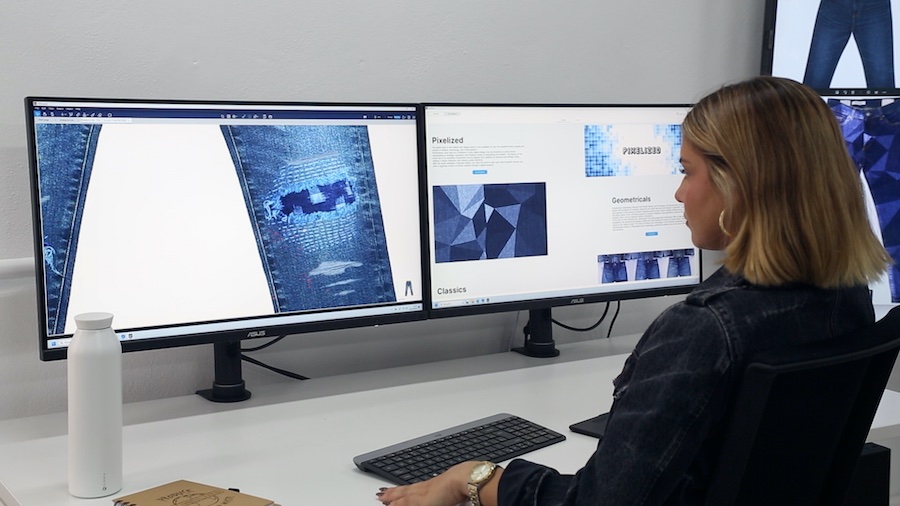
Jeanologia showcases the future of product development

Jeanologia is showcasing how software is transforming product development in the fashion industry at PI Apparel Europe: The Fashion Technology Show, taking place on March 30–31 in London.

#Denim

Jeanologia launches Billy

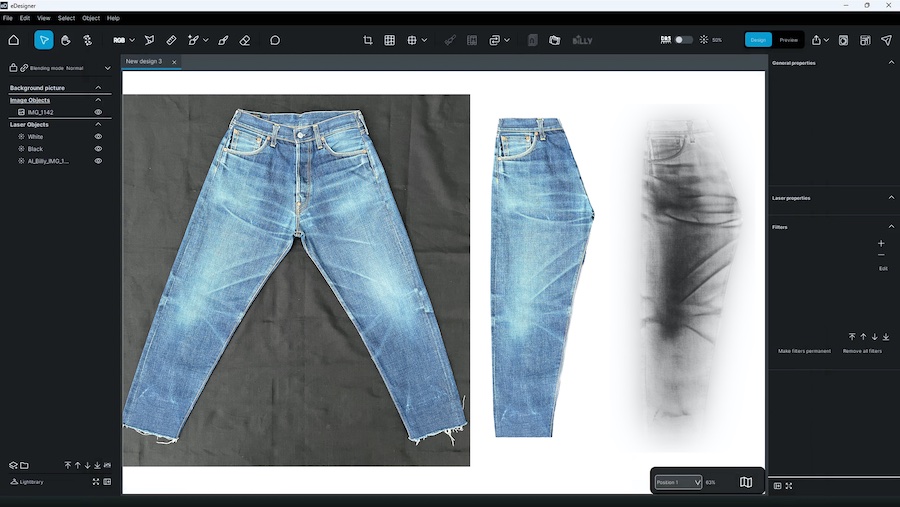
The new AI extracts precise laser designs from a garment image in minutes, transforming how vintage denim is recreated for production. If Jeanologia’s laser changed the way jeans were made at the end of the last century, its AI now takes the next step: moving from reproducing wear to designing it. / archive photo © 2026 Jeanologia

#Textile chemistry

Jeanologia urges industry to accelerate PP Spray phase-out following ZDHC Watchlist update

Potassium permanganate has officially entered the Chemical Watchlist of the ZDHC Foundation, signaling increased scrutiny and potential phase-out of one of the most hazardous chemicals still used in denim finishing. The inclusion confirms an industry shift that Jeanologia anticipated more than a decade ago.

#Denim

Jeanologia celebrates its 30th anniversary transforming how jeans are produced worldwide

Jeanologia celebrates its 30th anniversary reaffirming the mission it was born with in 1994, to transform the textile industry into a more sustainable, efficient, and human-centered sector. Three decades later, that vision has become a global reality. Today, more than 40 percent of all jeans produced worldwide are made using technologies developed by the Valencia-based company.

More News on Textile processing

#Techtextil 2026

Groz-Beckert showcases cross-segment innovations for technical textiles in Frankfurt

From April 21 to 24, 2026, Groz-Beckert will present its latest innovations and solutions across the product areas of knitting, weaving, nonwovens and sewing at Techtextil 2026 in Frankfurt (Hall 12, Booth B90).

#Textile processing

Major expansion for ACG Kinna follows record year

In response to growing demand for its full textile and finished product line automation services, ACG Kinna – a member of TMAS, the Swedish textile machinery association – has inaugurated a 1,000-square-metre expansion at its headquarters in Skene, Sweden.

#Texprocess 2026

Texprocess 2026: Automation, digitalisation and AI reshape textile processing

Investment decisions in textile processing have become increasingly complex. Rising energy prices, labour shortages and geopolitical uncertainties are forcing companies to prioritise technologies that deliver measurable improvements in efficiency and process stability. This applies not only to apparel production, but also to the processing of technical textiles and high-performance materials. Modernisation projects are therefore being evaluated more selectively – but the pressure to upgrade production systems continues to grow. Texprocess 2026 reflects this tension between cautious investment behaviour and increasing technological demand.

#Texprocess 2026

Gunold showcases embroidery product range and services at Texprocess

At Texprocess 2026, GUNOLD will present numerous hands-on examples related to embroidery in Hall 8, Booth E20. The focus is on creative embroidery designs as well as the extensive product range of threads, nonwovens, and accessories for embroidery and embellishment. “Trade visitors can once again look forward to many new and creative embroidery designs. Of course, we will also showcase the matching products required to bring these ideas to life,” announces Marketing Manager Stephan Gunold.

Latest News

#Raw Materials

New study shows low environmental impact by Cotton made in Africa Organic Cotton from Tanzania

Today, the Aid by Trade Foundation (AbTF) is announcing the results of a comprehensive life-cycle analysis (LCA) for cotton produced in Tanzania under the Cotton made in Africa Organic (CmiA Organic) standard. The study emphasises the small ecological footprint of CmiA Organic verified cotton. This can largely be traced back to the absence of synthetic pesticides, artificial fertilisers, and artificial irrigation. Consequently, CmiA Organic cotton can help the textile industry meet regulatory requirements as well as science-based targets. The results also show that the consequences of climate change threaten the livelihoods of these cotton farmers, even though the type of agriculture they practise barely contributes to climate change.

#Raw Materials

Better Cotton Initiative strengthens regenerative focus in standard update

The Better Cotton Initiative (BCI) has strengthened the regenerative focus of its field-level standard with the launch of a new version of its Principles & Criteria (P&C), which marks the next step in the organisation’s journey to becoming a regenerative standards system.

#Man-Made Fibers

Selenis and Kintra Fibers partner to scale 100% bio-based synthetic fiber technology

Selenis, a leading global specialty polyester manufacturer, today announced a strategic manufacturing partnership with materials science company Kintra Fibers to scale Kintra’s patented fiber-grade PBS resin - a 100% bio-based and biodegradable material designed for textile applications.

#Functional Fabrics

PERFORMANCE DAYS proves its relevance as the industry’s key meeting point

Held on March 18–19, 2026, PERFORMANCE DAYS once again confirmed its position as a leading international platform for functional textiles. A total of 3.366 trade visitors and around 560 exhibitors gathered in Munich, with the event already kicking off successfully on DAY 0, which received highly positive feedback for its interactive format. Despite challenging conditions caused by the public transport strike in Munich, the event saw strong attendance and a consistently high level of activity across both exhibition days.

TOP