#Research & Development
Hof University develops sustainable textile coating for the fashion of tomorrow from mushrooms
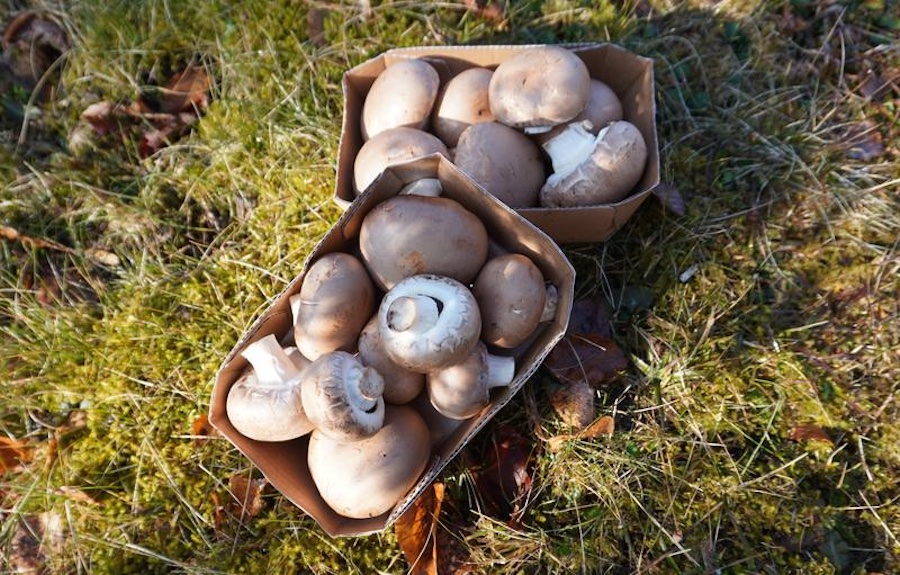
Under the title “DisAPPrint”, the Institute of Materials Science (ifm) at the Münchberg campus, in collaboration with Willy Maisel GmbH in Konradsreuth (district of Hof), is developing an innovative bio-based textile coating derived from by-products of mushroom production.
The aim of the project is to reduce textile resource consumption while creating an environmentally friendly alternative to conventional printing coatings.
A growing problem: Short-lived textiles
Whether concert shirts or promotional giveaways, many printed garments are worn only a few times. The result: increasing amounts of textile waste and additional environmental burdens from fossil-based materials used in printing coatings.
“We see enormous potential here to save resources while exploring new approaches in textile finishing,” explain Alexandra Luft and Dr. Katharina Wellmanns from the Institute of Materials Science at Hof University of Applied Sciences. “Especially in the area of short-lived textiles, the demand for sustainable alternatives is particularly high.”
The solution grows out of sight: Chitosan from mushrooms
The researchers are focusing on an unusual raw material: residual mushroom biomass from food production. Large quantities of this material are generated across Europe—yet it has so far remained largely unused. In Bavaria alone, there are numerous mushroom producers capable of supplying such by-products.
Within the project, chitosan—a bio-based substance—is extracted from these residues in powder form. When dissolved in an acidic solution, it forms a gel-like material that can be applied as a thin film to textiles.
“What makes this approach special is that we are using a resource that already exists but has so far generated little added value,” explains Dr. Wellmanns. “This creates the foundation for a solution that is both sustainable and economically attractive.”
From theory to practice: Testing under real conditions
The project includes extensive testing to determine whether the new coating performs reliably in everyday use. This involves not only assessing color brilliance and print durability but also evaluating compatibility with different materials such as cotton or polyester, as well as with various printing methods including screen and digital printing.
In addition, durability under real-life conditions is tested. At the university’s own testing facilities in Münchberg, researchers examine how the coatings react to sweat, alcoholic beverages, and fruit juices, and whether they can withstand everyday wear and tear.
A key partner is Willy Maisel GmbH from Konradsreuth, which tests the materials in real industrial printing processes. “For us, it is crucial that innovative materials work not only in the laboratory but also in industrial practice,” emphasizes Managing Director Willy Maisel. “This project offers the opportunity to integrate sustainable solutions directly into existing production processes.”
Interdisciplinary research as the key
The DisAPPrint project brings together multiple disciplines: chemistry, materials science, and textile engineering work hand in hand. While Hof University of Applied Sciences is responsible for the extraction, development, and characterization of chitosan, the industry partner contributes its expertise in practical application.
“Technology transfer between academia and small and medium-sized enterprises is a central component of this project,” explains Alexandra Luft. “Only in this way can innovations be brought into real-world use quickly and effectively.”
Challenges on the path to market readiness
Despite its promising approach, the project faces significant challenges. Producing consistently high-quality chitosan from biological residues requires precise processes, as does the development of coatings that are both stable and versatile.
Adapting the coating to different textiles and printing methods, as well as ensuring a pleasant feel and wearing comfort, are also critical factors that will determine the success of the innovation.
“The greatest challenge is to balance sustainability and functionality,” explains Luft. “In the end, the product must not only be environmentally sound but also meet the high quality standards expected by our customers.”
Creating value from existing resources
Beyond technical development, the project also pursues an economic goal: establishing a new value chain based on mushroom by-products. What has so far been considered waste could, in the future, become the starting point for an entirely new line of business.
Funding and duration
The DisAPPrint project runs from January 2026 to December 2027 and is funded under the Central Innovation Programme for SMEs (ZIM). In addition to Hof University of Applied Sciences and Willy Maisel GmbH, an external testing institute is also involved.
Outlook: Rethinking sustainable textiles
“Our goal is to create a genuine alternative to fossil-based coatings,” summarizes Dr. Wellmanns. “If we succeed, we will not only contribute to research but also to a more sustainable future for the textile industry.”