[pageLogInLogOut]

#Recycling / Circular Economy

ABB and Syre partner to explore technologies for industrial-scale textile recycling
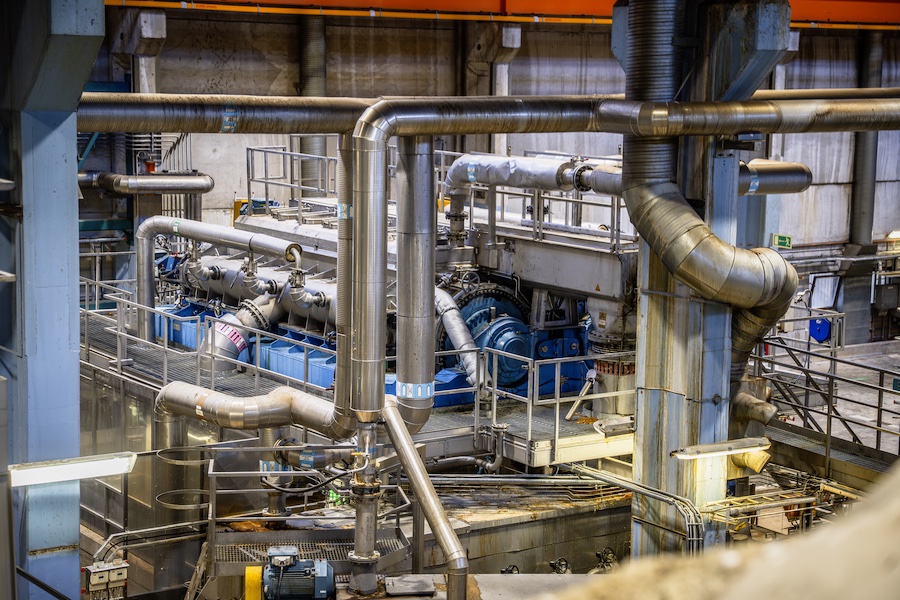
Production at ABB © 2026 ABB
ABB has signed a Memorandum of Understanding (MoU) with Swedish textile impact company Syre to jointly explore technologies to support the development of Syre’s first textile-to-textile recycling plant in Vietnam. The agreement establishes a framework for collaboration to investigate how ABB’s automation, electrification and digital technologies could contribute to safe, efficient and scalable operations. It will also explore how these capabilities could further optimize process and quality control performance as Syre advances its ambition to produce circular polyester at industrial scale.

The proposed plant in the Gia Lai province, Vietnam, is intended to recycle polyester from used textiles and industrial waste into new recycled polyester material. Polyester is one of the world’s most widely used fibers and is traditionally produced from fossil-based sources. Recycling polyester helps reduce reliance on virgin fossil inputs, lowers climate impact and keeps valuable materials in circulation, supporting the transition toward a more circular textile industry.

Under the MoU, ABB and Syre will assess how ABB’s technologies – including its distributed control systems, digital industrial software and electrification portfolio – could be adapted to meet the specific requirements of polyester textile-to-textile recycling. Activities are expected to run in parallel with the detailed engineering phase of Syre’s first plant.

“This agreement reflects ABB’s role in supporting emerging industrial applications where automation and electrification can enable greater resource efficiency,” said Wilson Monteiro, Global Business Line Manager for Pulp, Paper and Fiber in ABB’s Process Industries division. “Together with Syre, we will explore how our experience in fiber processing, chemicals and advanced process industries can be applied to polyester recycling. We’re excited to discover what’s possible as we embark on this new technological collaboration.”

“As we now move into full industrial deployment, partnerships like this become critical,” said Dennis Nobelius, CEO of Syre. “Industrializing textile-to-textile recycling is a complex undertaking, and while strong customer demand is essential, it must be matched with best-in-class industrial partners. ABB brings exactly the depth of expertise and execution capability needed; they are a cornerstone of the industrial ecosystem we are building.”

Since its public launch two years ago, Syre has rapidly built its technological foundation, establishing an R&D facility and pilot production line in Mebane, North Carolina. In 2025, the company accelerated to multi-ton production of circular PET chips, demonstrating the viability of its textile-to-textile recycling process. Syre is now focused on advancing plans for its first large-scale production facility in Vietnam, with construction targeted to commence in 2027.

While exploratory in nature, the partnership signals ABB’s dedication to advancing the next generation of fiber-based industries. As circular materials move from ambition to industrial reality, ABB continues to apply its automation, electrification and digital expertise to enable efficient, scalable production.


More News from Syre

#Recycled Fibers

Syre expands partnership with Target to advance next-generation recycled materials at scale

Advancing next-generation materials to support scalable circular solutions across global retail Stockholm, May 2026 — Syre, the textile impact company hyperscaling textile-to-textile recycling today announced an expanded collaboration with Target to accelerate the adoption of next-generation recycled materials across retail at scale.

#Recycled Fibers

Syre and JEPLAN Announce Strategic Partnership to Accelerate Textile-to-Textile Recycling

JEPLAN, INC. the Japanese pioneer developing and operating chemical recycling technologies for circularity in packaging and textiles, and Syre, the textile impact company on a mission to hyperscale textile-to-textile recycling, announced today a strategic partnership. Together, the companies aim to extensively accelerate the timeline towards commercialization of next generation textile-to-textile polyester recycling technology.

#Recycled Fibers

Syre announces partnership with Nike to scale circular Polyester

Syre, the textile impact company hyperscaling textile-to-textile recycling, today announces a multi-year agreement with leading sports brand NIKE, Inc., marking a milestone towards a circular materials future for the global apparel industry and beyond.

#Recycling / Circular Economy

Syre announces Gap Inc., Houdini, and Target as strategic Launch Partners to accelerate the great textile shift

Syre, the textile impact company hyperscaling textile-to-textile recycling, today announces a strategic partnership with Gap Inc., Houdini Sportswear, and Target as part of its commercial launch. The Launch Partners will play a critical role in bringing circular polyester to the broader market, accelerating adoption, and shaping the future of the textile industry.

More News on Recycling / Circular Economy

#ITM 2026

BB Engineering unveils new, patented “Val-uePack” spin pack at ITM

At the upcoming ITM in Istanbul, taking place June 9–13 at the Tüyap Fair Convention and Congress Center in Hall 7, Booth 702B, BB Engineering will once again be represented at a joint booth with its parent company, Barmag, and its representative, Tekstil Servis. The German machine manufacturer will show-case its expertise in man-made fiber and recycling technology, presenting its entire product portfolio, which includes compo-nents such as extruders and filters, as well as complete sys-tems for spinning synthetic fibers, air-texturing, and PET recy-cling.

#Recycling / Circular Economy

Project REWEAR investigates diverse economies of rewear as a global practice of circularity

Every year, European households discard millions of tonnes of clothing. Around a quarter of what gets separately collected is exported, much of it classified as rewearable. A significant share ends up in markets like Kantamanto in Accra, Ghana, where an estimated 15 million garments arrive every week. New research published today reveals what happens when that clothing arrives.

#Recycling / Circular Economy

RE&UP contributes to Global Fashion Summit 2026 circularity discussion

RE&UP contributed to the global conversation on textile circularity at Global Fashion Summit 2026 in Copenhagen, where Fatih Konukoğlu, Chairman of RE&UP and Vice Chairman of Sanko Holding, took part in both the keynote session “The New Rules” and the panel discussion “A Reckoning and Renewal for Circular Horizons”, alongside leaders from H&M Group, Looper Textile Co. and Sourcing Journal.

#Recycling / Circular Economy

Europe’s textile future at a turning point: New 2030 Circularity Blueprint aims to scale recycling and unlock investment opportunities

The EU textile system is at a critical crossroads. Today, less than 1% of discarded garments are recycled into new garments, despite EU-wide obligations for separate collection. In response, Global Fashion Agenda (GFA) is launching the 2030 Circularity Blueprint, in partnership with ReHubs. This ambitious initiative is designed to support the transformation of the EU textile ecosystem to advance textile-to-textile recycling and drive the transition to a circular economy.

Latest News

#INDEX 2026

“We clearly see that reliability, flexibility, service and total cost of ownership are becoming increasingly important again.”

The nonwovens industry continues to face a challenging market environment. Nevertheless, AUTEFA Solutions reports successful projects, new line sales and growing demand for energy-efficient and flexible solutions. In this interview, André Imhof of AUTEFA Solutions talks about competitiveness against Chinese suppliers, new service and recycling concepts, the growing importance of application development and the opportunities created by countercyclical investments.

#INDEX 2026

“Needle punching technology is more universal and sustainable than ever!”

Needle punching technology was long regarded as a rather traditional and comparatively slow technology within the nonwovens industry. In this interview, Johann Philipp Dilo explains why needle punching is more relevant than ever today – ranging from energy efficiency and resource conservation to hygiene applications, new machine concepts and design-oriented nonwoven solutions.

#Research & Development

Textile climate control system in workwear – exhibition at the 2026 SME Innovation Day!

Conventional protective workwear often reaches its limits during strenuous physical activity. In particular, the transport of sweat and excess body heat poses a problem. The German Institutes of Textile and Fiber Research (DITF) conducted research on flow-optimized, air-conducting textile structures that enable targeted climate control directly on the body. These structures can be integrated straight into protective work garments. The textile climate control system supports the body’s natural thermoregulation. This contributes to improved workplace safety and comfort.

#Nonwovens

PET spunbond from China – EDANA welcomes imposition of provisional anti-dumping measures

On 13 May 2026, after eight months of investigation, the European Commission imposed provisional anti-dumping duties of 45.6-50.0% on imports of PET spunbond from China. EDANA welcomes this expression of the Commission’s clear determination to protect EU industries from the unfair trade practices of Chinese producers.

TOP