[pageLogInLogOut]

#Recycling / Circular Economy

HKRITA and Epson develop silk-like regenerated fiber from cotton

The Hong Kong Research Institute of Textiles and Apparel ("HKRITA") and Seiko Epson Corporation ("Epson"; TSE: 6724) have succeeded in developing new regenerated cellulose fiber with a silk-like sheen from waste cotton fabric through a new production process.

A movement toward using fibers recycled from discarded clothing has been gaining momentum, driven by a growing recognition of waste clothing as a global environmental issue. In Europe in particular, a move is under way to use more regenerated fiber and reduce textile waste.

To address societal issues surrounding textile waste, HKRITA and Epson have been conducting research and development on regenerated fibers since signing a joint development agreement in January 2024. As a result of this collaboration, the partners have successfully developed regenerated cellulose fiber using a new production process that transforms discarded cotton fabric into regenerated fiber.

This new process was made possible by integrating Epson's proprietary Dry Fiber Technology for defibrating textiles with HKRITA's fiber-dissolving technology. The process involves (1) defibrating discarded cotton fabric into a powder-like state, (2) dissolving the cotton in a solvent, and (3) extruding it through a nozzle into a coagulation bath, where it solidifies and is spun into fiber.

The regenerated cellulose fiber produced through this process is expected to have both a smooth, silky sheen and the strength of cotton. This fiber is expected to be used in high-end materials such as scarves, neckties, and suit linings. Moreover, since the short fibers that occur during the regenerated fiber production process can also be used rather than discarded, as was usually the case, this regeneration process can help to increase the total clothing recycling rate.
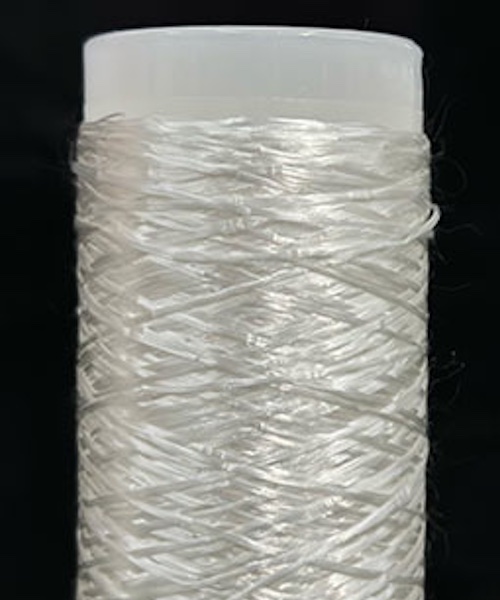
Yarn from the regenerated cellulose fiber © 2025 Epson


Newly developed regenerated cellulose fiber yarn

"As an applied research center, HKRITA is dedicated to solving real-world problems and enhancing current practices and products," said HKRITA CEO Jake Koh. "We are thrilled to collaborate with Epson to recycle fibers and repurpose them into high-quality yarns. This cross-industrial collaboration is not only reimagining materials but also redefining the future of sustainable production."

Epson Executive Officer Satoshi Hosono, who serves as the deputy general administrative manager of the Global Environmental Strategy Promotion Office and as the deputy general administrative manager of the Technology Development Division, said, "We are extremely pleased with the results that this joint development project has yielded. The selective application of this new wet process and our previously developed dry process should enable fiber to be regenerated from all waste cotton fabrics while reducing environmental impact."

Information about the work under this joint development project was exhibited at HKRITA's Booth 2415 at Textiles Recycling Expo 2025, held in Brussels, Belgium, from June 4, 2025.

Looking ahead, HKRITA and Epson will continue to combine their advanced technologies to accelerate the adoption of regenerated fibers, contributing to global efforts to solve the challenge of clothing recycling.

More News from Epson Europe

#Digital Printing

Epson launches SureColor G9000: high-production Direct-To-Film printer delivering greater productivity and reliability

Epson today announces the launch of the SureColor G9000, a new high-production Direct-To-Film (DTFilm) printer designed to meet growing global demand for flexible and efficient textile transfer printing. Expanding Epson’s DTFilm line-up alongside the SC-G6000, the SC-G9000 introduces enhanced speed, reliability and ease of maintenance for commercial garment decorators and textile producers.

#Digital Printing

Epson future proofs textile printing with Epson Textile Academy 2.0

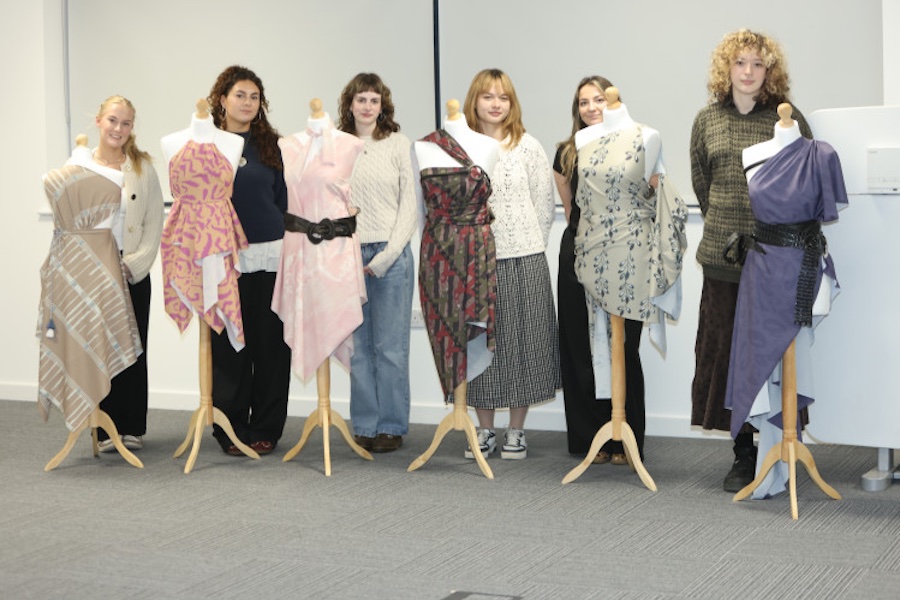
Technology leader Epson today hosted its second Textile Academy Event at the company’s Textile Innovation Centre in Lutterworth, Leicestershire. Building on the success of its inaugural Textile Academy earlier this year, the event welcomed Textile Design BA students from Nottingham Trent University (NTU) and Loughborough University. The event features workshops designed to enhance student’s practical textile printing skills; corporate and entrepreneurial business acumen; marketing and self-branding; and environmental awareness around the textile industry.

#Digital Printing

Epson unveils Monna Lisa ML-16000JQ for more efficient and sustainable Jacquard fabric printing

Global technology firm Epson announces a new direct-to-fabric digital textile printer designed for jacquard fabrics. The Monna Lisa ML-16000JQ delivers direct-to-fabric double-sided printing on jacquard fabrics, meeting the needs of fashion designers looking to enhance their creativity by seamlessly integrating vibrant colours with intricate woven patterns.

#Digital Printing

Acquisition of Fiery, LLC, a company leading the digitalization of the printing process

Seiko Epson Corporation ("Epson") is pleased to announce that Epson has entered into an agreement with affiliates of Siris Capital Group, LLC ("Siris"), including Electronics for Imaging, Inc., on September 19, 2024 to acquire all interests in Fiery, LLC ("Fiery"), a U.S.-based company which is the leading provider of digital front end* ("DFE") servers and workflow solutions for the print industry. The transaction is subject to customary closing conditions including required regulatory approvals.

More News on Recycling / Circular Economy

#ITM 2026

BB Engineering unveils new, patented “Val-uePack” spin pack at ITM

At the upcoming ITM in Istanbul, taking place June 9–13 at the Tüyap Fair Convention and Congress Center in Hall 7, Booth 702B, BB Engineering will once again be represented at a joint booth with its parent company, Barmag, and its representative, Tekstil Servis. The German machine manufacturer will show-case its expertise in man-made fiber and recycling technology, presenting its entire product portfolio, which includes compo-nents such as extruders and filters, as well as complete sys-tems for spinning synthetic fibers, air-texturing, and PET recy-cling.

#Recycled Fibers

Syre expands partnership with Target to advance next-generation recycled materials at scale

Advancing next-generation materials to support scalable circular solutions across global retail Stockholm, May 2026 — Syre, the textile impact company hyperscaling textile-to-textile recycling today announced an expanded collaboration with Target to accelerate the adoption of next-generation recycled materials across retail at scale.

#Recycling / Circular Economy

Project REWEAR investigates diverse economies of rewear as a global practice of circularity

Every year, European households discard millions of tonnes of clothing. Around a quarter of what gets separately collected is exported, much of it classified as rewearable. A significant share ends up in markets like Kantamanto in Accra, Ghana, where an estimated 15 million garments arrive every week. New research published today reveals what happens when that clothing arrives.

#Recycling / Circular Economy

RE&UP contributes to Global Fashion Summit 2026 circularity discussion

RE&UP contributed to the global conversation on textile circularity at Global Fashion Summit 2026 in Copenhagen, where Fatih Konukoğlu, Chairman of RE&UP and Vice Chairman of Sanko Holding, took part in both the keynote session “The New Rules” and the panel discussion “A Reckoning and Renewal for Circular Horizons”, alongside leaders from H&M Group, Looper Textile Co. and Sourcing Journal.

Latest News

#INDEX 2026

“We clearly see that reliability, flexibility, service and total cost of ownership are becoming increasingly important again.”

The nonwovens industry continues to face a challenging market environment. Nevertheless, AUTEFA Solutions reports successful projects, new line sales and growing demand for energy-efficient and flexible solutions. In this interview, André Imhof of AUTEFA Solutions talks about competitiveness against Chinese suppliers, new service and recycling concepts, the growing importance of application development and the opportunities created by countercyclical investments.

#INDEX 2026

“Needle punching technology is more universal and sustainable than ever!”

Needle punching technology was long regarded as a rather traditional and comparatively slow technology within the nonwovens industry. In this interview, Johann Philipp Dilo explains why needle punching is more relevant than ever today – ranging from energy efficiency and resource conservation to hygiene applications, new machine concepts and design-oriented nonwoven solutions.

#Research & Development

Textile climate control system in workwear – exhibition at the 2026 SME Innovation Day!

Conventional protective workwear often reaches its limits during strenuous physical activity. In particular, the transport of sweat and excess body heat poses a problem. The German Institutes of Textile and Fiber Research (DITF) conducted research on flow-optimized, air-conducting textile structures that enable targeted climate control directly on the body. These structures can be integrated straight into protective work garments. The textile climate control system supports the body’s natural thermoregulation. This contributes to improved workplace safety and comfort.

#Nonwovens

PET spunbond from China – EDANA welcomes imposition of provisional anti-dumping measures

On 13 May 2026, after eight months of investigation, the European Commission imposed provisional anti-dumping duties of 45.6-50.0% on imports of PET spunbond from China. EDANA welcomes this expression of the Commission’s clear determination to protect EU industries from the unfair trade practices of Chinese producers.

TOP