[pageLogInLogOut]

#Recycled Fibers

Recycling mixed-fibre garments becomes a reality: RadiciGroup, The LYCRA Company and Triumph take circular fashion a step forward

© 2025 Radici
The process, which is both economically and environmentally sustainable, has enabled the production of an underwear set made from 100% recycled nylon and LYCRA® fibre in a closed-loop system.

Recycling of garments made from different types of fibres has always represented a major challenge for the textile industry. In the absence of a chemical or mechanical process capable of separating and recovering the individual materials, these garments have so far become waste destined for incineration or landfill. Today, however, Radici InNova, the RadiciGroup division dedicated to research and innovation, has developed an innovative recycling process based on selective dissolution technology, capable of treating mixed textile waste — such as swimwear, tights and leggings — and recovering both nylon and LYCRA® fibre, making them available again for the production of new garments. The collaboration with The LYCRA Company and Triumph, internationally-renowned lingerie brand, has made it possible to validate the process by using the recovered fibres to create a 100% recycled lingerie set. The process, internationally patented, uses non-toxic, non-flammable and environmentally compatible solvents. It can be applied to the main types of nylon (PA6 and PA66) and is economically sustainable because it allows for the recovery of both nylon and LYCRA® fibre, regardless of their respective proportions in the fabric, as well as the solvent itself.

“Thanks to this project, textile recycling enters a new dimension, demonstrating for the first time that it is possible to recover fibers from mixed fabrics and reuse them to produce new garments. This is an unprecedented innovation that opens up revolutionary development opportunities for the textile industry. As RadiciGroup, we are proud to have conceived and achieved this important milestone together with our partners, and we are ready to take the next steps,” said Stefano Alini, CEO of Radici InNova.

“This innovative project highlights the role that elastane can have in helping to advance circularity in the apparel industry. Working closely with Radici InNova and Triumph, The LYCRA Company has demonstrated that LYCRA® fibres can retain their renowned stretch and recovery performance — providing comfort, fit and ease of movement — even when reintegrated into the spinning cycle,” commented Nicholas Kurland, Product Development Director, Advanced Concepts The LYCRA Company.
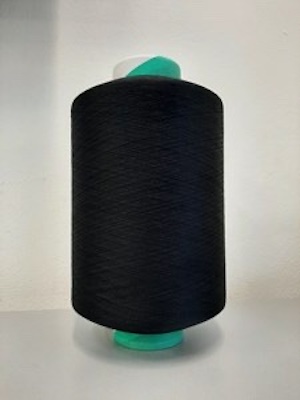
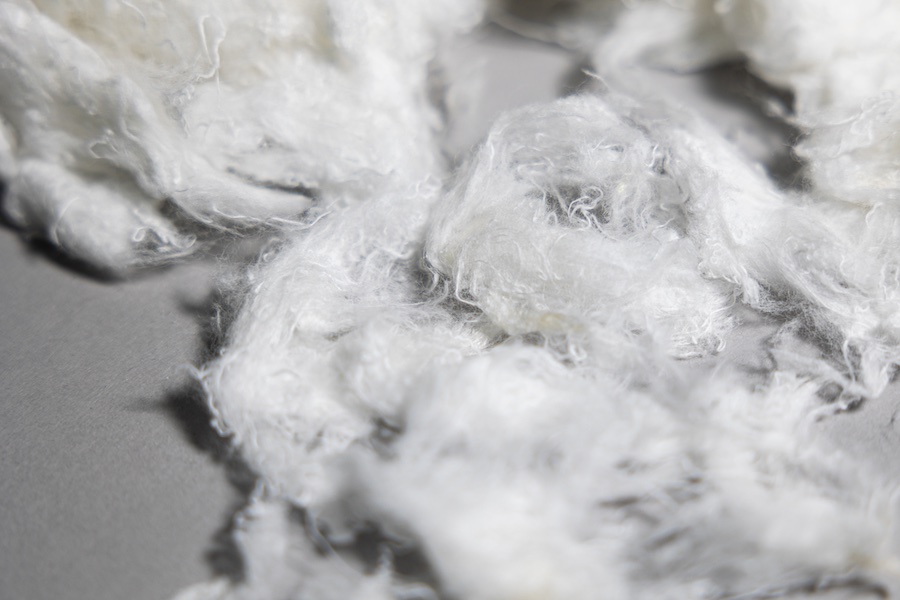
Recycled yarn © 2025 Radici


The project began four years ago, when Radici InNova launched the study of an innovative process for the dissolution and separation of mixed textile fibres. After the initial development phase, subsequent tests made it possible to recover samples of LYCRA® fibre from multi-material fabrics, which were then sent to The LYCRA Company to verify their recyclability. The next step was to demonstrate the feasibility in practice: Triumph provided its own production surplus, a fabric containing 16% LYCRA® fibre. From this material, Radici InNova succeeded in recovering both LYCRA® fibre and nylon. The LYCRA® fibre was then re-spun by The LYCRA Company, while RadiciGroup processed the recycled nylon to produce new Renycle® yarn. Using these recycled yarns (LYCRA® fibre and Renycle®), a 60-meter black fabric was created, which Triumph used to produce a coordinated lingerie set — bra and briefs — concretely demonstrating the possibility of closing the loop: from textile waste to new garments. The result achieved so far by Radici InNova, The LYCRA Company and Triumph should be considered a prototype (concept garment) designed to prove the technical feasibility of recycling mixed textiles and lay the groundwork for its future industrialization.

Underwear from recycled yarn © 2025 Radici


“Although still in its early stages, Triumph is proud to contribute to this pioneering initiative and to explore the potential of this innovative recycling technology for future applications. Our next step will focus on developing a capsule collection, while also working on solutions to ensure product identification, traceability and circularity systems, so that garments can remain in use for as long as possible and, once they reach the end of their life, can be recycled in the most appropriate way. At Triumph, we are committed to promoting innovation and collaboration in the field of sustainability. Being part of this project strengthens our belief that circularity for garments made from mixed textile fibers is possible, and we are proud to help turn this vision into reality,” said Vera Galarza, Global Head of Sustainability – Triumph.
More News from Radici Partecipazioni SpA

#Sustainability

RadiciGroup: 21st Sustainability Report published

RadiciGroup has published its 21st Sustainability Report, covering the year 2024, confirming more than two decades of transparency and measurement in the economic, environmental, and social dimensions. From its first Social Report in 2004 to the current reporting aligned with the GRI Universal Standards, the Group is now preparing for its next challenge: the adoption of the criteria that will be set out by the Corporate Sustainability Reporting Directive (CSRD).

#Recycling / Circular Economy

RadiciGroup and Ferragamo team up for an eco-design project under the Monitor for Circular Fashion initiative

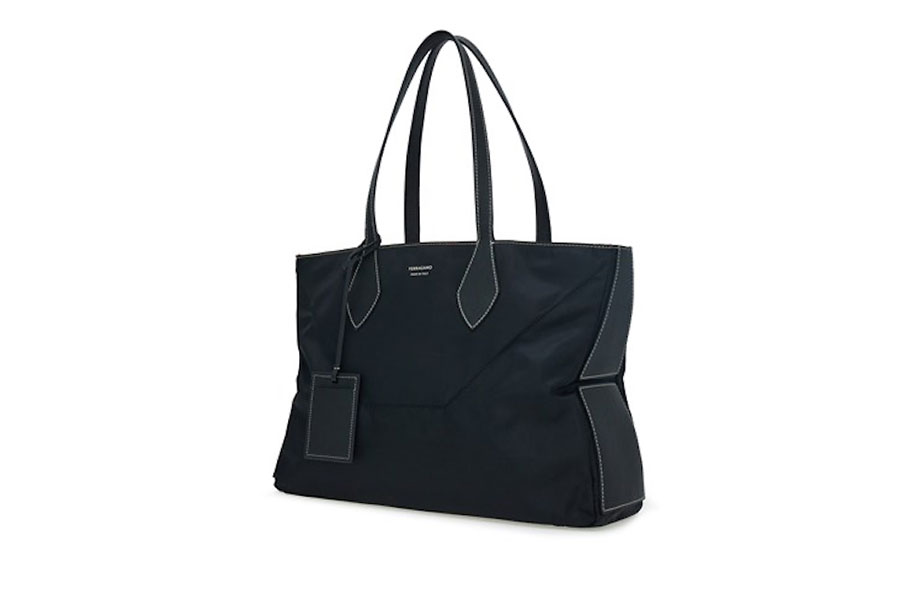
RadiciGroup, a leading player in sustainable textile solutions, has partnered with Ferragamo to develop “Nova – The evolution of a Star”, an eco-design project that reimagines one of the Maison’s iconic handbags through the lens of circularity.

#Yarn & Fiber

Twenty years of Sustainability Report for RadiciGroup

The RadiciGroup Sustainability Report reaches an important milestone this year: twenty years have in fact passed since the Group published its first Social Report in 2004, qualifying it as one of the pioneering companies in the realisation of voluntary non-financial reporting. The document measures the Group’s achievements and the actions it has taken to reduce its environmental impact, respect social values, and implement good business management practices.

#Yarn & Fiber

Geogreen inaugurates a new photovoltaic plant: over 5,000 solar panels to produce 5.5 million kWh/year of clean energy

Geogreen and RadiciGroup are speeding up their photovoltaic development with the inauguration of a new solar plant in the Municipality of Isola Dovarese in the Province of Cremona. Participating at the official ribbon cutting were the Geogreen shareholders including President Angelo Radici, the mayor of the Municipality of Isola Dovarese and other local officials.

More News on Recycled Fibers

#Research & Development

Elastic yarns to become more recyclable and environmentally friendly in future

On 29 April 2026, ITA student Tobias Dickmeiß was awarded a sponsorship prize by the Wilhelm Lorch-Stiftung for his innovative approach, to replacing conventional elastane with elastic yarns made from thermoplastic copolyester elastomers (TPC). Thanks to their thermoplastic nature and compatibility with typical polyesters used in the textile industry, elastic TPC yarns offer improved recyclability. Furthermore, the use of the melt-spinning process in yarn production eliminates the need for solvents that are harmful to the environment and human health.

#Recycled Fibers

Syre expands partnership with Target to advance next-generation recycled materials at scale

Advancing next-generation materials to support scalable circular solutions across global retail Stockholm, May 2026 — Syre, the textile impact company hyperscaling textile-to-textile recycling today announced an expanded collaboration with Target to accelerate the adoption of next-generation recycled materials across retail at scale.

#Recycling / Circular Economy

RE&UP contributes to Global Fashion Summit 2026 circularity discussion

RE&UP contributed to the global conversation on textile circularity at Global Fashion Summit 2026 in Copenhagen, where Fatih Konukoğlu, Chairman of RE&UP and Vice Chairman of Sanko Holding, took part in both the keynote session “The New Rules” and the panel discussion “A Reckoning and Renewal for Circular Horizons”, alongside leaders from H&M Group, Looper Textile Co. and Sourcing Journal.

#Recycling / Circular Economy

Europe’s textile future at a turning point: New 2030 Circularity Blueprint aims to scale recycling and unlock investment opportunities

The EU textile system is at a critical crossroads. Today, less than 1% of discarded garments are recycled into new garments, despite EU-wide obligations for separate collection. In response, Global Fashion Agenda (GFA) is launching the 2030 Circularity Blueprint, in partnership with ReHubs. This ambitious initiative is designed to support the transformation of the EU textile ecosystem to advance textile-to-textile recycling and drive the transition to a circular economy.

Latest News

#INDEX 2026

“We clearly see that reliability, flexibility, service and total cost of ownership are becoming increasingly important again.”

The nonwovens industry continues to face a challenging market environment. Nevertheless, AUTEFA Solutions reports successful projects, new line sales and growing demand for energy-efficient and flexible solutions. In this interview, André Imhof of AUTEFA Solutions talks about competitiveness against Chinese suppliers, new service and recycling concepts, the growing importance of application development and the opportunities created by countercyclical investments.

#INDEX 2026

“Needle punching technology is more universal and sustainable than ever!”

Needle punching technology was long regarded as a rather traditional and comparatively slow technology within the nonwovens industry. In this interview, Johann Philipp Dilo explains why needle punching is more relevant than ever today – ranging from energy efficiency and resource conservation to hygiene applications, new machine concepts and design-oriented nonwoven solutions.

#Research & Development

Textile climate control system in workwear – exhibition at the 2026 SME Innovation Day!

Conventional protective workwear often reaches its limits during strenuous physical activity. In particular, the transport of sweat and excess body heat poses a problem. The German Institutes of Textile and Fiber Research (DITF) conducted research on flow-optimized, air-conducting textile structures that enable targeted climate control directly on the body. These structures can be integrated straight into protective work garments. The textile climate control system supports the body’s natural thermoregulation. This contributes to improved workplace safety and comfort.

#Nonwovens

PET spunbond from China – EDANA welcomes imposition of provisional anti-dumping measures

On 13 May 2026, after eight months of investigation, the European Commission imposed provisional anti-dumping duties of 45.6-50.0% on imports of PET spunbond from China. EDANA welcomes this expression of the Commission’s clear determination to protect EU industries from the unfair trade practices of Chinese producers.

TOP