[pageLogInLogOut]

#Associations

Promoting sustainability, digitalisation and resilience

The EU project ADDTEX has reached an important milestone with the two publications White Book and E-Book. Both publications contain comprehensive guidelines, findings and policy recommendations to support the sustainable, digital and resilient transition of the textile industry. The focus is on technical textiles, whose innovations are considered key to the competitiveness and resilience of the European industry.

The ADDTEX project brings together partners from a total of twelve European countries. The IVGT, Frankfurt is a partner for Germany and represents the interests of its members and the entire technical textiles sector. The aim of the project is to sustainably promote close co-operation between industry, science, politics and civil society. This innovative approach, known as the ‘quadruple helix model’, is intended to help prepare the industry for the challenges of a volatile, uncertain, complex and ambiguous environment (VUCA), which have been exacerbated by crises such as the COVID-19 pandemic. ‘By focusing on green technologies, digitalisation and continuous training, we are making the technical textiles industry fit for the future,’ says Stefan Schmidt, IVGT project manager. ‘We want to strengthen the competitiveness and sustainability of this important sector.’
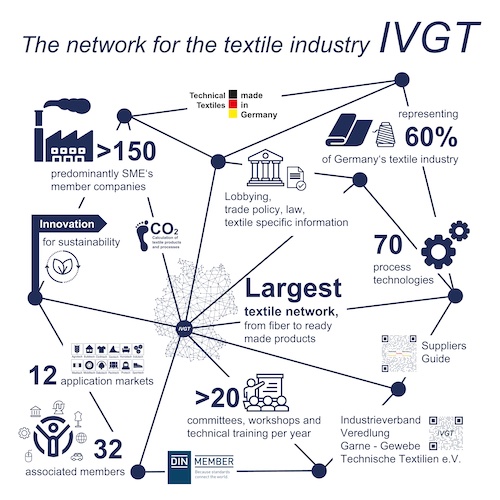
Industry clusters such as the IVGT play a crucial role by strengthening networks between companies, educational institutions and governments. They promote the exchange of knowledge, support the introduction of new technologies and help to drive forward circular economy projects. Picture: IVGT


Workshops as a basis for policy recommendations

Between September and October 2024, the ADDTEX partners organised interactive workshops in Germany, Greece, Italy and Spain. These served as a platform for a broad dialogue between industry, science and politics, in which innovative approaches and concrete strategies for action were developed. The participants focussed on topics such as sustainable practices, digital transformation and promoting resilience in the textile industry.
The future is digital! The IVGT offers a range of programmes to make you fit for the digital transformation. Image: IVGT


Key competences for change

A central aspect of the White Book is the emphasis on education and training to promote the dual transition - green and digital. The most important skills required of employees to shape a sustainable future for the industry are expertise in renewable energy, recycling, environmentally friendly materials and sustainable production (green transition), skills in data analysis, cyber security, IT and the ability to use AI-supported technologies (digital transition), as well as adaptability, innovation, risk management and cross-functional collaboration (promoting resilience). Ten aspects emerged as the most important political recommendations for action (see chart). These include, in particular, the promotion of sustainable practices in companies, investment in digital infrastructure along the textile value chain, support for collaborative research projects and industry-specific training funds to impart the essential skills mentioned. 

Further information www.addtex.eu; www.addtex.eu/resources/
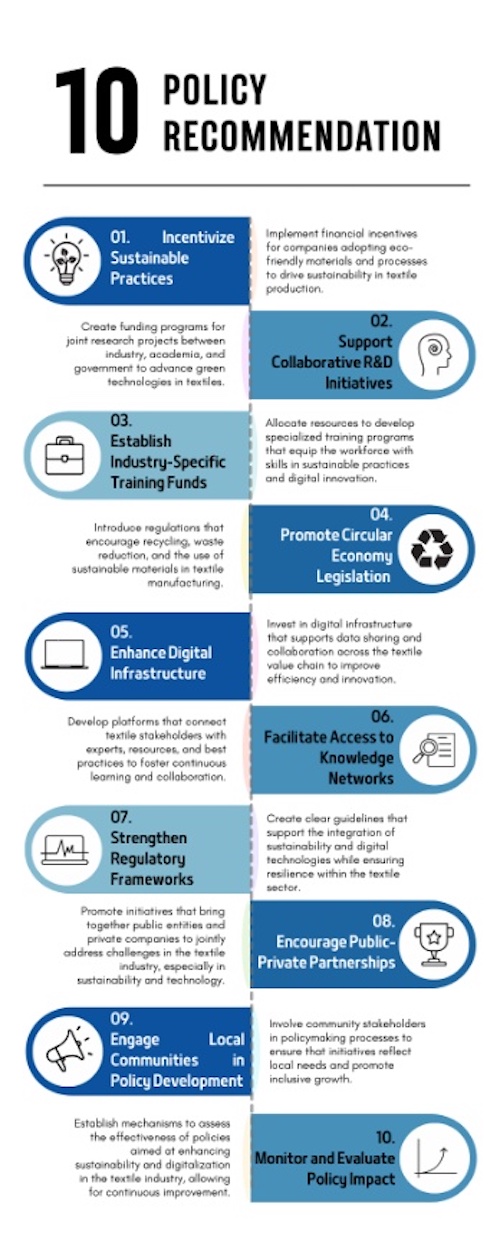


To promote both the double transition and the resilience of the industry, policy should incentivise sustainable practices and investment in green technologies. The developed recommendations for action as a graphic. Picture: ADDTEX


More News from Industrieverband Veredlung - Garne - Gewebe - Technische Textilien e.V.

#Techtextil 2026

IVGT joint stand brings innovation and networking to Techtextil 2026

At Techtextil 2026 and the parallel Texprocess 2026, key transformation topics such as artificial intelligence, digitalisation, sustainability, recycling and the circular economy will be reflected across the show. Against this backdrop, the IVGT, together with 16 member companies, will present its joint stand in Hall 12.1 (Stand D62) as a platform for exchange and networking.

#Textiles & Apparel / Garment

IVGT: AddTex final meeting in Terrassa

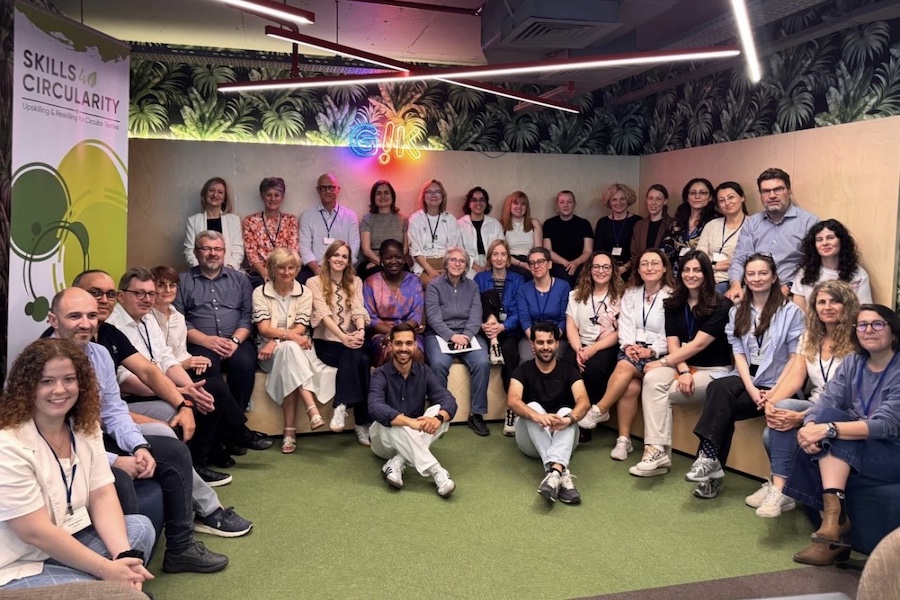
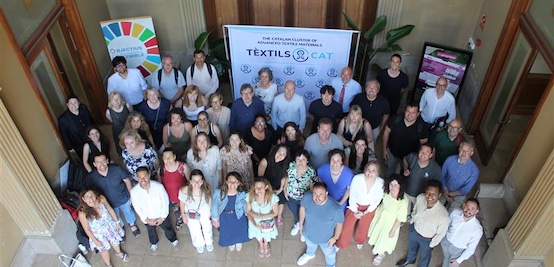
From 25 to 26 June 2025, the final meeting of the ERASMUS+ project AddTex took place in Terrassa, Spain, which aimed to train workers, pupils and students in the textile industry. Over a period of three years, eleven partners from Greece, Ireland, Italy, Portugal, Romania, Sweden, Slovenia, Spain, the Czech Republic and the IVGT association for Germany were involved in the project.

#Associations

IVGT on tour in Albstadt

For the second edition of the Albstadt ID industry event on 10 October 2024, more than 300 school students from all over Germany and around 200 other interested parties from the industry came to Albstadt to find out about new training and employment opportunities in the textile and clothing industry through numerous presentations. The IVGT was also there! In room 205-141, Iris Schlomski reported on the current status of the ADDTEX Erasmus+ project and explained in particular the content of the ADDTEX Academy and the Hackathon and Bootcamp programmes that have now been successfully implemented.

#Nonwovens / Technical Textiles

IVGT with the ETT Club at HANNOVER MESSE 2025

Technical textiles are highly developed materials that have been specially optimised for industrial applications. They are indispensable in many areas, even though they are often invisible. As "hidden champions" in the manufacture of numerous innovative products, technical textiles are a real alternative to conventional materials! HANNOVER MESSE, which will take place from 31 March to 4 April 2025, will bring together these important aspects for the first time and present the joint stand "Technical Textiles" in the innovative Future Hub in Hall 2.

More News on Associations

#Associations

Italian textile machinery sector faces weak start to 2026 despite domestic growth

In the first quarter of 2026, order intake for Italian textile machinery manufacturers recorded a decrease of 5% compared to the same period in 2025, reflecting a still challenging start to the year. The decline affected foreign markets (-7%), while the domestic market showed growth (+21%).

#Techtextil 2026

Young talents honoured – 60 years Walter Reiners Foundation

At the Techtextil trade fair in Frankfurt at the end of April, Peter D. Dornier, chairman of the VDMA’s Walter Reiners Foundation, presented awards to five successful young engineers. Promotion and sustainability awards were presented in the categories of bachelor’s/project theses and diploma/master’s theses. Academic theses are eligible for the sustainability awards if, for example, they develop solutions for resource-efficient products and technologies.

#Associations

BTMA backs global growth while investing in future UK leaders

As one of a number of new initiatives launched this year, the British Textile Machinery Association (BTMA) is launching the UK-India Textile Machinery Coalition. The UK-India Free Trade Agreement, signed in July 2025, has implications that extend across sourcing, competitiveness and long-term trade dynamics, believes BTMA CEO Jason Kent.

#Raw Materials

China projected to increase cotton production, yields, and imports in 2026/27

World cotton production in the 2026/27 season is projected at 25.9 million tonnes, exceeding global consumption of 25.2 million tonnes, according to the May 2026 issue of Cotton This Month. That means both production and consumption are expected to remain close to current season levels, while global cotton trade is projected to decline by 2.7% to approximately 9.6-9.7 million tonnes.

Latest News

#INDEX 2026

“We clearly see that reliability, flexibility, service and total cost of ownership are becoming increasingly important again.”

The nonwovens industry continues to face a challenging market environment. Nevertheless, AUTEFA Solutions reports successful projects, new line sales and growing demand for energy-efficient and flexible solutions. In this interview, André Imhof of AUTEFA Solutions talks about competitiveness against Chinese suppliers, new service and recycling concepts, the growing importance of application development and the opportunities created by countercyclical investments.

#INDEX 2026

“Needle punching technology is more universal and sustainable than ever!”

Needle punching technology was long regarded as a rather traditional and comparatively slow technology within the nonwovens industry. In this interview, Johann Philipp Dilo explains why needle punching is more relevant than ever today – ranging from energy efficiency and resource conservation to hygiene applications, new machine concepts and design-oriented nonwoven solutions.

#Research & Development

Textile climate control system in workwear – exhibition at the 2026 SME Innovation Day!

Conventional protective workwear often reaches its limits during strenuous physical activity. In particular, the transport of sweat and excess body heat poses a problem. The German Institutes of Textile and Fiber Research (DITF) conducted research on flow-optimized, air-conducting textile structures that enable targeted climate control directly on the body. These structures can be integrated straight into protective work garments. The textile climate control system supports the body’s natural thermoregulation. This contributes to improved workplace safety and comfort.

#Nonwovens

PET spunbond from China – EDANA welcomes imposition of provisional anti-dumping measures

On 13 May 2026, after eight months of investigation, the European Commission imposed provisional anti-dumping duties of 45.6-50.0% on imports of PET spunbond from China. EDANA welcomes this expression of the Commission’s clear determination to protect EU industries from the unfair trade practices of Chinese producers.

TOP